
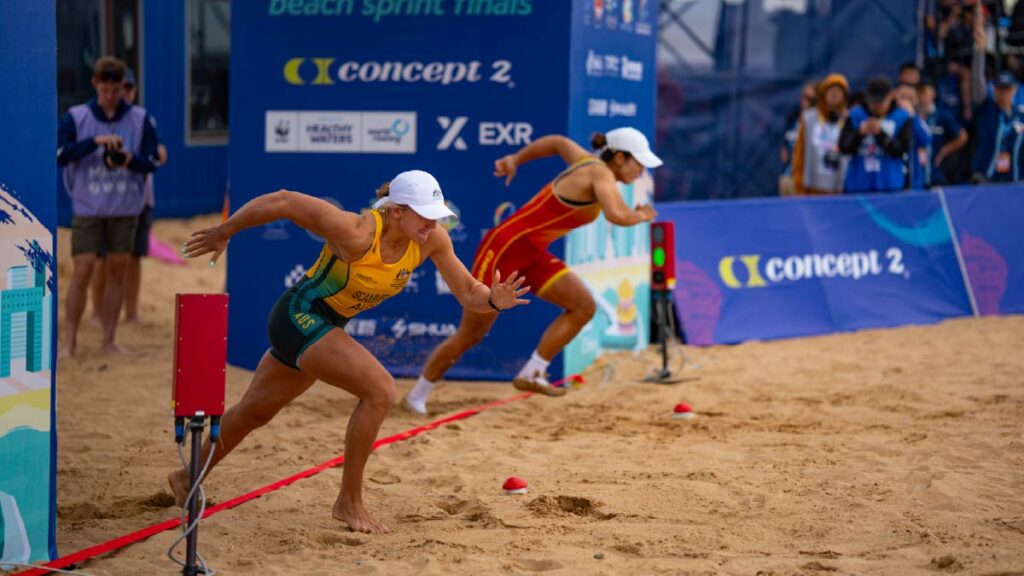
With the 2026 World Rowing Beach Sprint Finals now history, we’ve updated the world rankings early to include those most recent results. The big news is that Australia’s Isabella Scammell becomes the new women’s solo No. 1, Germany’s Moritz Wolff climbs up into top spot on the men’s side, and despite losing in the A final in China, Lithuania’s Martyna Kazlauskaite and Dominykas Jancionis hold onto their position in the mixed double. Rowers from Central Europe appear to be dominating in that team boat right now: the top five men and women in the double are all from Germany, Lithuania or Poland.
We also ran a little experiment to find out if Wild Rowing’s rankings might be able to predict regattas. And matched our system up against World Rowing’s rankings to see which was best. Read to the end to find out more.
Just a few short months ago, Australia’s Scammell was ranked a long way outside the world’s top 32, and probably off many teams’ radars. Her first points of the year had come at the final round of the 2026 Filippi Trophy in June, where she was eliminated in the time trials of the women’s single and knocked out in the last 16 of the mixed double. But in the space of three regattas—the 1924 Pharoes Trophy, the Oceania championships, and, now, the 2026 worlds—she surged up through the field to not just win in Qingdao, but to take the world No. 1 spot from Austria’s Magdalena Lobnig by a difference of just 25 points.
Scammell’s achievement, and that of her teammates, underlines the conclusion that Australia has finally arrived on the beach sprint scene. In China, Samuel Forbes won silver in the men’s solo—and now sits fourth in the world—Maddison McLaughlin came second in the under-19 women’s solo, and the Australian mixed quad took bronze. As everyone waits to find out next year whether beach sprint will remain on the Olympic program through Brisbane 2032, the success of the Rowsellas is sure to be seen as a positive development. The host country now has a good reason to want beach sprint to feature.
In the men’s solo rankings, none of the new top four athletes are past world champions in the solo. Wolff rises to No. 1, ahead of a tie in second place, in large part because of consistency and participation in regattas this year. And also because the USA’s Christopher Bak was knocked out in quarterfinals. As the 2025 world champion, Bak loses 800 points for not being able to defend his title, and now sits in sixth. This year’s champion, China’s Jiayu Liu is fifth, because unlike Wolff he has competed at far fewer races this year, and thus earned fewer points over the season.
With the launch of the world series next year, and the fact the continental races and world championships become critical qualification regattas, we hope to see rowers racing more. That should mean they’ll gain points more steadily during the year, and there’ll be less possibility of athletes like Scammell and Liu apparently coming out of nowhere to win a world title.
Lithuania’s two-time world championship partnership of Kazlauskaite and Jancionis have sat top of their respective tables ever since we launched our world rankings in August. Their scores take a hit because they came second in Qingdao. The new world champion duo of Sophie Leupold and Franz Werner, who won from down in 16th position after the time trials, each jump 900 points upwards. But the Lithuanians hold on, at least for now.
The mixed double is likely to take on very high importance next year, because it becomes the main route to LA28 for teams hoping to qualify the full quota of one men’s and one women’s spot. That could be good news for Lithuania, Germany and Poland, which dominate the top five of the double rankings. But expect coaches to change lineups and pack this boat with the very best rowers they have available. Next year, the race to be top of the mixed double is sure to be tight.
One of the biggest ranking-related questions is how reliable they really are. We’ve said before that our system isn’t intended to predict the results of regattas, but more to give an idea of who the key players in this sport are, based on both participation and results. But if it was used to pick winners and losers, how well would it actually do?
Aside from Wild Rowing’s individual athlete rankings, we now essentially have two rival systems: seeding and world series qualification. At world championships in both 2025 and 2026, the top eight ranked national entries from the previous year were seeded in the first time trials. And in Qingdao, World Rowing revealed the system by which it ranks and selects national teams for its new world series. If we used the results from these three systems, could they predict the results of the 2026 World Rowing Beach Sprint Finals? And would they do any better than pure luck, in which teams all have equal chances. (Note that to use the world series system for this purpose, we must apply the algorithm to last year’s results to get a pre-2026 ranking. It wouldn’t be fair to use the post-2026 ranking!)
Looking primarily at the knockout phases of the Olympic events, rather than time trials, there were 48 head-to-head races in China. Because not every team is ranked, we’ll ignore (impossible to predict) matchups between unranked teams, but include contests between a ranked and unranked opponent. World Rowing’s seeding system picked 20 correct results out of 36 admissible races, meaning it got the right answer 55,6% of the time. That’s a little better than luck (50%). World Rowing’s series system was almost the same. It picked the winner in 26 out of 47 contests, which is an accuracy of 55,3%.
But Wild Rowing came top, with 30 out of 48, or 62,5%. Or, to put that another way, Wild Rowing’s rankings ranked No. 1 in the ranking of rankings.
More information on our world rankings can be found here.