
For the rowing world, the Dakar 2026 Youth Olympic Games were about far more than beach sprint’s debut and the successes of its first ever Olympic champions and medalists. Behind the scenes, they were also the best, and possibly last, chance for World Rowing to secure the sport’s Olympic future.
At a team managers’ meeting in Senegal, World Rowing president Jean-Christophe Rolland told assembled coaches that “we will continue to fight to have this not only in L.A. but in Brisbane, too.”
The International Olympic Committee will decide which sports will be on the program for the Brisbane 2032 Summer Olympic Games at the 147th IOC session, due to be held in Punta Cana, Dominican Republic, next April. But we’ll get a preview of what that program could look like next month, when the IOC’s executive board divides up existing and candidate sports into three groups: those recommended to be at Brisbane, those excluded, and those whose presence is yet to be determined. Theoretically, no sport is safe, although no one is expecting that the IOC would kill off athletics.
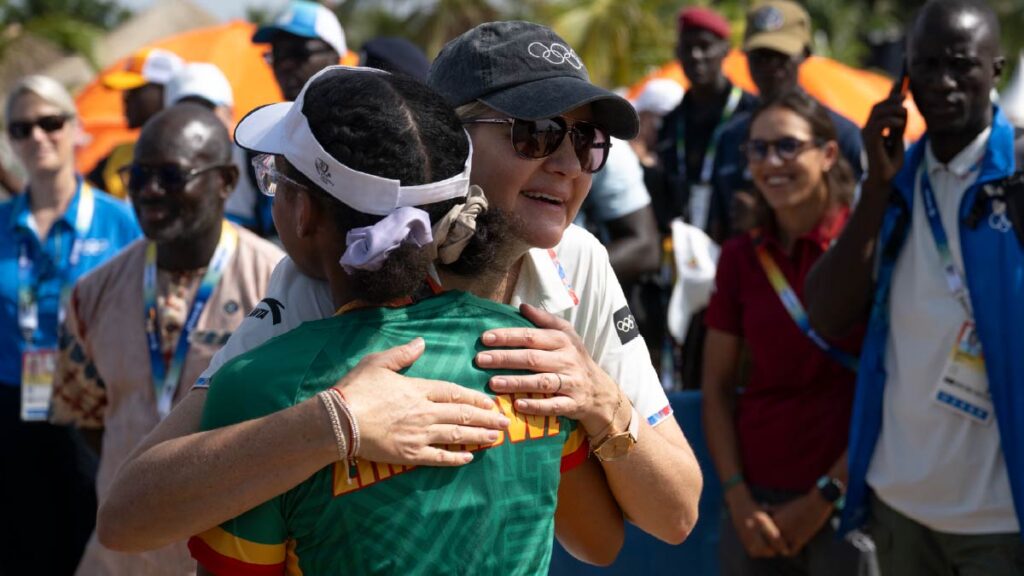
The Games in Africa were an opportunity for the world’s highest ranking sports politician, IOC president Kirsty Coventry, to experience beach sprint in person. Not only was Coventry invited to watch the final rounds of the men’s and women’s solos, but five-time beach sprint world champion Chris Bak also jumped in a double with her to give her the unique athlete perspective.
“It’s awesome. It’s super fun. It’s high energy,” Coventry said at the end of her visit. “I love that at any moment, anything can change.”
After being named president last year, Coventry launched a “Fit for the Future” initiative that aims to significantly reform the Olympic Games. Within those reforms is the review of all existing Olympic disciplines as well as candidate sports. And the core criteria for making assessments are global appeal, cost and complexity, and athlete representation. Essentially the Olympics wants sports that are popular worldwide, that are inexpensive and that include their own competitors within their decision-making structures.
For World Rowing, keeping rowing part of the Olympics is the No.1 priority. “We want to grow beach sprint because it gives us another reason for the sport to stay within the Olympic program,” says World Rowing CEO Vincent Gaillard. “It is a shorter format, easier to produce, relatively cost efficient to put on, in a venue that you can share with other sports, and is fundamental in our ability to keep rowing relevant.”
Beach sprint, and coastal rowing in general, are also part of the push to expand rowing’s footprint outside of the group of countries that regularly reach Olympic podiums. The same motivation explains the global federation’s interest in indoor rowing.
“The big reason why this is fundamental is it gives access to rowing to countries who may never have a 2000m flatwater lake,” Gaillard explains. “It’s about incremental new demographics for us, whether in Oceania or in the Caribbean or on the West Coast of Africa. Countries that might never have flatwater rowing.”
Adapting the sport of rowing to boost participation checks off a key part of the IOC’s criteria, that of global appeal, and is perhaps is not just a way to hold on to beach sprint’s Olympic quota, but that of rowing as a whole. At LA28, rowing will have the fourth largest number of athletes competing: 502. It will be dwarfed by athletics (1,810), outranked by swimming (874) and edged out by soccer (504), but has an enviable allocation greater than that of each of the other 43 sports.
However, at the same time, coastal rowing insiders frequently express frustration that the national quota limit for beach sprint itself at LA28 will be so small. National teams can qualify as many as 44 athletes in flatwater rowing, 22 men and 22 women. But there are just two available per country in beach sprint, one man and one woman. The consequence of that may be reduced interest from established national federations and from their athletes and coaches, for whom the flatwater road to L.A. would seem to offer many more opportunities.
“We wish we had more, many, many, many more,” Gaillard says. “But the reality is the Games are not going to keep growing in terms of the number of athletes. We already have a very large quota with classic rowing. We tried to put more athletes on the program with this new discipline. But for now, at least, we have to do with 64.”
“Will that change in the future? Maybe. But if it does, it probably will mean reducing the quota for classic flatwater rowing. Which will not be an easy discussion.”
Another consequence of the tight Olympic quota is that the mixed coxed quad, beach sprint’s fastest discipline and the closest parallel to the star attraction of flatwater, the eight, has been somewhat sidelined. While it is still a part of the racing program at world championships, it is absent from continental championships and won’t feature in next year’s inaugural World Rowing Beach Sprint Series. Results from the quad weren’t taken into account when deciding who would be part of that new series, and won’t affect Olympic qualification. Because of all that, the boat is perhaps valued more by coaches as an opportunity to give different athletes racing experience at worlds, rather than as a primary objective.
“We would have liked to have it [at LA28] as well,” Gaillard says, “but we just couldn’t given the limitations of the quota to 64 athletes. What that quota could allow us to do is a mixed relay, for instance. It’s not a quad, but you could bring another medal event.”
The world series will include such a mixed relay, and the beach sprint action at Dakar 2026 also finished with a mixed team relay. In Senegal, that combined athletes from different countries and was not a medal event. And the relay will also not count towards final standings in next year’s series, putting the idea into the same no man’s land as the quad at worlds: coaches may not prioritize a race that isn’t as important as the Olympic disciplines. But perhaps the suggestion that it could become an Olympic medal event might help boost overall national team interest in the mixed double.
There are key beach sprint nations whose strengths lie within one of the solos rather than in both or in the double. Austria is a good example. Magdalena Lobnig won the world championship in 2024, silver in 2025 and bronze this year. But Austria has never won a medal in the senior men’s solo or mixed double at worlds or Europeans. Qualifying the double offers an advantage, because it automatically means your athletes can compete in all three events. But missing out on qualification entirely because you prioritized the double would be a huge disadvantage. Yet if another medal were made available, another that could only be won by those with both spots, perhaps priorities would shift.
Gaillard says that World Rowing is open to further modifying the format of beach sprint, if that is deemed necessary. “We want to make it a hugely exciting popular discipline,” he says.
“We’re reviewing things constantly to try and adjust. We will [make changes] if we have to.”
Possible modifications could include adjusting the format or schedule of regattas. Wild Rowing has previously argued that the time trials may not be the most fan-friendly way to determine who goes through to the final stages of races. And also that as a consequence, many competitors never get the opportunity to take part in beach sprint’s most exciting one-on-one knockout format.
“It was determined that the time trials were at this moment the most efficient way to go through the process,” Gaillard explains. “Would that change? It could.”

In August, when World Rowing revealed plans for next year’s series, Gaillard told Row360 [https://row-360.com/beach-sprint-series-antalya-2027] that part of the goal of launching the new competition was to show the IOC that “that this is getting super serious.”
The inaugural round of that series will take place in Antalya, Turkey, from 20 to 28 March, 2027. The crucial 147th IOC session, at which the Brisbane 2032 program is due to be agreed, is scheduled exactly a month later, from 29 April to 1 May. Assuming that beach sprint makes the initial shortlist in December, either as a recommended or potential discipline, the timing for that first regatta might just be perfect.
But Gaillard cautions, though, that the series is meant to be more than simply a pitch for beach sprint’s Olympic inclusion. “It may help, but it’s not why we’re doing it,” he says. “We’re doing it to provide more competition opportunities for athletes. It’s as simple as that. On the road to LA28 and after LA28. It’s also important for commercial reasons as well. First it’s about the sport, allowing more competition, then commercially, allowing us to make room for more sponsors, partners and broadcasters.”
The first two years of the world series, in 2027 and 2028, will feature just two events: one regatta in Turkey and another in China. The hope is that from 2029 onwards, it will then expand to more races in more countries, and even become a structural part of the beach sprint season.
“Hopefully the beach sprint series will have a role in the pathway to the beach sprint finals, and eventually to the Olympic games,” Gaillard explains. “Right now they’re two stand alone events, because it was too late vis-a-vis the qualification process for LA. But we hope they will [have a bigger role in the future].”
There is a sense that interest in beach sprint is gaining significant momentum. It debuted at the Santa Fe 2026 South American Games, and is due to be on the program for both the Istanbul 2027 European Games, which have never featured rowing, and the Lima 2027 Pan American Games. And it has also always been a part of the Mediterranean Beach Games, and will again be on the schedule for Portimão-Lagoa 2027.
Gaillard hopes to secure places on the programs of more of the world’s key multisport events. The sports that will be part of the Cairo 2027 African Games have not yet been announced, and getting beach sprint added to the Doha 2030 Asian Games and Amdavad 2030 Commonwealth Games would be huge achievements.
But the Olympics are still the biggest show on earth, and much of the growth of beach sprint over the last three years has been ultimately down to the IOC’s 2023 decision to include the sport on the LA28 program. Which means little rest for World Rowing in this final stretch to that initial December announcement, and the subsequent decision next spring.
“We’re working on providing them with all the data they need to convince them to keep us in,” explains Gaillard. “We’re doing everything we need to do to show them the potential of this, what it means not just for rowing, but as a whole, to bring new countries to the sport. How exciting it can be to new generations, to new audiences. How relatively cost efficient and relatively low complexity it is to put on.”
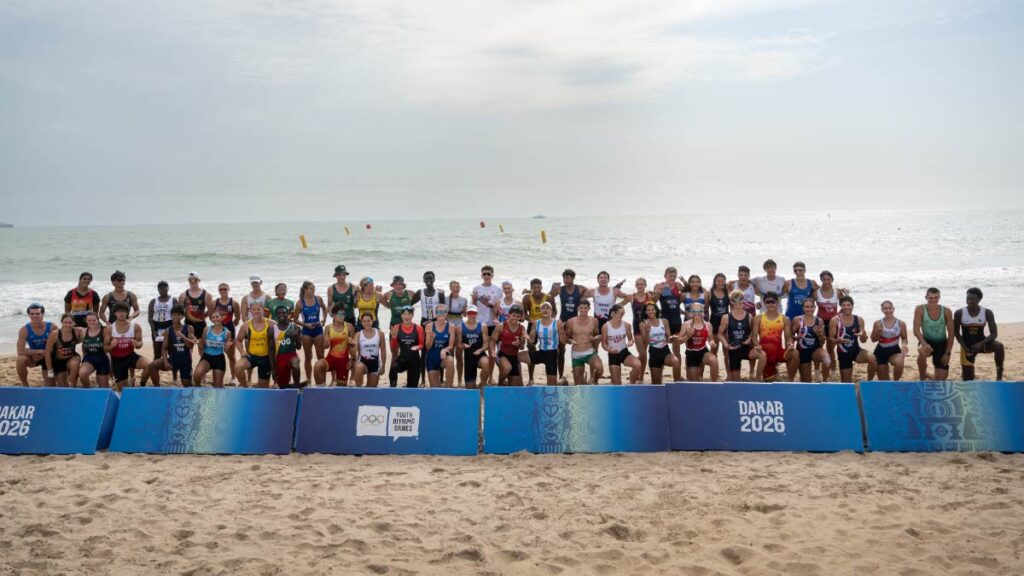
The youth rowers from Dakar 2026 are almost certainly too young to aspire to race at LA28, meaning that whether or not they will ever have the opportunity to repeat and race at another Olympic Games may rest entirely on the IOC’s decisions for Brisbane and beyond.
“It is great for us particularly when you see African teams, Oceanian teams, and by that I mean small islands and not just Australia and New Zealand, Caribbean teams, South American teams. So very exciting, and you can see what is happening,” he continues. “But for that momentum to continue, we need to stay Olympic.”