
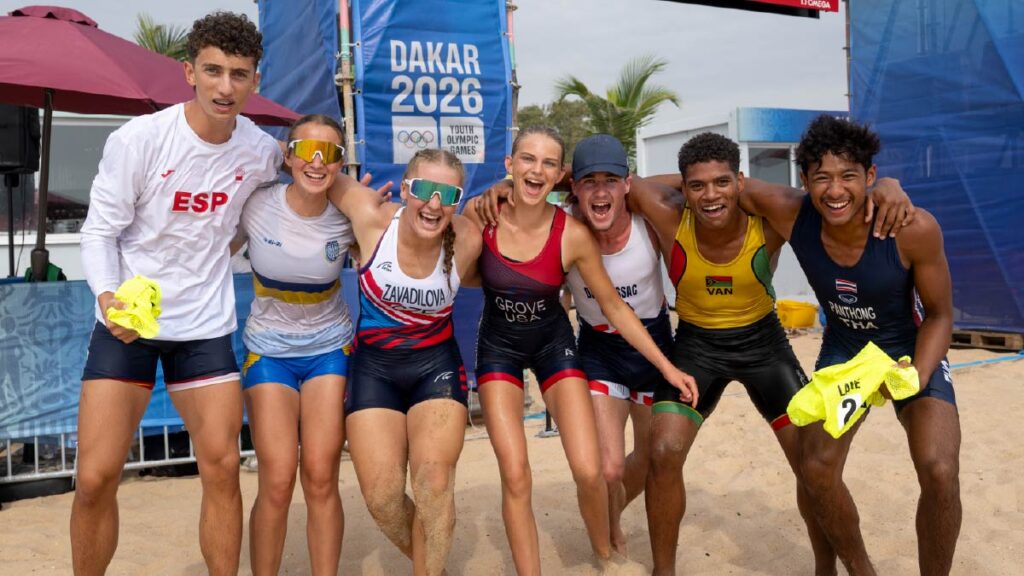
World Rowing and the International Olympic Committee may have gotten a little more than they’d bargained for in their end-of-regatta, “friendly” mixed team relay. Athletes, afterall, are athletes. Maybe there weren’t medals at stake, maybe they’d never trained or practiced this, maybe they couldn’t even speak the same language as some of their new teammates. But they could still win for the sake of winning, or at least fight for that.
To add some extra spice to that mix, the wave conditions yesterday afternoon were probably the toughest of the entire beach sprint competition at Saly Beach West in Senegal. The waves were big and breaking hard in the transition zone. Cue some epic flips right on the beach, a handful or broken oars leaving boats stranded out by the buoys, and a jet ski and zodiac needing to come onto the course to help out while trying not to obstruct the rowers. In the break between the time trials and finals, World Rowing’s Manuel Pita called the athletes into a group meeting to ask them to go slower, take more care, and not treat the relay as a race.
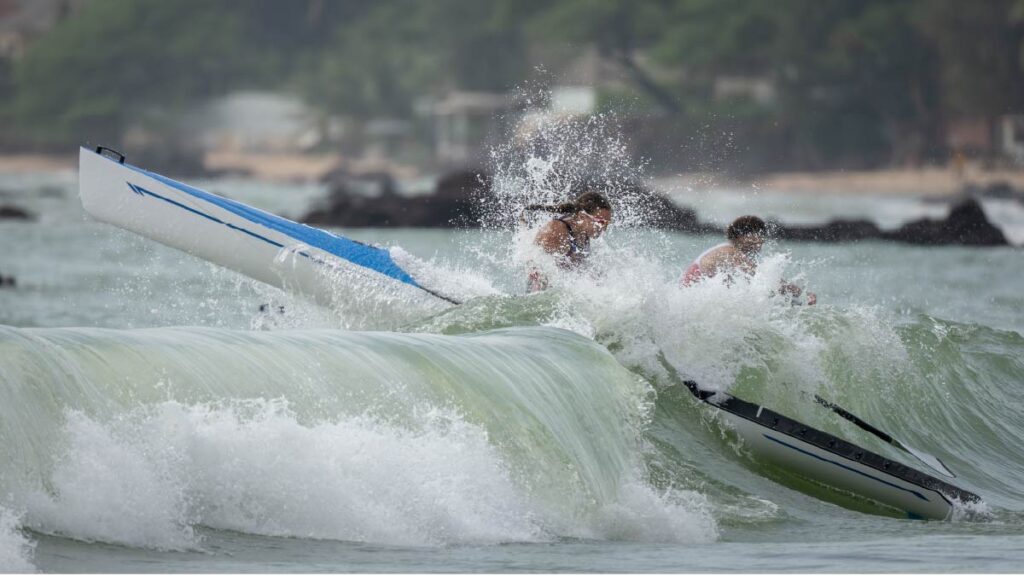
The idea behind the surprise event was to help create connections between all the different athletes who had competed in the beach sprint competition at Dakar 2026. While beach sprint in general has a strong community theme—athletes share boats and often even boat handlers—when there are still medals at stake, people have different priorities than making friends, and crossing between cultures is not always easy.
But as IOC president Kirsty Coventry said at the Opening Ceremony: “Be brave. Make new friends. Get to know people from different countries.”
Coventry herself even braved the waves earlier in the day yesterday, when the USA’s Chris Bak, who was in Dakar as an athlete role model, took her out in the mixed double. And then dropped the two-time Olympic backstroke champion by the turn buoy to make her swim back in.
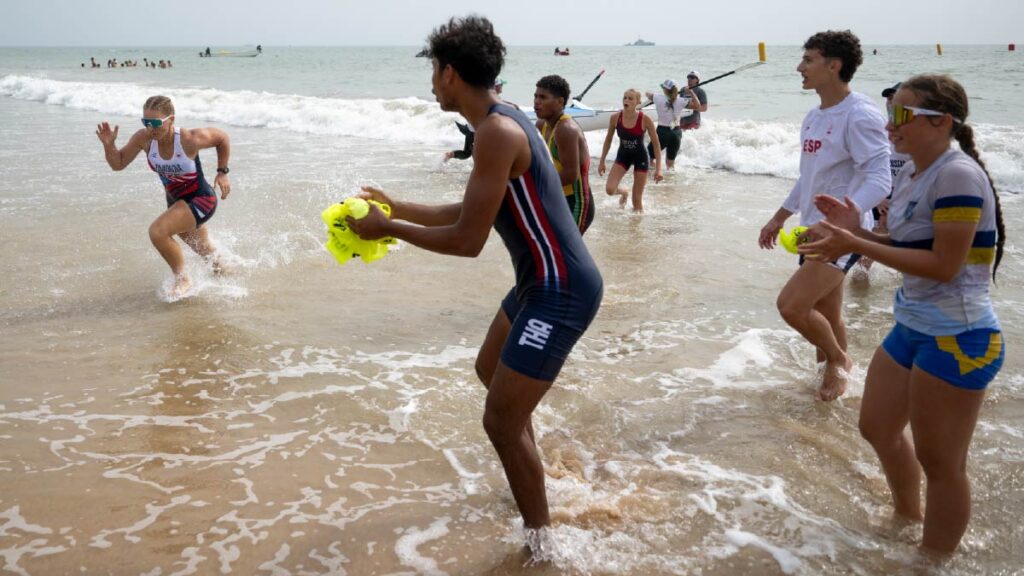
Mixing everyone together into new teams, and putting the athletes in charge—they became their own coaches and boat handlers, and picked their own team names—aimed to strip away many of the differences that divided them. That being said, with the complicated water conditions, race organizers quickly realized they needed to ask a handful of the real coaches and other regatta staff to assist in the transition zones. Austrian coach Wolfgang Sigl even went swimming to recover a broken oar and move it out of the way.
The teams all raced first in a time trial, with half of the team competing on the water and the other half working as boat handlers. They then all got to compete in a final, matching up the two fastest times in the A final, the next two in the B final, etc. The idea had been to flip roles so that each athlete would only row once, but a couple of the teams were missing people who had run to catch flights home, and so there were a few cases of rowers doubling up.
The A final would be between Team 6-and-7 and The Avengers, and in the end 6-and-7 won comfortably with a time of 5:51.75 to their rival’s 6:41.27. But, again, waves were probably the biggest differentiator between the two teams. If you were unlucky enough to be launching just as a wave hit, you were probably going to lose a few seconds even if you didn’t get knocked out of your boat.
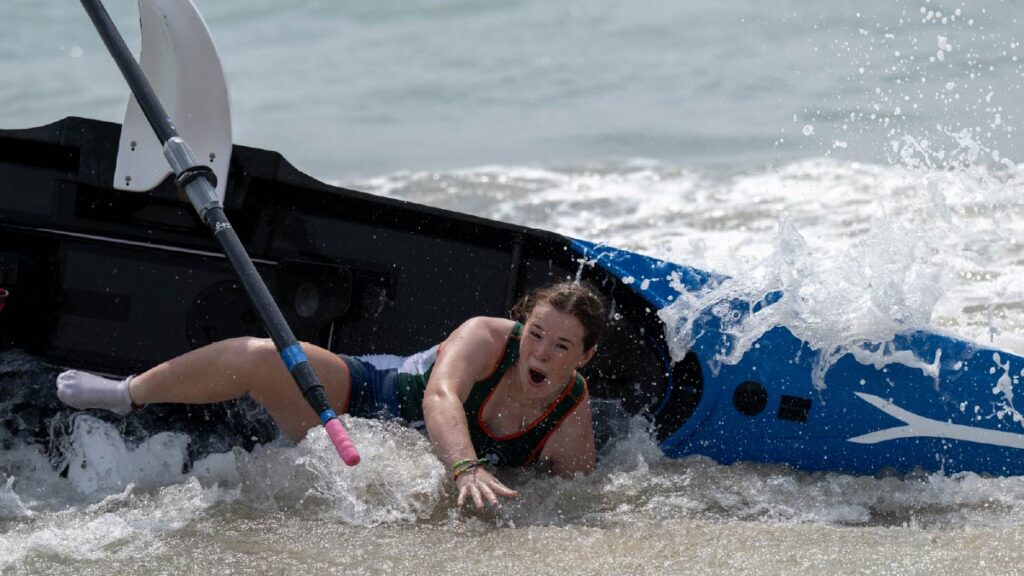
And possibly some of the rowers had taken heed of Pita’s plea for them not to take this too seriously. When Germany’s Johann Felix Meyer got hit hard by a breaking wave in the solo in the C final, he took his time to put his baseball cap back on before starting to row. Style is important, too.
Arguably, and despite the challenges with the conditions, the relay had its intended effect. By the end, athletes who had spent the previous few days separated out into national teams, listening to their coaches and staying off their feet and out of the sun between races, were all mixed up together chatting and hanging out in the water beside the course. Now that many will make the step up to senior next year, and others soon after, there’s a good chance they’ll see each other again at major regattas like worlds and even another Olympics. And perhaps the relay will mean that next time around much of that initial social distancing will be gone.
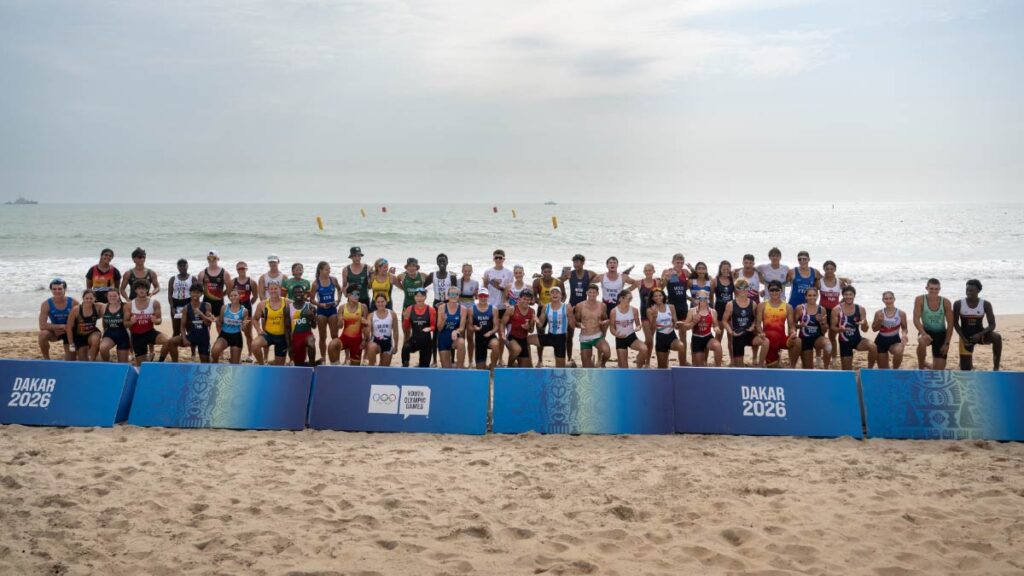
The full teams and results from the mixed relay at the Dakar 2026 Youth Olympic Games were:
Team 6-and-7:
- Athletes: Tupulua Vaouli (American Samoa), Diego Molina Martinez (Spain), Marie Zavadilova (Czechia), Raphael de Boussac (France), Trairat Panthong (Thailand), Viktoriia Radchenko (Ukraine), Allison Grove (USA), Teva Chabod (Vanuatu)
- Time trial: 5:31.68
- A Final: 5:51.75
The Avengers:
- Athletes: Joaquin Ezequiel Pare (Argentina), Lili Liu (China), Steven Runin (Estonia), Saaga Hakala (Finland), Elisa Guilloton (France), Maki Asakura (Japan), Jose Azevedo (Portugal), Marcel Otim (Uganda)
- Time trial: 5:45.20
- A Final: 6:41.27
The Ocean Gulls:
- Athletes: Ondrej Zizka (Czechia), Natalia Juliet Townsend (El Salvador), Lexi Gill (Great Britain), Elena Lara (Honduras), Davide Gazzola (Italy), Sarra Amari (Tunisia), Mykola Tomchai (Ukraine), Isaac Moos (USA)
- Time trial: 5:59.46
- B Final: 6:16.01
Ayo:
- Athletes: Evgenia Maria Polycarpou (Cyprus), Yossuf Moursi (Egypt), Chun Cai (Hong Kong), Frida Weber Lozano (Mexico), Victoria Gimenez (Paraguay), Teo Rubio (Peru), Constantin Medan (Togo), Elif Ozdemir (Turkey)
- Time trial: 5:59.39
- B Final: 6:29.43
The Friends:
- Athletes: Joao Pedro Franca Silva (Brazil), Alia Ali (Egypt), Blanca Lopez Valera (Spain), Johann Felix Meyer (Germany), Ahmed Al-Azzawi (Iraq), Enrique Cristiano Morelos Olivares (Mexico), Thatchaporn Phengsawang (Thailand), Diadou Cisse (Senegal)
- Time trial: 6:06.92
- C Final: 6:09.72
The Four Rings:
- Athletes: Alexander Watt (Australia), Carolina Guerra Gonzalez (Germany), Iason Mouselimis (Greece), Wai Hei Chen (Hong Kong), Kate Dunne (Ireland), Dhari Alabbas (Saudi Arabia), Jenan Khaleefoh (Kuwait), Iyed Zantour (Tunisia)
- Time trial: 6:26.77
- C Final: 6:14.13
The Dolphins:
- Athletes: Camilla Griffin (Australia), Lukas Shoenhuber (Austria), Sofija Klujeva (Latvia), Justas Domarkas (Lithuania), Giorgia Cassina (Italy), Callum Dreyer (South Africa), El Hadj Malick Lo (Senegal), Arianna Robinson (Zimbabwe)
- Time trial: 7:19.36
- D Final: 5:59.55
The Sharks:
- Athletes: Ghizlene Besma Bennacer (Algeria), Alena Lux (Austria), Juntao Su (China), Louie Walker (Great Britain), Adam Moor (Hungary), Crina Adelina Neicu (Romania), Tanya Brendle (Switzerland), Zihni Senih Alatas (Turkey)
- Time trial: 6:48.92
- D Final: 6:03.28