
When Italian world champion Davide Riccardi moved to Colombia in 2015 he was sure he was leaving rowing behind for good. The South American country had almost no rowing history or infrastructure. It had never won a rowing medal in the Pan American Games, the World Championships or the Olympic Games. It lacked boats, clubs, athletes and government investment. A decade later Riccardi is on a mission to change all of that.
“I quit rowing because there is no tradition of being a rower like in other countries in Latin America,” Riccardi explains. “Here rowing is almost totally absent, and especially in the Colombian Caribbean, the region where I live, there wasn’t anything. Completely zero.”
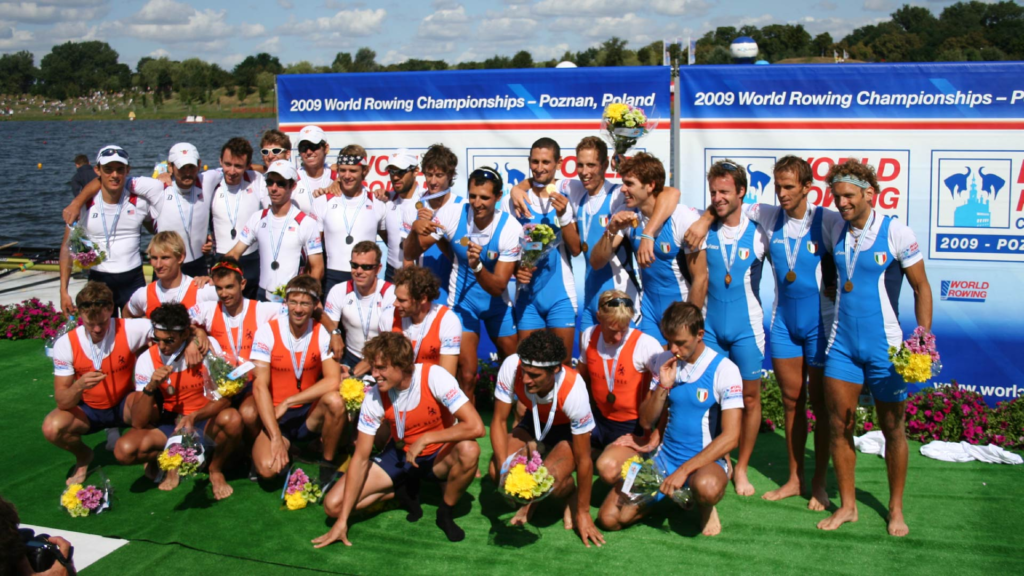
Riccardi was first brought to Colombia, to the small agricultural town of Arjona in the Bolívar department, by a friend who is a Carmelite missionary in 2004. The country was embroiled in a long-running civil war between government forces, drug cartels and paramilitaries, and guerrilla groups, and Arjona faced the growth of youth gangs and urban violence. But the experience changed Riccardi’s life. Over the following years he would meet his wife, Veronica, in Arjona, and would found a non-profit organization, Animosa, that built a school and health clinic and supported the work of the Carmelite mission there. When his Italian men’s lightweight eight raced to victory in the 2009 World Championship in Poznań, Poland, the boat carried the slogan “Rowing for Peace in Colombia.”
At home, Riccardi doubled up being a national police officer—a member of Italy’s Polizia di Stato—with elite rowing and an academic career that spanned political and social science, international relations and an MBA. Before stepping away from competing to focus on his studies, he raced both for the national team, from 2003 to 2012, and the Fiamme Oro, the police’s sports section, from 2006 to 2012. Besides his 2009 world championship, he picked up a host of medals both nationally and internationally, including gold medals in world cups, the 2010 European Championship and the 2005 Under 23 World Championship.
In 2015, Riccardi moved to Colombia with his wife and young sons Alejandro and Gabriele so that he could pursue a Ph.D. in social science at the Universidad del Norte in Barranquilla. The country was by then in the midst of peace negotiations between the government and the Fuerzas Armadas Revolucionarias de Colombia (FARC) guerrillas, which would result in an agreement signed and ratified in late November 2016 and would significantly reduce the scale of the ongoing conflict. Riccardi studied the difference between the international aid offered to Colombia by the USA and the EU over the previous two decades, contrasting American military power with European diplomacy. After defending his thesis he took up a position as an assistant professor in the International Institute of Caribbean Studies at the Universidad de Cartagena. Rowing had become a part of the life he had left behind in Italy.
Until three years ago, when he began talking to his neighbour José López, a maritime pilot in the port of Cartagena and a partner in the company Promar. López and his employees guide heavy container ships to and from the open sea. In his free time, López had tried almost every water sport, from windsurfing to kayaking and canoeing, but never rowing. “We shared this dream to implement rowing on the Colombian Caribbean coast,” Riccardi says, “especially in a place as pretty as Cartagena.”
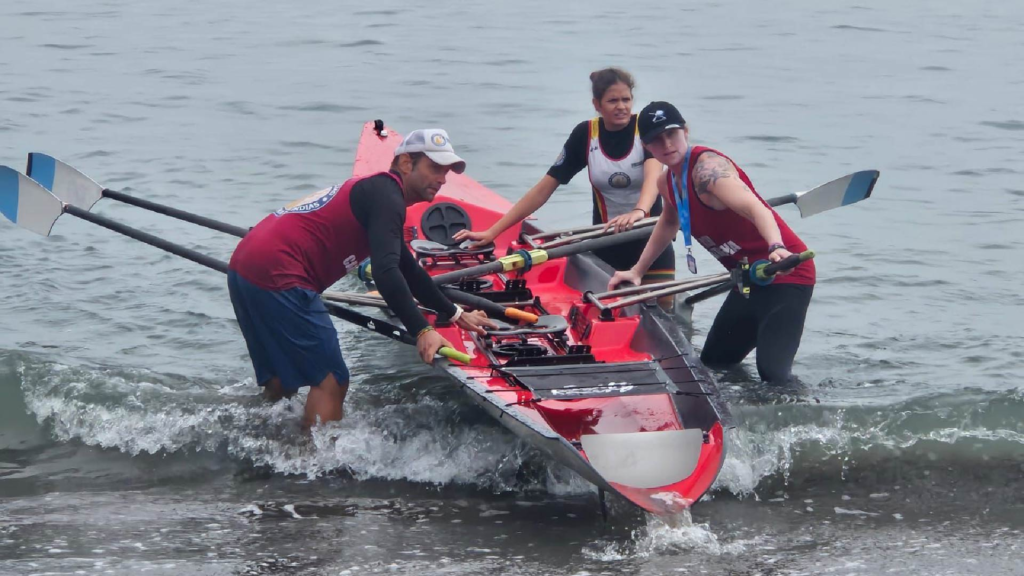
With the support of Promar and López, Riccardi founded the city’s first rowing club: Club de Remo Cartagena de Indias. They bought a fleet of coastal rowing boats—four singles, four doubles and four coxed quads—and the Liga Vallecaucana de Remo, a regional rowing federation based in the Cauca valley in southwest Colombia, lent Riccardi four flatwater boats so that his athletes could gain experience in traditional Olympic rowing.
Riccardi also began working directly with the small Colombian rowing federation to coach the national team, and last November they qualified six boats for the Santo Domingo 2026 Central American and Caribbean Games. In December, the club brought on the help of Yuleima Charris, who won Venezuela’s first international gold medal in rowing at the 2002 Central American and Caribbean Games in San Salvador, El Salvador, but has Colombian roots. And in March this year, the club hosted coastal rowers and coaches from the USA and South America in a combined camp, exhibition regatta and World Rowing coaching course run by U.S. coach Marc Oria.
His other project in Colombia, the non-profit Animosa, has been indefinitely paused, but Riccardi sees a continuation of its central idea. “It has evolved. And the evolution has been rowing,” he says. “The goal is also to include vulnerable communities from Colombia, from Cartagena and nearby. For a social reason and for a talent reason. There are many young people here that have an incredible talent, and who through sport can transform their lives and those of the people around them. Animosa has transformed into a rowing club.”
When Riccardi rowed in Italy, he would race in coastal regattas with his teammates to have fun at the end of each season. But the proposition for the club in Cartagena is to make coastal rowing the focus, alongside offering masters rowing and camps as a way to make everything sustainable. “The camps, as much as creating competition with other clubs and other countries, give us the opportunity to finance our local sports activities,” Riccardi explains.
Much has changed in the rowing world over the last decade and coastal rowing is no longer just a post-season distraction. A growing number of clubs and training centers dedicated solely to coastal rowing have been founded across the world, and with beach sprint soon to debut at the LA28 Olympic Games, national federations have turned their attention to the new discipline.
“At the beginning, there was a stigma against coastal rowing [and beach sprint], that it was a lower category of rowing. Those who came from traditional rowing didn’t consider it very highly,” Riccardi says. “But over the last few years, with all the attention that has been put on it, I believe that it has demonstrated its value, both in terms of technique and in terms of being spectacular.”
Cartagena de Indias might be the perfect place to grow rowing away from the calmer water of rivers and lakes and away from its established global powers. World Rowing put its support behind coastal rowing, and invented beach sprint, to do just that in places just like this.
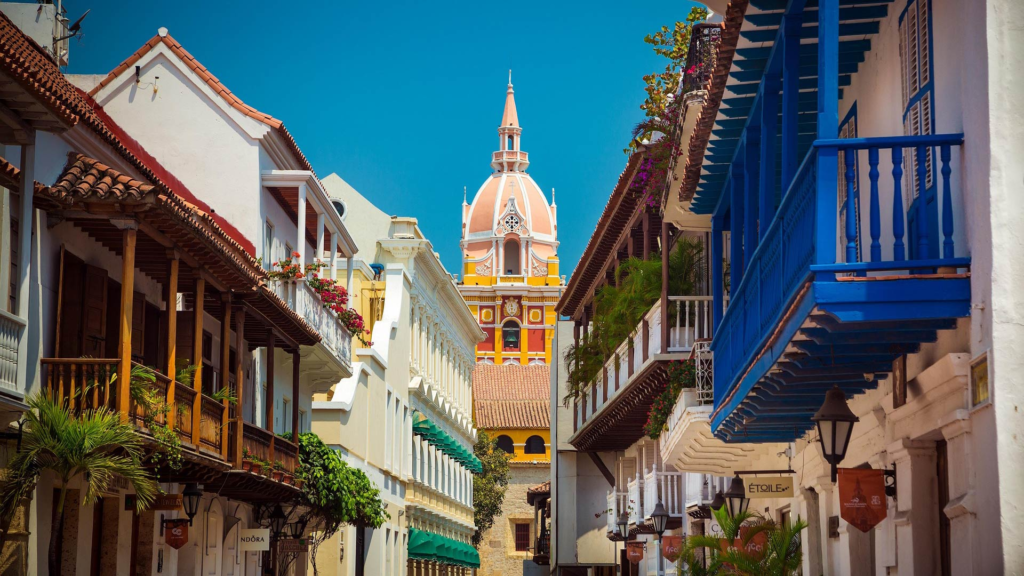
A former Spanish colony, the old town is a UNESCO World Heritage Site and welcomes around seven million visitors per year. The town was given the nickname “La Heroica” (the heroic city) when, after declaring independence, it resisted a siege by the Spanish for more than 100 days—the town was eventually captured before being freed six years later—and is dominated by coral stone fortifications and the formidable San Felipe de Barajas castle. Its streets are lined with colorfully painted colonial houses and palm trees, and its food mixes native, European and African influences.
In Cartagena the traditional sport of rowing can be reimagined with the surf vibes of a tropical paradise. Beaches line its shore and nearby waters feature coves and islands that can be explored in coastal boats. You can even row in flatwater shells in the Laguna de San Lázaro directly alongside the city walls. And, according to Riccardi, you can go out onto the sea year-round.
Riccardi and his team use friendships and social media to help spread the word about what they are doing, and visit local schools to introduce kids to the basics of the sport and capture new athletes. “It is more attractive [than flatwater rowing] for young people, at least here in the Colombian Caribbean,” Riccardi explains. “In a few months they can be in a regatta and obviously from there grow the hunger to improve and convert themselves into experts in this rowing discipline.”
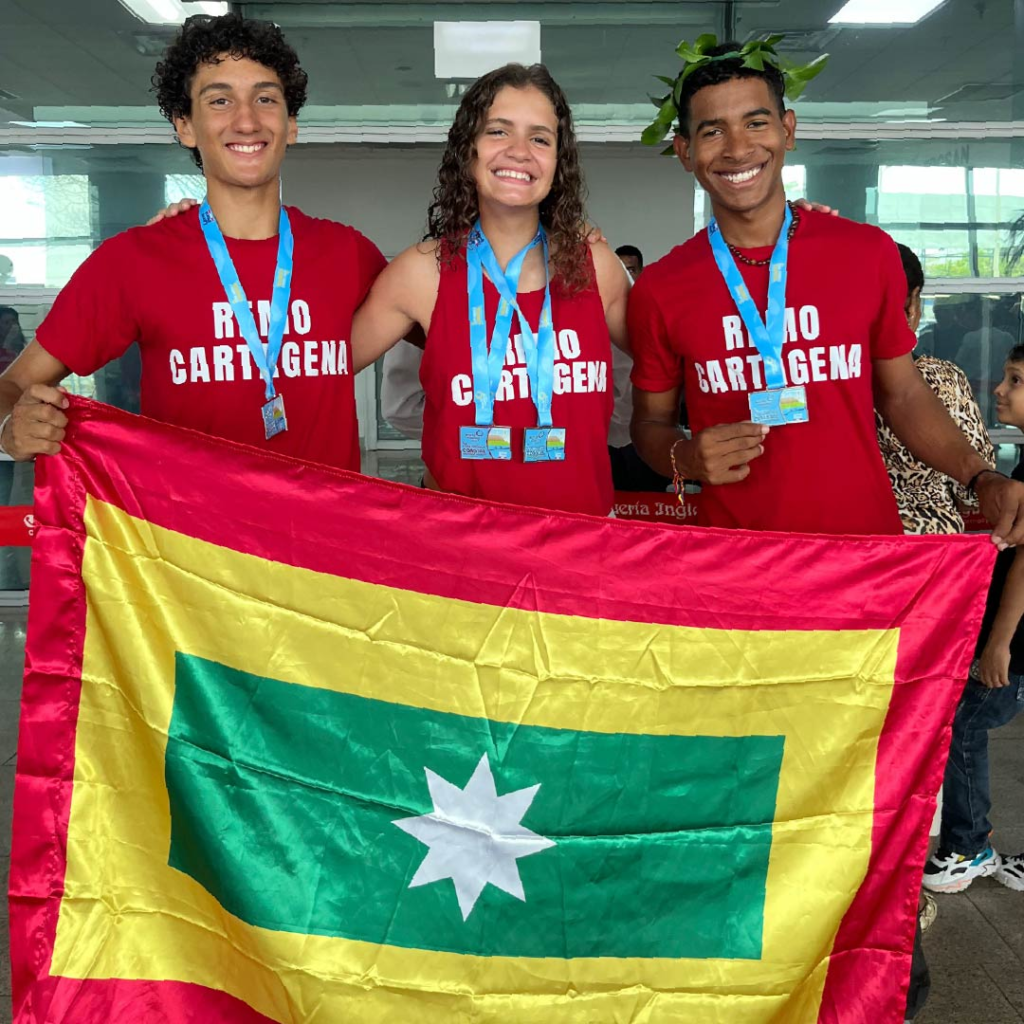
Last week, they took three athletes—Santiago Monsalve, 17, Matilde Maciá, 14, and Alejandro Riccardi, 15—to Lima to compete in the fifth edition of the Copa America Coastal. They returned home with Colombia’s first ever international beach sprint medals. Matilde winning silver in the under-19 women’s solos, Alejandro (Riccardi’s oldest son) another silver in the under-19 men’s solos and Matilde and Santiago combining to win a third silver in the under-19 mixed doubles.
But as excited as he may be by those results, Riccardi is quick to urge caution. “I could tell you that Colombia is heading to Los Angeles,” Riccardi says, “but if I have to make a technical analysis, there are two quota places [per gender] for America, for all of America.” The USA, as hosts, will qualify automatically. Six places per gender will be allocated to the top mixed doubles, and six more in the men’s and women’s solos, at the 2027 World Rowing Beach Sprint Finals. That will leave just two more mixed double slots and two more solos, both male and female, to be assigned in the Americas qualification regatta. “Two quota places from Canada to Argentina. It’s not that easy. You have to compete against Brazil, which has a very good team. You have to compete against Cuba and Venezuela, which have rowing history. Mexico also is growing its structure in coastal. Peru has a good tradition. Chile doesn’t do coastal but comes from a good tradition in shells.”
“It’s not enough to participate. Between the possibility of qualifying in beach sprint and traditional rowing, it is 1,000 times more possible in beach sprint,” Riccardi adds. “But we’re still very young.”
He counts many locals among his supporters, including club co-founders Veronica Bossio, Ismael Yepes and José Romero, while Albert Castellar, director of the local national police vacation center, has brought his officers to train with the club and retired Colombian navy vice admiral Andrés Vásquez has become the president of the Liga de Bolívar, a new regional rowing federation for the Cartagena area. He also has received help from Jhon Santos, president of the small national rowing federation, Mario Arrieta, president of the Liga Vallecaucana, and Daniela Gomes, World Rowing’s head of development and sustainability.
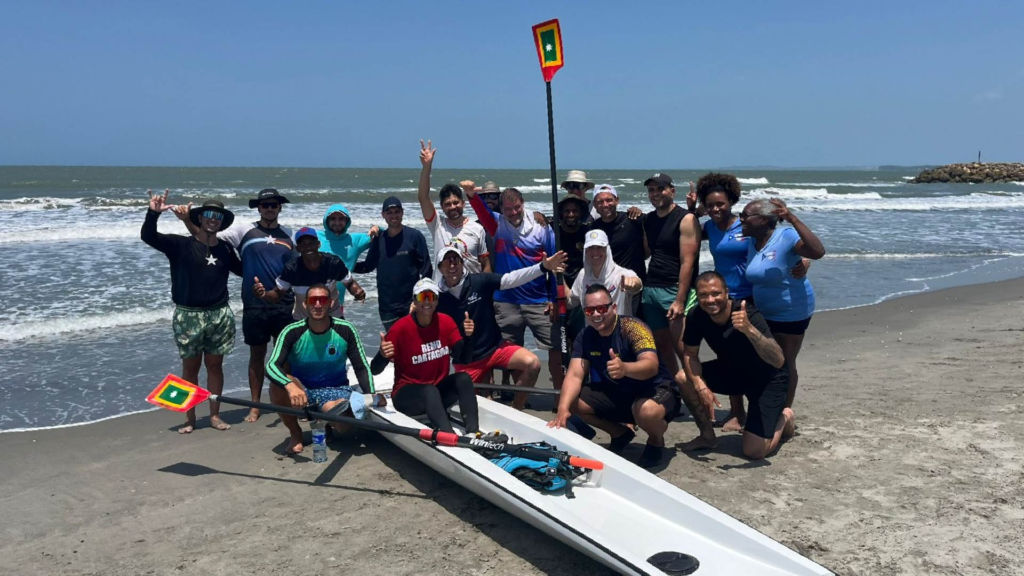
However, Riccardi has so far struggled to bring in investment and interest from the Colombian government. “The Colombian sports bureaucracy is complicated and requires a minimum number of clubs, that still doesn’t exist, to have official financing from the state,” he explains.
For this reason, one of Riccardi’s projects is to launch the Liga de Bolívar to compete alongside the Liga Vallecaucana, and why he hopes other local clubs and regional federations will appear, too. Another goal, with the help of coach Yuleima Charris is to strengthen ties with neighboring Venezuela, and the World Rowing coastal course in March brought together coaches from Argentina, Colombia, Germany, Puerto Rico, Spain, USA and Venezuela. More coaches, more clubs and more rivalry will mean more rowers, more competition, public support for the national federation, and a revolution in the world of Colombian rowing.
In Riccardi’s Italian-accented Colombian Spanish: “Hay mucho por soñar y hacer.” There is a lot to dream about and do.