
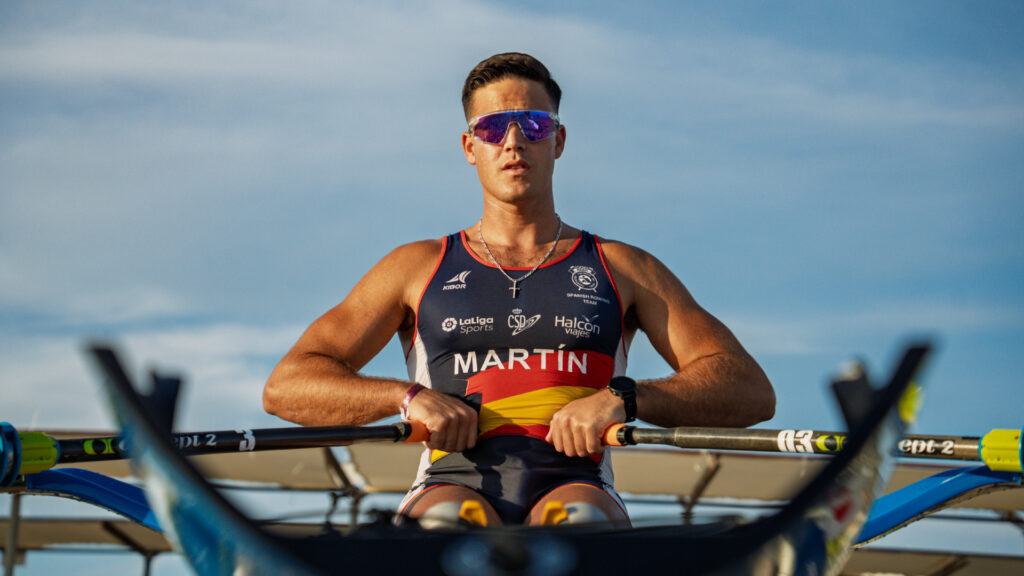
Visit Ander Martín in Torrevieja, Spain, and you will begin to understand the connection he has with his Valencian hometown. He’ll drive you along the coast to see sandy beaches and rocky coves, take you to visit his neighborhood, La Mata, to the pink salt lake or to Torrevieja’s giant Sports City complex. He’ll walk you around Real Club Naútico Torrevieja, the place where he learned to row and now volunteers his time. He’ll want to take you to eat arroz negro or caldero (what most people know as paella is really only one specific recipe within a whole world of Valencian rice dishes). And, above all, he’ll take you out onto the sea where his father, Felix, and grandfather Felixín worked as fishermen.
The two-time beach sprint world champion is focused on fighting for a medal at the Los Angeles 2028 Olympic Games, but Martín is driven by something else, too. In 2024, he founded a training center, the Beach Sprint Academy, in Torrevieja as a way to build community within his startup sport. He struggles to call it a business, even if the reality is that it is.
“I don’t want it to be seen as a company with pure profit goals,” Martín explains. “I don’t like that vision. I want the academy to be seen as a place where people come together and share experiences.”
The BSA has quickly become one of the leading centers for beach sprint worldwide, and, given its clientele so far, perhaps the most important of all. Many national teams have run training camps with Martín in Torrevieja, including the two countries that top the all-time Olympic rowing medal table, Great Britain and the United States. (Tied for 34 golds each, the U.S. has the edge with a handful more silver and bronze medals.) Those two also make the all-time podium of beach sprint world championships, ceding first place only to Martín’s home country, Spain, and are sure to be among the favorites at LA28. Both have come back for repeat camps in Torrevieja.
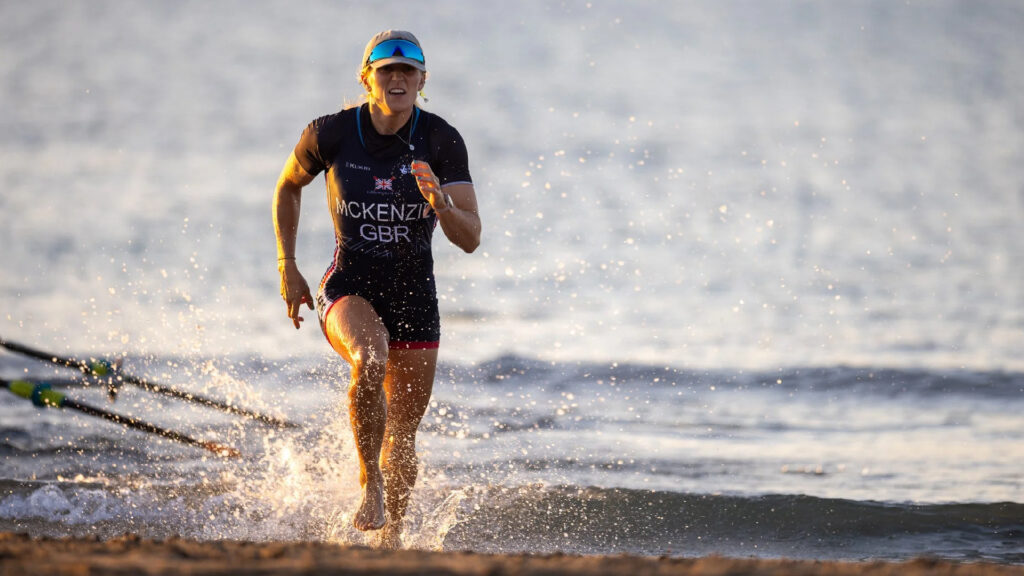
“This the best place in the world,” Martín says about his academy, which has a fully equipped gym with Concept2 row, bike and ski ergs, rowing-specific weights and a TV for video analysis. They also use the local Sports City’s running tracks and pools, bring in fleets of Swift or Filippi boats as needed and have direct access to the water. “From the dock we have two beaches at 400m and 600m. One of the beaches is inside the port, so it’s always protected. You can always do a session on the beach, it doesn’t matter if there is rain or thunder. And the other beach is in the open sea. It is something that I don’t believe any other place in the world has.”
For Martín, 2023 was the year when everything changed. We learn more from our lows than our highs, and Martín remembers that year as a complicated time. Homesick for the Mediterranean Sea, it was the year he left Sevilla and the Spanish flat water national team, and when he took a temporary sabbatical to Ireland. While it was the year in which beach sprint rowing would officially be added to the LA28 Olympic program, there were also changes within the Spanish beach sprint community: the creation of a national team and the first ever beach sprint trials regatta. And there were organizational uncertainties to deal with: Worlds switched Italian locations from Sabaudia to Barleta after the original hosts pulled out and the Bali 2023 World Beach Games were canceled entirely.
That year, Martín came third in Spanish trials to make the national team, and went on to win Spanish national championships in both the men’s solo and the mixed double. He took home two golds from the Heraklion 2023 Mediterranean Beach Games, based on time trials after a storm forced the suspension of the final rounds. But he was eliminated in the heats of the men’s solo at the European beach sprint championships and in the quarterfinals of the mixed double at the World Rowing Beach Sprint Finals. Returning from worlds, he wrote a double, soul-searching post on Instagram criticizing his own approach that year. “La realidad es que no he sabido afrontar las diferentes situaciones,” Martín wrote. “The reality is that I didn’t know how to handle the different situations.”
A few months before, “that summer,” Martín says, “I was lucky enough to be with my friends from New Zealand and the United States. It was the only moment of the year that I remember that I was happy. I was with them and it felt like a refuge.”
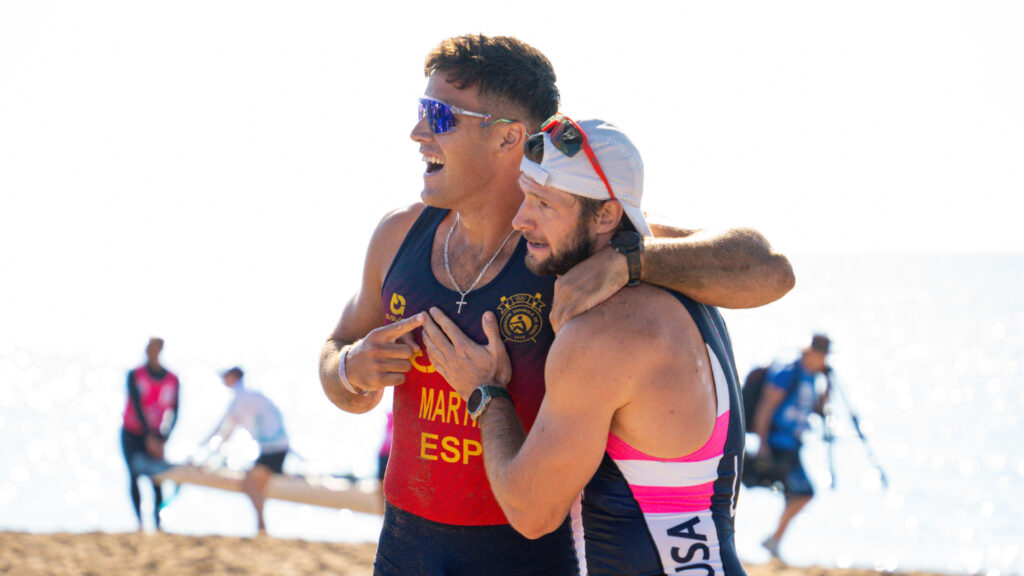
“We were training together because they had come to Europe to prepare before the World Championships. I went around Europe with them. I met Joe Sullivan, Michael Brake, Chris Bak, Kory Rogers, Christine Cavallo, people from the United States and New Zealand,” Martín continues. “For me they were the light that year.”
“From that I began to think: What can I do so that we can all join up another time, or have an excuse to get us all together?”
The first boat Martín ever rowed in, as a 10-year-old novice back in September 2010, was a coastal quad. He fell in love from Day 1. He would go on to win Spanish titles in flat-water boats, from a long distance championship in the single aged just 15 years old, to sprints in the double, the pair, coxless four and the eight. And he would relocate to Sevilla to train with the Spanish national team, and compete at junior and under-23 world championships in Lithuania, the USA and the Czech Republic. But, Martín says, “I didn’t enjoy it in the same way. In the end, when you do something that you enjoy a lot, it becomes easier.”
In Torrevieja, he explains, “naces de cara al mar” (“you’re born facing the sea”). He missed the feeling of how a boat moved in waves, winds and tides, the challenge of adjusting stroke by stroke to handle the always changing water, the way nothing was predictable, even the results of races. In 2018 he travelled to Victoria, Canada, to compete in his first World Rowing Coastal Championships, representing the Cofradía de Pescadores de Torrevieja (the fishermen’s association of Torrevieja), and came home with a bronze medal in the mixed double. A year later in Hong Kong he won gold in the men’s double.
However, the biggest impression left on Martín by his 2019 visit to China wasn’t that coastal rowing victory, but the experiment World Rowing ran in Shenzhen a week before. Eight years previously, the sport’s global federation had begun to trial the idea of coastal rowing races that included running starts and finishes on beaches. Four years later, it had demoed a new format called “beach sprint” at the Pescara 2015 Mediterranean Beach Games.
Now World Rowing was creating a beach sprint world championship, and providing accommodation and boats to teams willing to sign up. Athletes would have to sprint 80m down the beach, jump into their boats, row a 500m zig-zag course around buoys, jump back out of their boats and sprint to the line. The team manager’s manual marked a DJ booth on the venue map, and its final page shows the crew of a coastal coxed quad wearing bicycle helmets.
“It was like a gymkhana (obstacle course). I had fun. And immediately following I felt that this could be something that succeeds,” Martín says. “Even becoming part of the Olympic Games.” It was unpredictable and spectacular and felt more like a game than a regatta. Racing with Ana Navarro, he was knocked out in the quarterfinals of the mixed double, but he was hooked immediately.
Two years later, in the aftermath of COVID’s global shutdown of sports, Martín convinced long-time friend Esther Briz to team up with him for the Oeiras 2021 World Rowing Beach Sprint Finals and Coastal Championships. Briz was just about to start her senior year at Stanford University, and had been training remotely from the rest of the Spanish team. She’d had her sophomore rowing season and 2020 world and European championships canceled by the pandemic, and coastal rowing offered her a new focus.
“Esther does everything well,” Martín says, “but there was a difficult year for her in which she was away preparing a world championship and a European championship alone in a single. It was the year that they canceled her world championship. She had trained and worked a lot, and then the opportunity to row together came along.”
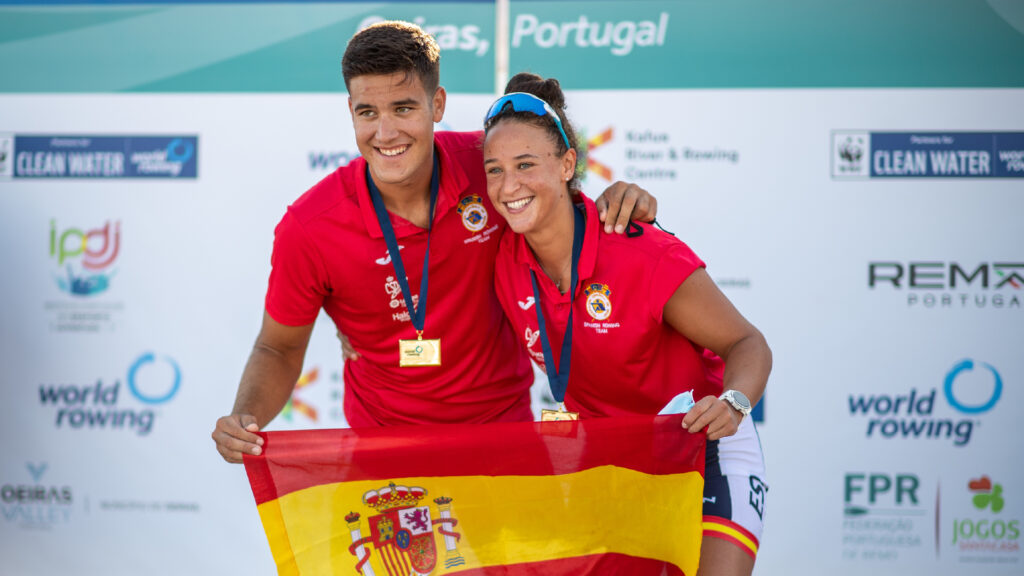
They trained together for just two weeks, and won gold in the mixed doubles in both championships. A year later in Saundersfoot, Wales, they repeated the same feat.
Much has changed in the last few years, and making such a quick switch from flat water to coastal, and especially to beach sprint, is much harder now. The rower with the best all-time record in beach sprint, the United States’ Chris Bak—four world titles: three in the men’s solo and another in the mixed quad—has dedicated his time to coastal rowing ever since missing out in the lightweight double at U.S. Olympic trials in 2021, and has never competed internationally on flat water. At last year’s world championships, Bak won gold, leaving Martín with silver.
“People believe that it is much easier than it is,” Martín says. “Until they try it. There are many examples of people that are very good in Olympic rowing who have competed in beach sprint. For some it has gone very well, and for some it has gone very badly.”
“These are two different sports. Evidently, if an athlete is very good at traditional Olympic rowing, it is going to help. But they will need to work on many things and train for a long time if they want to be good at beach sprint. [Now] no one switches from traditional Olympic rowing to beach sprint and in one year is winning the world championship.”
The double challenge for Martín over the next two years will be continuing to grow the Beach Sprint Academy without losing focus on LA28. Although, really, the two things are deeply intertwined. When national teams visit Torrevieja, Martín, who usually trains alone, has the opportunity to share ideas and learn with them. And Martín’s success offers both proof and publicity for his academy.
To achieve both, he will rely on the team of people around him, on family and friends. He counts on coaches past (Moncho Ferrer, now Hong Kong’s head coach) and present (Antonio Barbero, head coach of Spain’s beach sprint national team). He calls his mother, Idoia, his role model. And Torrevieja’s PR1 rower Javier Garcia, who came back from a car accident in 2018 to represent Spain at Paris 2024, is an inspiration. But the support of two friends in particular—Esther Briz and Eimear McCormack—might be key.
Martín met McCormack when he travelled to Ireland in 2023. His girlfriend, Laura, was working in Dublin for a year, and travelling with her seemed like the perfect opportunity to improve his English. He initially planned to stay a full 12 months, but he didn’t want to step away entirely from rowing. Looking for a place to train, he found McCormack on Instagram. While she was a marketing professional by day, she had also recently helped found the Dublin City Coastal Rowing Club.
On a rainy drive home from the Irish Coastal Championships in County Donegal that July—where Martín won Dublin City’s first medal, a bronze in the men’s solo—he explained his idea of creating his own training center to McCormack, and his fear of distraction. Coincidentally, McCormack had been working on her own version of a very similar idea. “She told me ‘Don’t worry, focus yourself on the sport and I’ll help you with the operations of beach sprint.’ ” They co-founded the Beach Sprint Academy together in 2024, and McCormack now splits her time between Torrevieja and Dublin. “Without Eimear,” Martín says, “the academy would be impossible.”
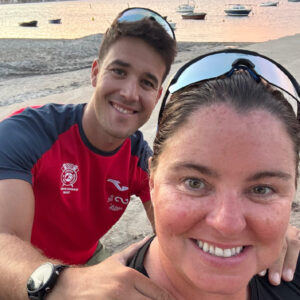
McCormack’s role will be crucial as the BSA looks to not just bring back its regular beach sprint national team clients, but also to expand into junior, masters and recreational coastal rowing, and perhaps even to launch its own race. And all that while Martín prepares for his toughest ever athletic challenge: qualification for the Olympics.
There will be three beach sprint events in Los Angeles, the men’s and women’s solos, and the mixed double. But quota rules mean that only one athlete of each gender can qualify per country. On the one hand, this will mean two chances of a medal for any athlete who seals a place (competing both in the solo and double), but on the other, it reduces opportunities for the countries whose beach sprint programs are most developed. At the first stage of the 2026 Filippi Lido Trophy’s International Circuit just a week ago, all of the three men on the podium were Spanish, and all were past world champions: Miguel Salas (under-19 men’s double, 2021), Martín and Adrián Miramón (men’s solo, 2019 and 2023). And there are more Spanish world champions vying for the same Olympic spot.
Perhaps Briz will be Martín’s secret weapon. Qualification priority for LA28 will go to the mixed double, and the top six doubles at the Oeiras 2027 World Rowing Beach Sprint Finals will be the first to seal their places for Los Angeles.
“The last few years we haven’t been able to row together for different factors,” Martín says, “but I believe that we can fight for everything.” The choice for who represents Spain in the mixed double at Oeiras 2027 will be that of the Spanish coach, but Martín and Briz are a hard duo to bet against. When they returned to action together, at the 2024 World Rowing Beach Sprint Finals, they took home the bronze medal. And a year later, at the inaugural 1924 Pharoes Trophy, in Oeiras, they won.
“That the qualifying regatta, the world championship in 2027, is going to be in Oeiras, where Esther and I won our first world championship, for us it was a signal,” Martín says. “A brutal feeling that we may have the opportunity to qualify where we won our first world championship is something very special.”