
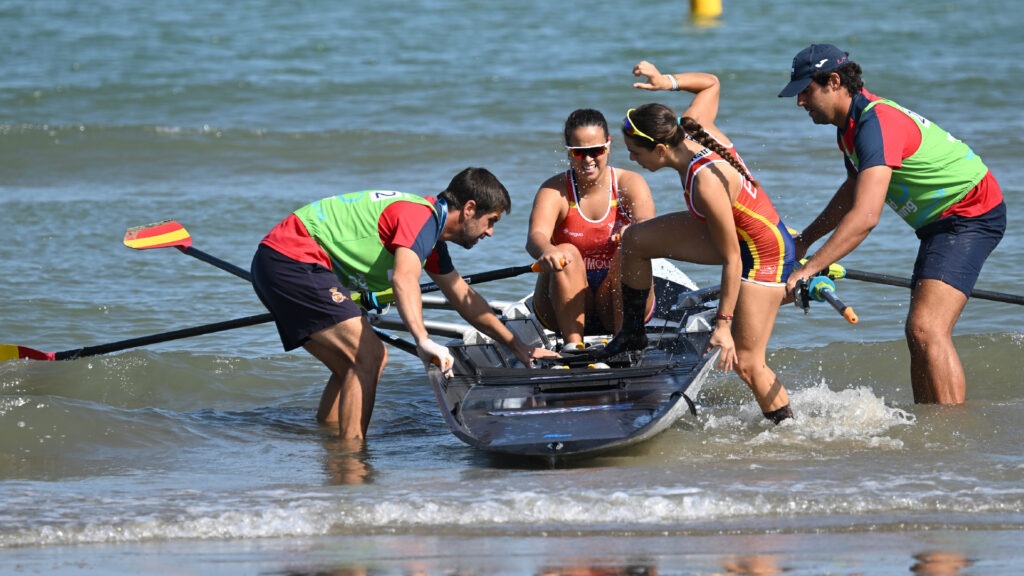
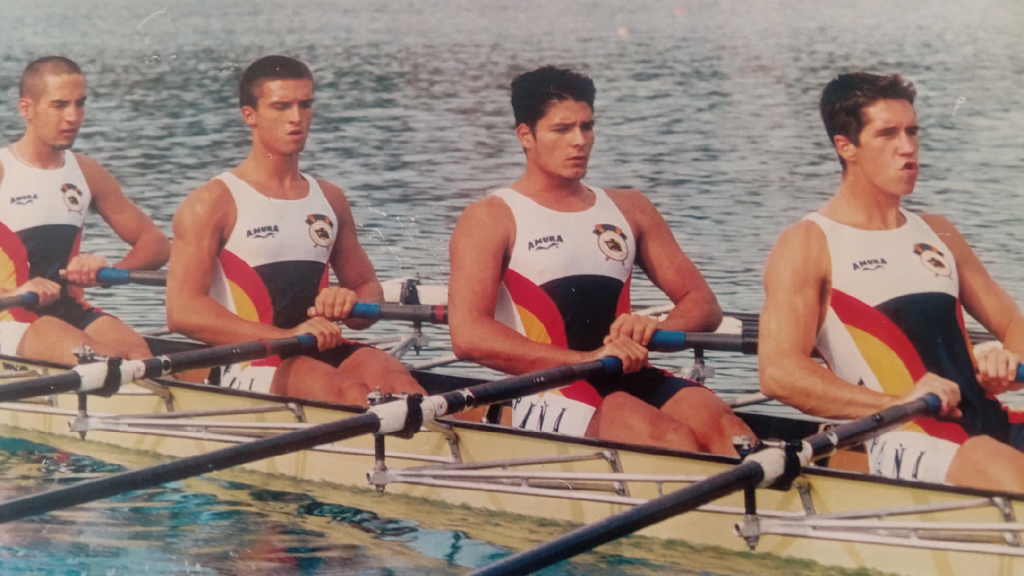
Real Club Mediterráneo head coach José López won at almost every level as a rower, from Spanish national championships in the U13 single aged just 11 years old to a World Cup in 2002 in the Spanish lightweight men’s quad. And as a coach, he was part of the coup that placed Spain firmly top of the all-time beach sprint standings.
Before beach sprint was officially added to the Olympic program in 2023, Spain’s representatives at the World Rowing Beach Sprint Finals were the winners, respectively, of the same races at national championships, meaning that they represented both club and country. At Oeiras 2021 and Saundersfoot 2022, RCM won the coxed quad twice and the U19 men’s double once. And in the inaugural worlds at Shenzhen 2019, before Spain first held beach sprint nationals, both the men’s single (gold) and the coxed quad (silver) had their origins at RCM.
None of that beach sprint success came by accident. Spain and, in particular, Spanish clubs based on Mediterranean beaches (RCM is in Málaga) turned their attention to this new discipline before many of the world’s traditional rowing powers began to focus on it. “There was a very big gap,” López explains, “but it was an empirical gap, and 100% ours. We can say trial and error, or test, test, test, test and see what works best. The way to get into the boats, the way to run, the way to turn, to signal. All of this we had to learn.”
That edge has been eroded in recent years, but Spain has still won at least one gold medal at every one of the six world championships to date. And beach sprint’s debut at LA28 could be an opportunity for the country to pick up its second ever Olympic rowing medal. (The first, a silver medal in the men’s pair, dates back to the last time the Olympic Games were held in Los Angeles, in 1984.)
López backs the addition of beach sprint to the Olympic program, and not just because of Spain’s success. He believes it will help broaden the appeal of rowing in general.
“It is very easy for the spectator who doesn’t follow traditional rowing [to understand],” he says. “I don’t mean the spectator that follows the world championships, that has been a rower. I mean the spectator who turns on the television during the Olympics to watch all of the sports. And suddenly sees a race of 2.5 minutes in which they run, get into the boats, fight with the waves, turn. It’s going to be very spectacular.”
Beach sprint involves a huge luck factor that isn’t present in calm-water Olympic rowing, and luck can mean upsets that makes sports more entertaining from the outside. The waves may break bigger on one side of the beach than the other, affecting the two lanes differently. Or a wave might break in one lane just as a rower tries to enter the boat.
“It introduces many factors that you try to minimize, but that are impossible to control. For the spectator that is very good, because it is very exciting,” López says. “But for the rower and the coach it’s not quite so fun.”
However, the arrival of beach sprint at the LA28 Olympics also marks the disappearance of lightweight rowing, which had its farewell at Paris 2024. As a former lightweight, López can’t help but feel divided that a population of talented rowers may have lost their opportunity to represent their countries at future Olympic Games.
“Love and hate, both things,” López explains. “It’s very sad that they couldn’t retain the two things. One thing shouldn’t be connected to the other. But these are things from the Olympic committee. They’ve given out one place and they’ve removed others.”
“Before [Atlanta 1996] lightweight rowing didn’t exist. Then lightweight rowing existed in the coxless four and double scull. [At Tokyo 2020] they removed the coxless four, leaving only the double scull. And they converted the lightweight double scull, without doubt, into the regatta with the highest level that there has been in rowing,” López says. “Without doubt.”
Comparing times between different races in rowing is all-but impossible because water and wind conditions can have such a significant impact. For this reason, World Rowing keeps a list of best times, but there are no official world records. However, at Paris 2024, both the men’s and women’s lightweight doubles outpaced their openweight alternatives. The gold-medal time in the LM2x was 6:10.99 compared to 6:12.58 in the M2x, and 6:47.06 in the LW2x versus 6:50.45 in the W2x. An alternative analysis, comparing the percentage difference between reaching the podium and leaving the Olympics without a medal, implies the openweight races may have been competitively closer. The difference between third and fourth places in the LM2x was 0.82% compared to 0.49% in the M2x, and 0.58% and 0.25% in the LW2x and W2x, respectively.
“Many lightweights have put the blame on beach sprint. But it’s not the fault of beach sprint. It’s the fault of the committee that hasn’t been able to back both things,” López argues. “On one side, the most spectacular discipline of traditional Olympic rowing. The discipline with the most rivalry and the highest level. Hold on and keep it there. And at the same time add a new discipline that is very spectacular, and for fans is going to be very entertaining.”
The substitution of beach sprint for lightweight rowing in 2028 will also reduce the maximum number of rowing places available per country, while driving participation from a greater number of countries. According to the IOC and World Rowing system, each nation will be able to qualify a maximum of one male athlete and one female athlete for the beach sprint competition at LA28, and the quota for the number of participating nations in each of the beach sprint disciplines will be 32. Rowers who qualify via the mixed doubles will be able to compete in both the solos and mixed doubles in Los Angeles. Rowers who qualify via the men’s or women’s solos will also theoretically be able to compete in both the solos and doubles, though only if a rower of the opposite gender from their home country also qualifies.
“It’s very cruel,” López says. “I say this to my athletes. It’s great to specialize in beach sprint, but be careful. If your goal is the Olympics, it’s very hard. It’s very hard in the world championships in which there are four places, four places and no more. But if it’s hard in the world championships, imagine in the Olympics, in which there is only one place.”
In the World Rowing Beach Sprint Finals, countries can compete in four senior disciplines, CM1x, CW1x, CMix2x and CMix4x+, accounting for four rowers of each gender plus one coxswain. Last year, among other countries, both Great Britain and Spain brought the maximum of nine senior beach sprint athletes to worlds. For comparison, at the Paris 2024 Olympic Games, countries could qualify up to 23 rowers of each gender, plus two coxswains. Great Britain had a representation of 22 female rowers, 18 male rowers and two coxswains. Spain, while a smaller team, still had three women and six men.
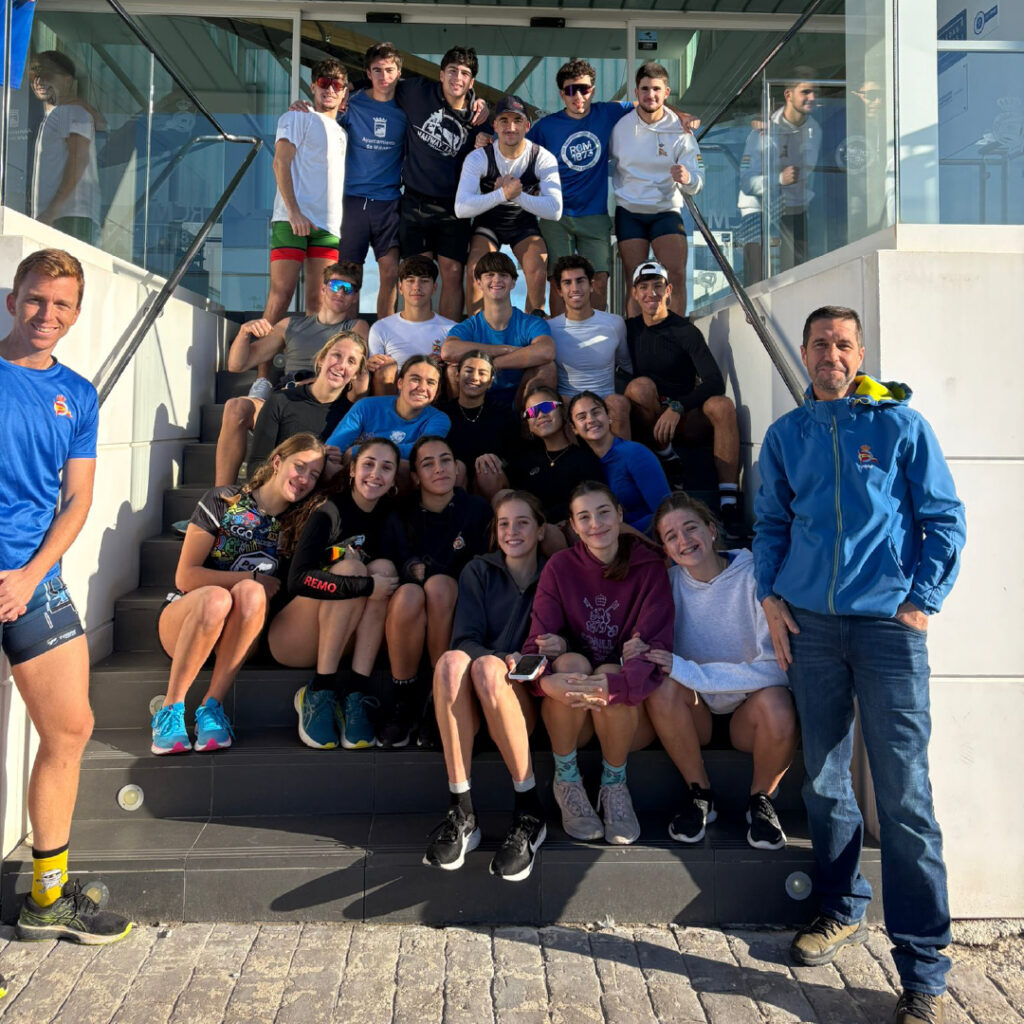
The restricted opportunities to compete at the highest levels in beach sprint make focusing purely or even predominantly on that discipline unrealistic, especially at the youth and development level.
“Traditional rowing is going to continue, and will continue for many years. It’s very easy to transfer across [to beach sprint] from Olympic rowing, and more so for us,” explains López. “But the other way around it’s almost impossible. I won’t say impossible, but it’s more difficult for an athlete that has only done coastal rowing to become good at traditional Olympic rowing. They are other sensations, other speeds, other abilities that require more time.”
Real Club Mediterráneo’s marina sits in the center of Málaga and is just 500 meters from the beach. Its athletes can row directly out onto the sea almost every day of the year, and the club has a fleet of C1x, C2x and C4x+ boats. To practice in flat-water boats they must travel almost an hour by car to the reservoir at La Viñuela, which in times of drought can empty almost completely. Focusing on coastal rowing and beach sprints would be simple.
“[But] traditional Olympic rowing needs to be the foundation,” López says. “For us it is really easy to do beach sprint, but we’re very headstrong and we don’t want to do the easy thing.”