
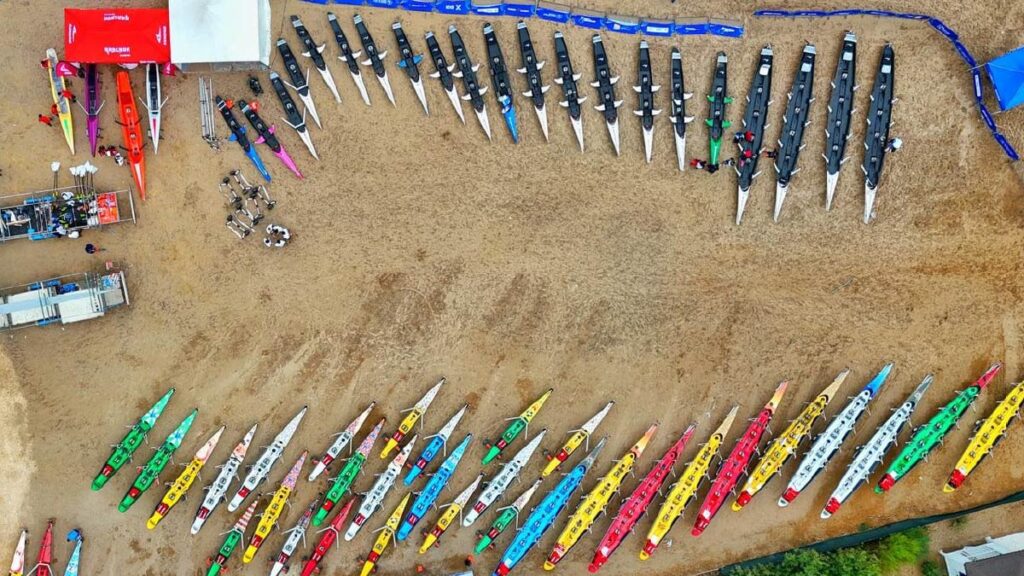
World Rowing soon has a tough decision to make: Which of the dozens of coastal boat manufacturers will go down in history as beach sprint’s first, and possibly only, Olympic supplier?
At the first ever World Rowing Beach Sprint Finals, back in Shenzhen, China, in 2019, there was just one boat builder: Filippi. And the Italian company would hold an exclusive lock on the competition through to 2024, when Swift Racing won the right to supply that year’s doubles. Since then the number of manufacturers has steadily increased. Filippi and Swift were joined by Kanghua in 2025, and will be joined by Empacher and Falcon this year.
But out of the growing flotilla of beach sprint and coastal boat builders, three stand out above the rest. In part because of their experience in coastal rowing, in part because of their market share, and in part because of the history they bring with them. Filippi, Swift Racing and Empacher.
Of the big three, Filippi arguably has the most experience. The Italian company, founded in 1980, began to invest in coastal boats about 15 years ago. “The goal was to push the discipline to the top level,” says Stefano Montisci from Filippi. “We took part in some international coastal endurance events. And when beach sprint started to grow we were immediately in the right place.”
The genesis of beach sprint dates back about as far as Filippi’s interest in coastal, to the 2011 World Rowing Coastal Championships, which were held in Bari, Italy. The organizers ran an experiment the day after the regatta: a shorter 2km race starting with a sprint along the beach. And when the first ever international race was held at the Pescara 2015 Mediterranean Beach Games, also in Italy, competitors used Filippi boats.
Chinese manufacturer Swift Racing has the largest share of the coastal rowing market, and is perhaps the biggest across the entire rowing industry. Founders Gareth Gruenbaum and Tim Yang launched the company in 2005 to grow the sport of rowing in general, and Swift builds a lot more than just racing shells: oars, racks, timing systems, and even dragon boats.
Swift Racing came to coastal rowing a little bit later than Filippi, supplying the Asian coastal championships for the first time in 2017 and the world championships since 2018. Swift had been alerted to the potential of coastal by Euro Diffusions, a Swift distributor in France and one of the early coastal boat builders. (Euro Diffusions is no longer operating.)
“We want more people to enjoy rowing and stay in the sport,” says Lauren Hughes from Swift Racing. “If we can build boats that help make that experience better, we’re doing our job.”
For Empacher, the trigger for its interest in beach sprint was the 2023 decision to add the sport to the LA28 Olympic Games. “That was the starting gun for us,” says Tom Hinrichs from Empacher.
The German boatbuilder, founded in 1923, prioritizes boats that compete at the Olympic level above all, and so following confirmation that beach sprint would be in Los Angeles, Empacher began to evaluate options for joining the race. Ultimately they decided the best idea would be to partner with a manufacturer with more experience in coastal rowing, and in 2025 signed a deal with Spanish boatbuilder Rubenetti—the bottom part of the hulls are Rubenetti, while the top part are Empacher.
“We didn’t think that you can copy the work Rubén [Muñoz] from Rubenetti did, or Filippi or Swift,” Hinrichs explains. “They are 10 years into the business, so you see a development. You can’t get there in one year. When Empacher had an entry into the sport, we wanted to have a proper one.”
The three manufacturers have probably done about all they can do to sway World Rowing’s opinion, supplying boats for the two biggest beach sprint regattas run by the sport’s global federation this year: the European and world championships. Now they must wait for an official announcement, which they expect to come next year. World Rowing did not reply to multiple requests for more information on this process.
Asked about that LA28 decision, the big three’s responses are cautious and muted. “We don’t know yet, not yet,” says Stefano Montisci from Filippi, whose company will be providing boats for the sport’s Olympic debut at the Dakar 2026 Youth Olympic Games next month. Filippi will have the under-17 men’s and women’s solos in Senegal, and Swift will have the under-17 mixed double.
“We’d love to be involved in LA28,” says Lauren Hughes from Swift Racing. “But the bigger goal is helping more people experience rowing. Whether it’s at the Olympics or at their local club, we want athletes to get in a boat and enjoy being on the water.”
Hinrichs says that Empacher is aiming to be ready in case they get the call. “We are building singles and doubles at the moment,” he says. “We will prepare to have both available. [But] World Rowing will take some time with the decision.”
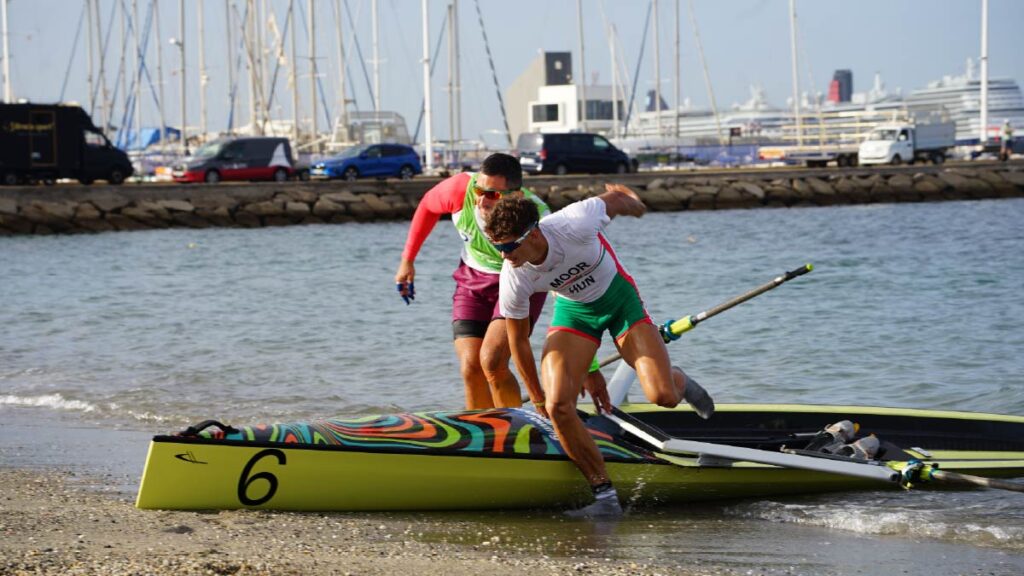
In recent years, Filippi and Swift have split the right to supply boats for the events that will be Olympic in less than two years time—the men’s and women’s solos and the mixed double—which could imply that there might also be multiple manufacturers at LA28. There will be, of course, three events. Perhaps the most politically correct option would be to divide those up equally among the three companies.
Although doing so, and even the diversity of suppliers at worlds in recent years, begins to erode the simplicity and cost savings of pool boats. Talk to athletes and coaches, and you’ll discover that the equipment produced by each manufacturer is not the same. An athlete with the potential to be world champion in a familiar boat may struggle in an unfamiliar one. And while bigger federations might be able to invest in a fleet of different boats to train in, that won’t be the case for everyone.
A bigger concern, and the most tricky one, is that we still don’t know whether beach sprint will remain on the Olympic program for Brisbane 2032 or beyond. Similarly to the LA28 boat decision, we expect to know more next year. Some insiders have a positive outlook. Others do not. Kurt Traer, head coach of the Austrian rowing team, believes that the risk of its potential exclusion extends far beyond beach sprint, too.
“You can like [beach sprint] or not. But it’s an olympic sport and it’s rowing, and it’s 64 athletes competing. If we lose it, we will lose 64 athletes. [Those quota places] will not go back to flat water. We will lose them forever.”
If we lose beach sprint, we lose 13% of rowing’s Olympic quota places. And the overall sport (and industry) will become smaller. World Rowing is sufficiently worried that it’s launching a two-event world series next year in an effort to convince the International Olympic Committee that beach sprint deserves to be at the highest level of world sport.
“We can’t afford to make mistakes,” Gruenbaum says of the critical months ahead for Swift Racing and for beach sprint in general. “This is our big shot. I’m very conscious of the fact that it could potentially be a one-time deal in Los Angeles. We’re going to certainly play our part and try and make it so that’s not so.”
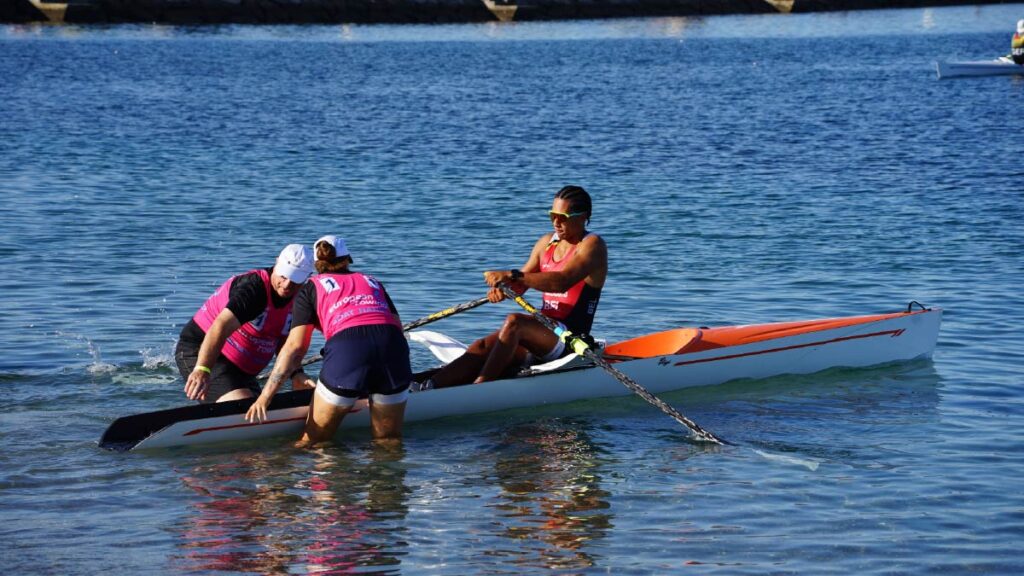
If the sport isn’t in the Olympics in 2032, “it’ll have a big impact,” Montisci says. “[But] World Rowing showed us how much they are interested in beach sprint, announcing the world beach series for 2027 and 2028 in Turkey and China. I think this is the best step that World Rowing can do to show the beach sprint athletes and the beach sprint world that they have their support. [That they want] to grow the movement, to assure the future of the movement.”
Should the IOC decide to skip beach sprint for Brisbane, the investment from national federations and manufacturers is almost certain to drop. Empacher decided to build coastal boats because it will be an Olympic sport in 2028, and Germany only ramped up its interest in beach sprint once they knew there would be Olympic medals at stake.
“We focus on the Olympic boats,” Hinrichs says. “That was the decision made by my boss [Helmut Empacher]. We are waiting for the IOC and World Rowing, for what they decide.” Hinrichs hopes that they may still build some coastal boats, but knows those boats would lose priority and that internal development resources would remain with flat water.
“There’s always a fear in the back of your mind if it will continue,” says Margaurite Deasy from Swift Racing. “But I think [beach sprint] is so exciting to watch and World Rowing have done a superb job with it already. The rush that people get will tell you a lot about the sport. When I think about this deeply, I don’t think there’s any fear of it not continuing.”
And Deasy believes that with or without the Olympics, the sport will go on. “There is nothing stopping this beach sprint train.”
Whatever next year’s critical decisions might be, something is certain about the 15-year—so far—experiment of beach sprint: Rowing will likely never be the same again.
“I imagine [LA28] to have a Wimbledon effect. When everyone sees tennis on the television they go out and buy a racquet,” Hughes says about the hope of seeing beach sprint on the TV or streamed online during the Olympics.
As well as her day job with Swift, Hughes is part of the Lower Thames Rowing Club in the U.K. “When we had the [London 2012] Olympics, we ended up with a hundred new registrations on our club website,” she explains. “I think that we’re going to see that again, but on a much larger scale.”
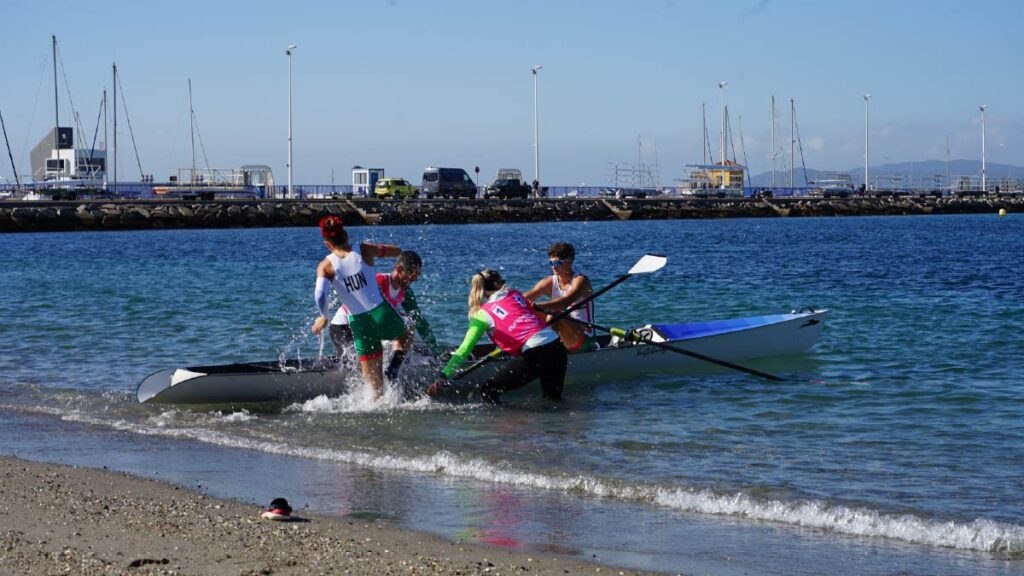
Montisci admits that Filippi’s beach sprint strategy is currently more about surfing the wave of the enthusiasm in the sport than pure economic interests. “We want to stay on the side of the rowers. It’s not only for business. We would really like the discipline to continue,” he says.
Boat manufacturers don’t usually run their own regattas, but with beach sprint’s shift to the ideal of using pool boats instead of rowers bringing their own equipment, that suddenly became possible. In 2020, in the middle of the COVID-19 pandemic, Filippi launched the European Rowing Coastal Challenge, with a beach sprint competition open to national team rowers and an endurance event open to everyone. That ran for three years, and has since become the Filippi Trophy, a four-regatta beach sprint series in Italy attended this last year by more than 30 national teams.
“We have worked hard to organize the Filippi Trophy in order to grow the discipline,” Montisci says. He believes that even with the announcement of World Rowing’s new series, Filippi’s competition will remain an important part of the international calendar. “You need to have lots of people from the youngest to the oldest. And that’s the difference between the Filippi Trophy and the world series.”
Hinrichs says that Empacher’s approach has been to focus on the details. That was one of the reasons they chose to build the top part of the boat, but use Rubenetti’s designs for the bottom, essentially controlling everything that the rowers have direct contact with: riggers, seat, tracks and shoes. Austria’s Magdalena Lobnig has rowed an Empacher single for a long time, and who won an Olympic silver medal at Tokyo 2020 before switching to beach sprint (and winning the 2024 world championship). According to Hinrichs, her first impression of their solo last year was that “it feels like an Empacher.”
But even the German company has been changed by beach sprint. Now in its 103rd year, Empacher has long been known for its distinctive pale yellow boats. It almost never paints boats any other color.
“We have broken with our tradition with the yellow;” Hinrichs says. “On the canvas you’ll see different designs all over the boats. We have 20 to 25 different designs now. We will continue doing that because beach sprint is not traditional rowing. We want to reflect that in the boats too.”
And Gruenbaum, who founded Swift in 2005, believes that beach sprint and coastal rowing have allowed his company to gain an important foothold worldwide. “[Coastal rowing] shows what is achievable when there isn’t a legacy to overcome,” he explains. “We came out early, took a nice position, and so far we’re holding on to that.”
Swift Racing’s ambitions extend far beyond coastal rowing, but coastal may have helped them build up their brand on flat water as well. “I genuinely believe that our racing shells compete with the absolute best. We’ve won medals at under-23s and at seniors, and you don’t do that by fluke,” Gruenbaum says. “[And] when somebody’s happy to row one of our boats, we’re happy to support them.”