
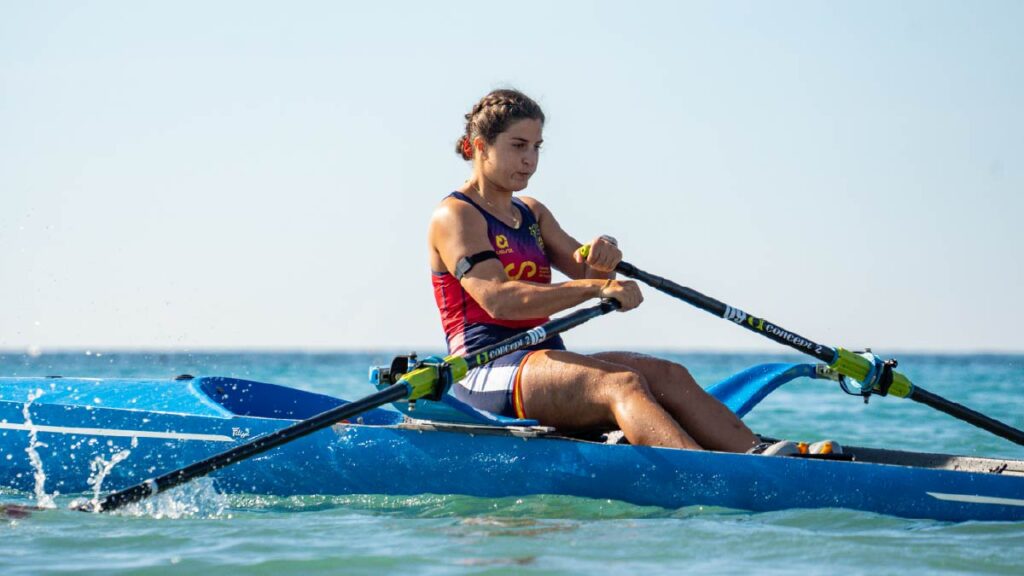
Spain’s Teresa Díaz knows that our biggest barriers to success are often the ones we place upon ourselves. In the semifinals of the women’s solo at the 2025 World Rowing Beach Sprint Finals in Antalya, Turkey, Díaz had to make a choice; she was going up against the reigning world and European champion, Austria’s Magdalena Lobnig.
The Tokyo 2020 women’s single silver medalist had beaten Díaz in the semifinals at European championships on the same beach a month before. In the first of the two semifinals at worlds, Great Britain’s Laura McKenzie had backed off soon after the turning buoy, conceding the win to New Zealand’s Emma Twigg—the Tokyo 2020 gold medalist—while conserving energy for the bronze medal final. And by rowing first, McKenzie would have an extra six minutes recovery over whomever she faced 16 minutes later in that race. By the Beach Sprint Playbook, many might argue Díaz should have done the same. She didn’t.
“Spain is closing, every single stroke on Austria,” said World Rowing commentator Camilla Hadland-Horrocks on the livestream as the two rowers closed in on the shore. “No let up here, she’s not saving anything for her bronze medal match.”
Díaz pushed Lobnig all the way to the beach. When they jumped from their boats, she was just a couple of seconds behind. “I wanted to challenge myself, and see where my limit was,” she says now. “I wanted to think ‘Why not? Why can’t I do it? Don’t question yourself.’”
Sometimes you need to take risks in sports. Like in 2023, when, having already won two world championships in the mixed quad (Oeiras 2021 and Saundersfoot 2022) and a European championship in the women’s solo (Donostia/San Sebastian 2022), Díaz stepped away from beach sprint to pursue a flat-water Olympic dream. Official confirmation hadn’t yet come of beach sprint’s promotion to the program for LA28, but Díaz was aware that Paris 2024 would probably be the last time lightweight rowing would ever feature at the Olympic Games, and with it might go her biggest opportunity in classic rowing.
So Díaz, who was still just 22 years old, and had raced for Spain as an openweight rower the year before at under-23 worlds, joined up with longtime friend and teammate Natalia Miguel. And together they launched a long shot bid to become the first rowers from Real Club Mediterráneo in Málaga to ever reach the Olympics.
“That year was like a transition from being a girl who trained to being a real athlete,” she says. “I wanted to go to Paris, but it was very close and I had just put myself into the lightweight category. It was very ambitious.”
“But from there I learned to make the jump and say ‘I want to be an athlete. I want to see myself reflected in Natalia. I want to be in a boat with her.’”
A little more than two years after missing out on Paris, Díaz is back on the beach for her second Olympic attempt. With just a single quota place available, and with the Spanish team being one of the deepest in terms of both talent and past world championship success, she is fully aware of what lies ahead.
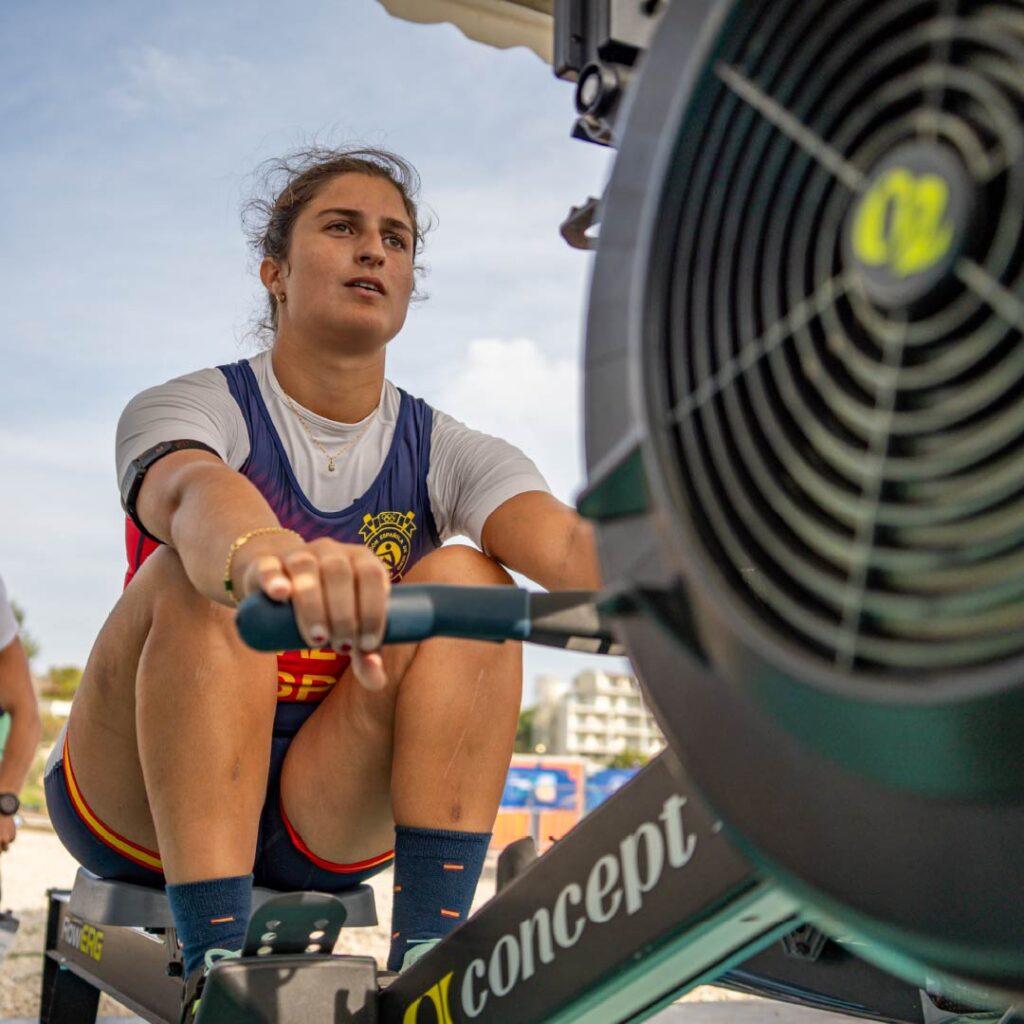
“There’s going to be a lot of sacrifice, it’s going to cost a lot,” Díaz says, leaning on her experience from that lightweight year with Natalia. “But why not try to do it?”
“No. Not: ‘Why not try it?’ But: ‘Why not do it? Why not achieve it? Why put a limit on myself?’ There doesn’t have to be a limit. The limit will be what the clock says.”
Despite her success in beach sprint and coastal—across world and European championships to date: five gold medals, three silver and three bronze—“[classic] Olympic rowing has always been the plan A,” Díaz says. “Until Paris, it was the plan A.”
Still, she has shifted back and forth between flatwater and coastal rowing through much of her career. She first learned to row in flatwater shells, but then began to train in coastal boats as well after her club moved its boathouse outside Málaga’s port. Her first Spanish title came in coastal rowing, in the under-17 women’s double in 2016, but her second came on the flat-water, also in the under-17 women’s double, the very next year.
Díaz picked up seventh place in her first world championship (coastal) at Victoria 2018, in Canada, racing with Natalia’s younger sister, Celia. And the following year, she won gold in the women’s eight and a gold and silver in the women’s pair for Spain at the (flatwater) Coupe de la Jeunesse.
After the return from sport’s pandemic-enforced break, Díaz continued to balance between the different versions of rowing. In 2021, not only did she win her first beach sprint world championship, but she was also crowned Spanish champion in coastal (women’s double and women’s quad), in flat-water (women’s coxless four) and traditional rowing (women’s llaut, an eight-person fixed-seat boat). The next year she repeated her world championship and added Spanish and European titles across beach sprint, flat water and coastal.
But the dream was always to compete internationally in classic rowing, and, of course, to reach the Olympics, and she needed to prioritize that. Following the 2022 European beach sprint and coastal championships, she began to make the switch across to the lightweight category. Athletes often talk of four-year training cycles to prepare for each Olympic Games, but Díaz had a year and a half.
What lay ahead were countless kilometers in the single and the double, mostly on the Guadalquivir river in Sevilla, Spain, one of the main bases for the Spanish national team, but also in the winter fog on the Miño river in Galicia and on the Banyoles lake in Catalunya, the site of the rowing competition at Barcelona 1992. She spent long hours inside on the erg, including on sliders with her machine connected to Natalia’s, and traveled up past the snow line to Spain’s altitude-training center in Sierra Nevada.
Because she would have to weigh in at 60kg or under to be able to race as a lightweight, she also had to learn to measure her food and deal with being hungry. And all while gaining the strength to be internationally competitive as a senior.
In July 2023, just a year before Paris 2024, she raced for her last time at under-23 worlds, coming second in the B final in the women’s lightweight double with Carlota Gonzalez. A month later, she made her international debut for Spain as a senior in the women’s lightweight single, winning the C final at the 2023 World Rowing Championships. At those same worlds, in the first opportunity to qualify the Spanish lightweight double, Natalia, rowing with Rocio Lao, finished ranked 17th.
Not everything was flatwater rowing that year. Coastal endurance training is probably closer to classic rowing training, and so while beach sprint didn’t fit well, she would win a pair of silver medals in Spanish coastal championships, in the women’s solo and women’s quad. At coastal worlds she picked up a third silver in the quad, too, rowing with both Celia and Natalia, as well as Marta de las Heras, another of her longtime club and Spanish teammates.
The following February, Natalia and Díaz finished first and second, respectively, in the lightweight single at Spain’s national team selection regatta, and that April they competed for the first time together in the lightweight double, at a World Cup in Varese, Italy.
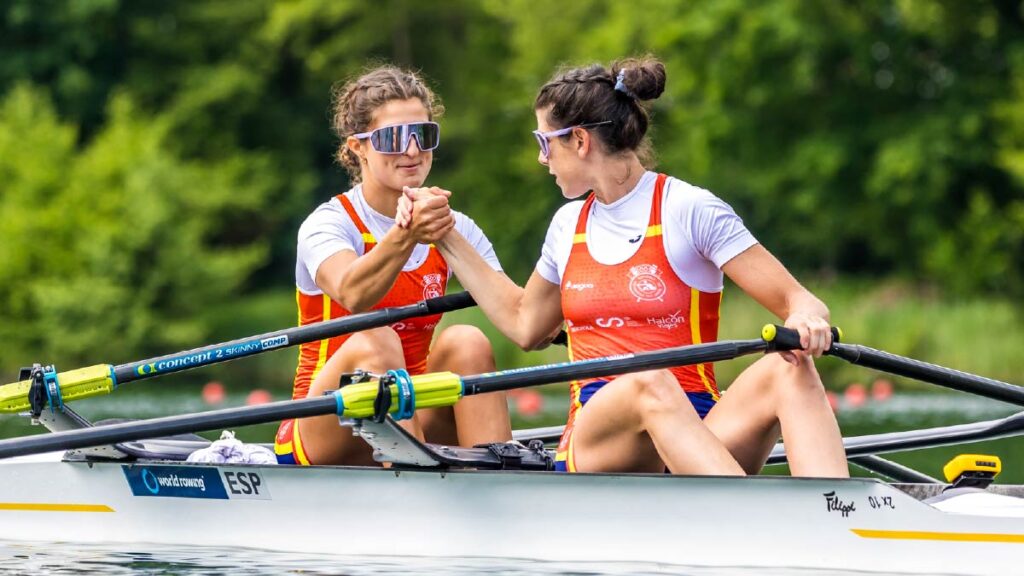
But by then, the last chance qualification regatta was just a month later, in Lucerne, Switzerland, and ultimately, the timeline to switch across to the senior category, compete as a lightweight and make the Olympics was just too short. “If only we’d tried it now,” Díaz says. In Lucerne, they needed to come first or second to qualify, but they finished sixth.
“It was super hard because we didn’t qualify. But with the time that has passed I now see it as something very beautiful,” Díaz says, who explains that she faces every challenge with a smile. “We tried. And the illusion that we had, no one can take that away from us.”
The first time Díaz tried rowing, during a summer camp activity in 2013, she told her mother afterwards that she wanted to switch back to sailing. She didn’t like that first experience in an unstable, flatwater boat. However, she came back the next day. By then she had tried almost every sport available at Real Club Mediterráneo, from tennis and pádel to triathlon, and swimming to sailing, yet had never really found a group to belong to. That summer, and the season that followed, in rowing, she finally found her team: a group of girls and boys as competitive as she was.
She has spent years living and training in Sevilla with the Spanish flatwater national team, but the club in Málaga remains a key part of her identity. “I will always be one of the kids of the club,” she says. “I grew up there. Everyone knows me. When I enter the door of the club, I’m there on a poster. Everyone knows me since I was very little.”
When she went to her first coastal world championships in 2018, she traveled to Canada with some of the kids she’d grown up rowing with: Celia, Javier Madrid and Ramón Gómez. Three years later, Celia and Gómez were part of the 2021 world championship mixed quad, and when they defended that title in 2022, all four of them were in the boat.
“We’ve won two world championships in the quad. It’s been the boat of reference,” Díaz says. “That experience has been really cool, to share it with my friends, with my teammates from the club. We’ve lived it very intensely.”
“The training sessions were super fun. I remember the first time when we stood up in the boat with the oars. When we had to quickly put our feet in the foot stretchers. or when we had to go to the beach and jump from the boat. We had such a hard training session that we almost killed ourselves. But we laughed.”
That trip to Canada was also when she first met coach Sergio Pérez, one of the club’s former rowers who had competed with the Spanish national team as well as in Spain’s professional rowing league. None of them knew that he would end up being their coach, and Díaz had never met him, but she was still a minor, and the club needed a responsible adult to travel with them.
“We were fighting, Celia and I, over the measurement of the oars,” she says. Laughing as she explains how they initially reacted to having an unknown coach trying to change everything. “He wanted to put one thing and we said ‘No. We row with this. We’ve always rowed like this.’ But ‘Girls, the oars are too heavy,’ he said. ‘No,’ we [fought back].”
Pérez would eventually win that argument, and as head coach of her club—and using his oar measurements—would lead Real Club Mediterráneo and Díaz to global success in 2021 and 2022. And though he has switched roles to become head coach of Austria’s coastal team, eight years after they first met, the two are still close. Austria even set up a training base in Málaga this past season, meaning that Díaz and Lobnig have trained side-by-side.
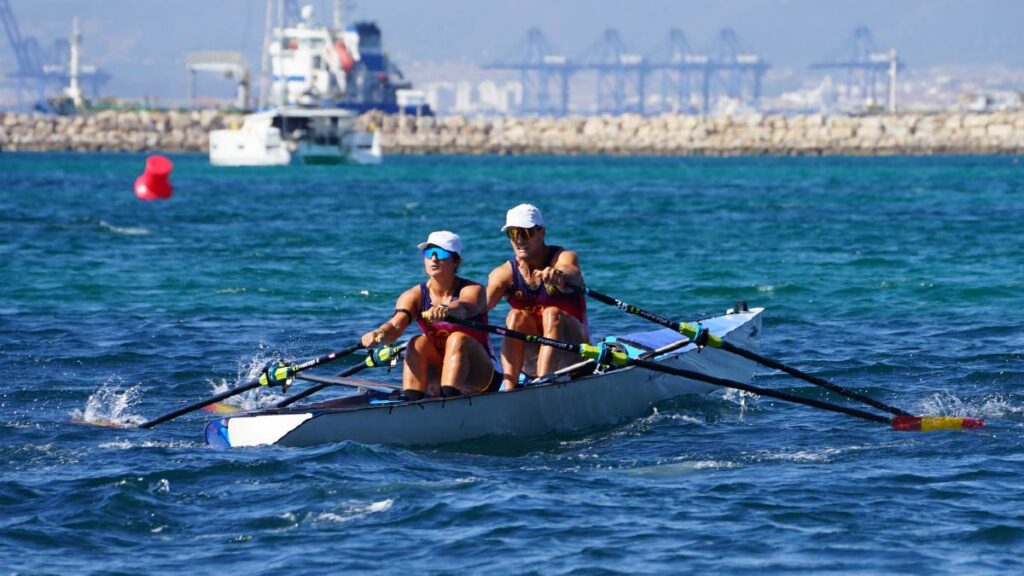
Díaz will race at this year’s World Rowing Beach Sprint Finals in the mixed double with Miguel Salas, who won gold in the under-19 men’s double at Oeiras 2021 and silver in the mixed quad at Antalya 2025. It will be the first time she’ll have competed in any coastal world championship—endurance or beach sprint—with anyone not from her club. But it’ll also be a return to racing in a team boat.
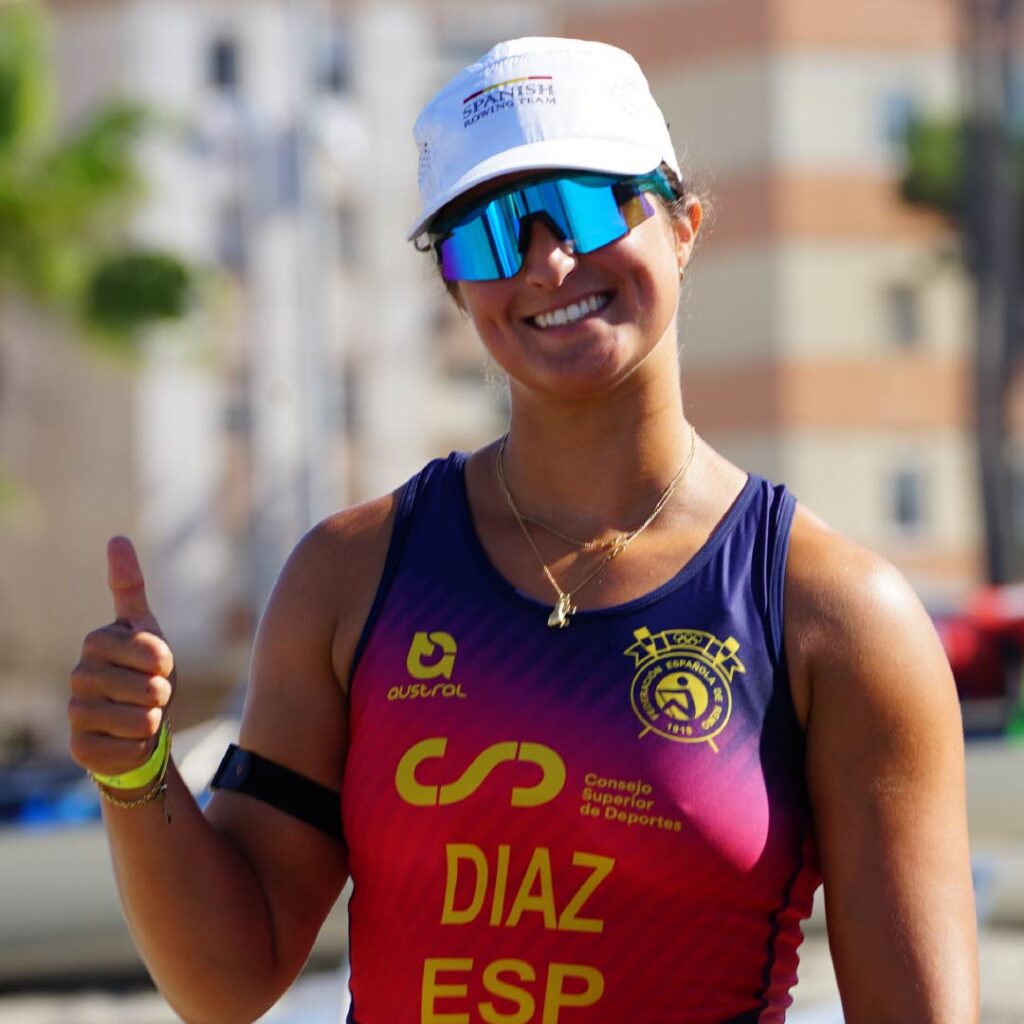
Following that last chance regatta in 2024, Díaz posted on Instagram about the experience, and about everything she’d learned alongside Natalia. When things don’t work out the way you want them, she explained, “after a little cry, you keep smiling, because the beautiful part is enjoying the process and the journey, and being surrounded by people that care about you.”
And a year before, after her final under-23 race in 2023, she wrote that “en equipo siempre es mejor.” (“It’s always better as a team.”)