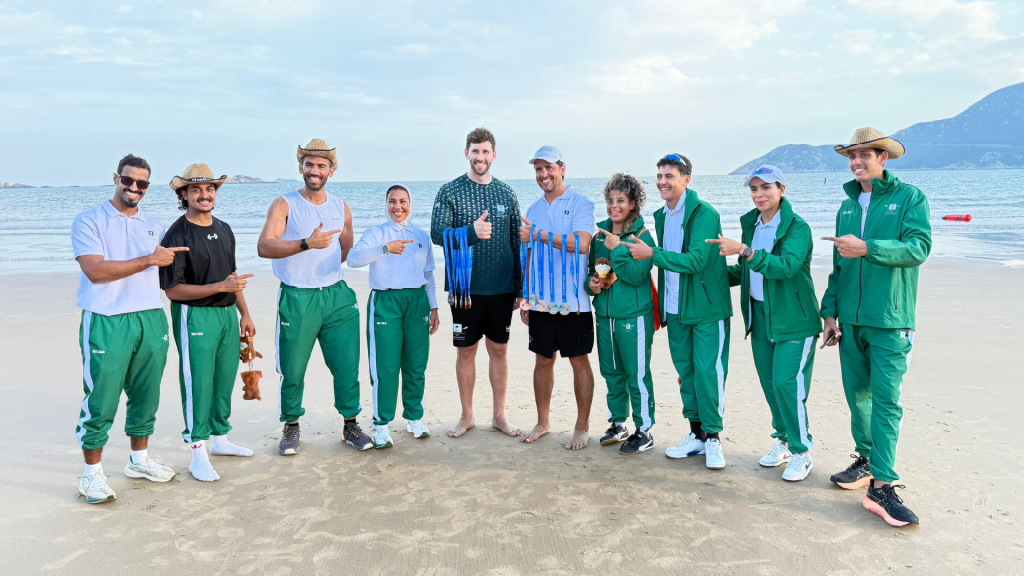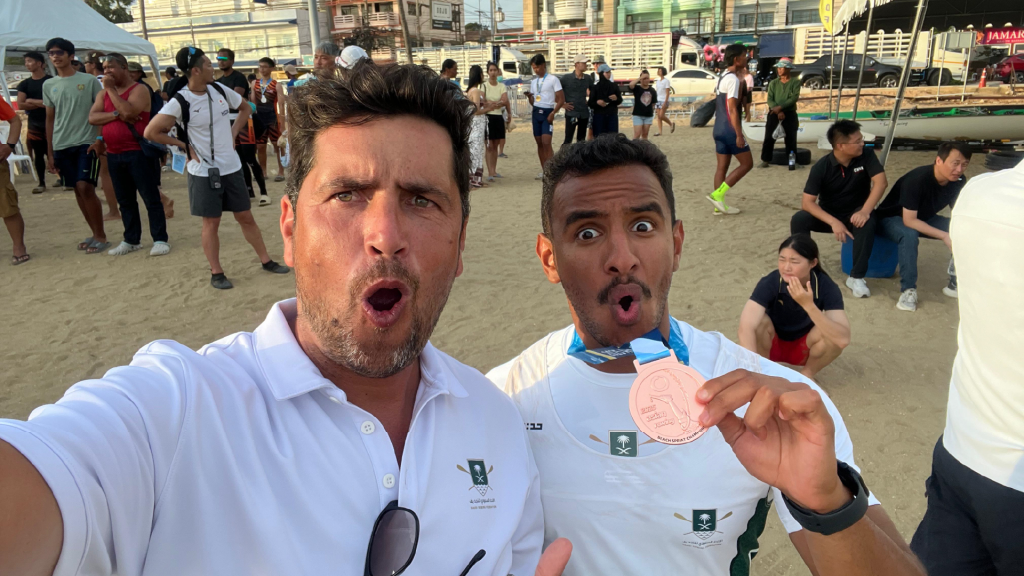
Spend any time with Saudi head coastal coach Fernando Gómez, and he’ll be sure to ask you one thing: ¿Estás contento? Are you happy?
A few years ago, he wasn’t exactly. He was comfortable, juggling three jobs in Málaga (as a rowing coach at Real Club Mediterráneo, a distributor for Jobe Watersports and running a water activity company on the beach during the summer with his brother), but he was anxious for adventure.
“I wanted to leave my comfort zone. In Spain, if I continued as a coach, it was easy to achieve specific objectives,” Gómez explains. “It was a model that I had under control. I knew how everything worked.” In his final season as a coach in Spain, his U17 girls coxed four and U19 boys pair won national championships, and rowers he has worked with from the beginning continued to win international medals in both coastal rowing and beach sprint.
“I needed a challenge. Call it the crisis of the 40s, but I needed a challenge. A country where I didn’t have the same control neither in the language nor the culture, nor the number of rowers, nor the level. Nothing. And for me right now the challenge is to get Saudi Arabia to the top in Asia, to try to qualify for the Olympic Games. This is a challenge. And, sincerely, it is very difficult. But with work I believe it can be achieved.”
In early 2024, Gómez moved alone to Jeddah, on the coast of the Red Sea, to begin working with the Saudi Rowing Federation. His young family wouldn’t join him until that fall, when the four of them—Gómez, his wife Celia, and their sons Román and Fernando—settled in Jubail, on the Persian Gulf. Jeddah and Jubail are the two main rowing training centers in the country.
The performance director and head coach of the entire federation is Matthew Tarrant, a British four-time world champion rower, and the main language of rowing in Saudi Arabia isn’t Arabic but English. Gómez could speak English before moving to Saudi Arabia, but part of the challenge was being able to live and work completely in a language that wasn’t his native Spanish. He’s proud that now his two sons, who attend an international school, speak English fluently and without an accent.
The culture of Saudi Arabia is also distinctly different to that of southern Spain, even though Andalucía has strong historical ties and cultural influences from the Arab world. “When you arrive in a country where you don’t control the culture or the language, you can’t develop your capacities in the same way. As I’ve been able to better understand the mindset of the rowers, the culture and the traditions, I’ve been able to better apply my experience and my knowledge,” Gómez says.
Recruitment has been difficult because of cultural differences, and especially when trying to bring in more female rowers. But this isn’t simply the complication of a difference in women’s and men’s rights in the country.
“The girls don’t know how to swim,” Gómez says. “They don’t like the water. Because they haven’t been taught, because they’ve lived in a town far from the sea, or simply because there isn’t this culture of the water. This is the first barrier for rowing.”
Saudi Arabia has seen significant legal reforms in the last decade that have expanded women’s rights. Among other changes, in September 2017, women were given the right to drive, a month later they were allowed to attend sports events. In November 2018, wage discrimination in the private sector was prohibited, and in December 2019 underage marriage was banned for girls and boys. On 20 February, 2023, the Saudi women’s soccer team played, and won, its first ever international game, and a year later, FIFA appointed the first ever female international referee from Saudi Arabia.
“Now in my training center in Jubail, the boys and girls train together. Something that was probably unthinkable six years ago,” Gómez says.
“I believe that now is the moment to bet on women’s sports,” Gómez says. “More and more they’re open to play sports, to the water, and to competition. But it’s a process that requires time.”
The key objectives for Gómez’s rowers this year are the Asian Beach Sprint Championships this summer, the World Rowing Beach Sprint Finals in Qingdao, China, in October, and the Youth Olympic Games in Dakar, Senegal, in November. Gómez expects his team to spend a significant portion of their summer in Italy, Portugal and Spain, combining training camps with regattas.
“Then in 2027 we have a big objective, which is to try to qualify for the Olympic Games,” Gómez says. The World Rowing Beach Sprint Finals in Oeiras, Portugal, next year will be the qualification regatta for beach sprint’s debut at LA28. “At the moment we’re far away, but we have the tools to achieve it.”
Mufleh Alkhaldi, who will represent Saudi Arabia at Dakar 2026, and will turn just 17 the day those Games begin, is likely to be one of the key hopes to qualify for Los Angeles.
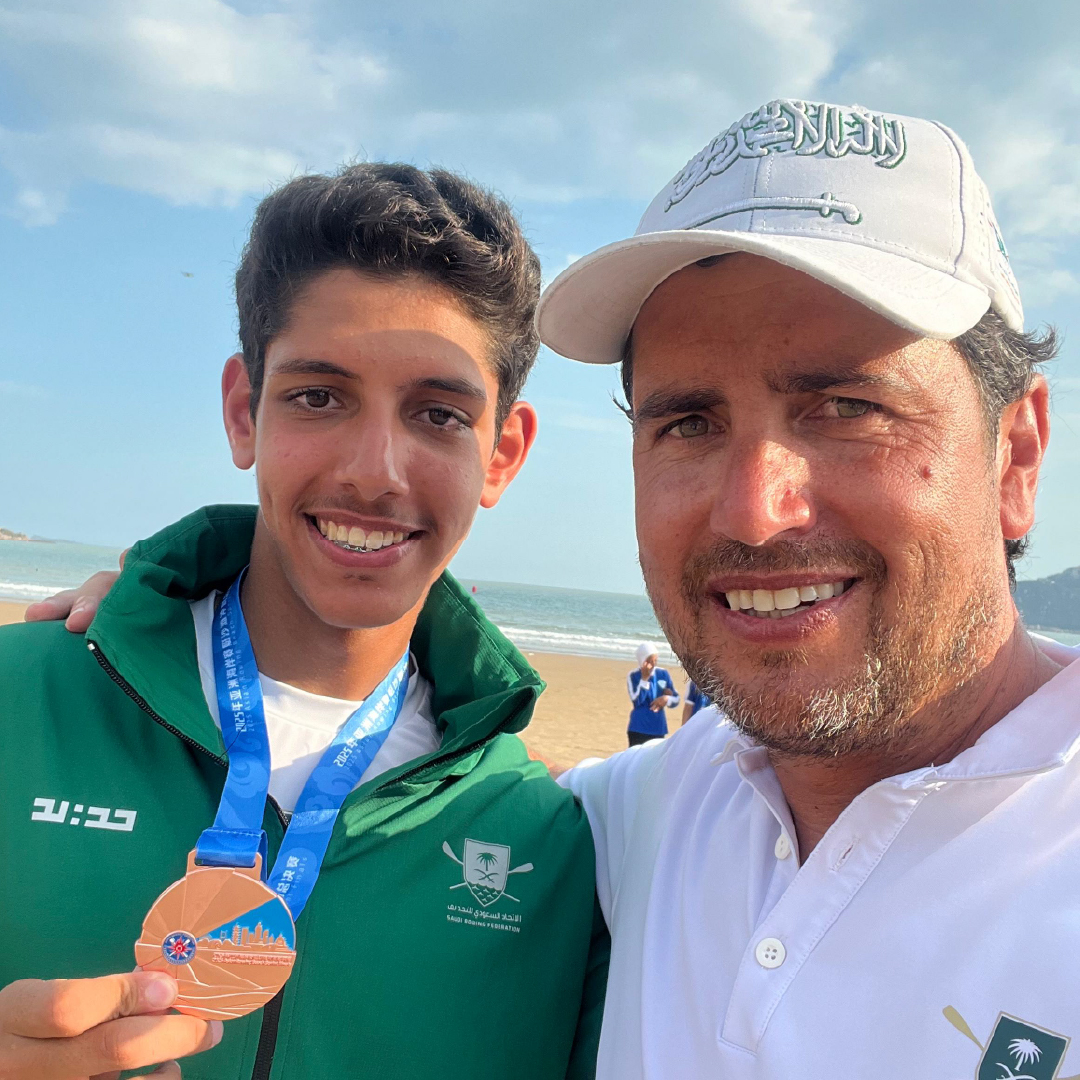
“This kid has a lot of talent, though he only has a year’s experience in rowing,” explains Gómez. Alkhaldi didn’t make it out of the time trials in the U19 men’s solo at the 2025 World Rowing Beach Sprint Finals, but still picked up four key medals over the season. In 2025, Alkhadi won medals at the Asian Beach Sprint Championships (silver in the U19 CM1x and bronze in the U19 CM2x) and at the Asian Rowing Beach Sprint Finals (silver in the U19 CM2x and bronze in the U19 CM1x).
“Now we have a new generation of particularly good kids between 14 and 16 years old, who we recruited last year and now have a base in coastal rowing and in Olympic rowing,” Gómez continues. “The idea with these kids is, in two years’ time, to present them for the U19 Asian championships both in classic rowing and in coastal rowing.”
Beach sprints, and coastal rowing in general, has been promoted by World Rowing as a way to open up the sport to a wider variety of athletes, clubs and countries; to make rowing more accessible, without the need for extensive lakes and rivers and expensive equipment (though while coastal boats are typically more economical that flat-water boats, they are still not cheap). Rowing has featured at 29 Olympic Games, but only one rower from Saudi Arabia has ever competed at that level: Husein Alireza, who reached the quarterfinals at Tokyo 2020.
The Saudi Rowing Federation recently opened up its national beach sprint championships in the hope of attracting competition from elsewhere. Invites for the 2026 Saudi Open Beach Sprint Championships on 6 and 7 February have been sent out to a range of Asian countries, including China, Japan, Kuwait and Thailand. (For information on inscriptions, see the Saudi Open event page.)
The growth that Gómez has seen in Saudi Arabia in the last couple of years is clearly making him happy. But perhaps what is taking place in the country is also an example that World Rowing’s bet on coastal is paying off.
“Last year the [Saudi] federation understood the importance of coastal rowing, and the possibilities we have with coastal,” He explains. “It was the first year we obtained more than seven medals in the Asian coastal rowing championships. This has made history. It has validated what we’re doing for the future.”