
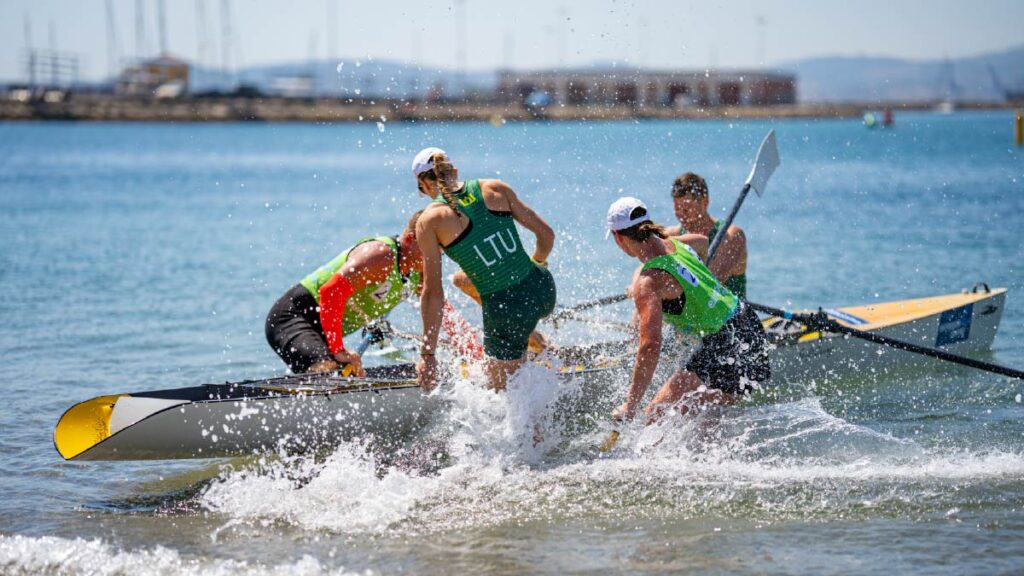
Dominykas Jancionis, who is vying to represent Lithuania at his third Olympic Games in Los Angeles in 2028, admits that when he first raced in the mixed double with Martyna Kazlauskaite, he had serious doubts about continuing any further. That might seem crazy in hindsight—they have now won back-to-back world championships, and have a complete set of medals from Europeans—but he wasn’t sure beach sprint was going to work out.
“We didn’t expect to be first in our first competition at European championships,” he explains. “[And] if we hadn’t won that year, I don’t think we would have pursued further. At least from my point, because I’m old. Not very old in terms of classic rowing, but quite old.”
Kazlauskaite, meanwhile, is 10 years younger, and Jancionis thinks that maybe she would have stuck around longer. But she’s spent this season switching roles between flat water and coastal and perhaps she would have stayed in classic rowing through LA28. With just one women’s quota place available in beach sprint compared to the 22 on offer in classic rowing, her options for reaching Los Angeles could be far narrower in a coastal boat. A month before Kazlauskaite picked up silver with Jancionis on the beach at the recent European championships, she also won bronze with Dovile Rimkute in the women’s double at flat-water Europeans.
Jancionis had raced for Lithuania in the men’s quad at Rio 2016 and again at Tokyo 2020, and has a silver medal and bronze in the same boat from the 2016 and 2020 European championships, respectively. But in 2024, he says, “my flat water results weren’t what I wanted them to be. I thought I would quit rowing entirely. But then Zygimantas and Vygantas invited me to try it.”
Teammate Zygimantas Galisanskis is a year older than Jancionis, and together with head coach Vygantas Virsilas he began experimenting with coastal rowing and beach sprint at the Oeiras 2021 world championships. Galisanskis had picked up a pair of fourth place finishes in the men’s solo at worlds in 2021 and 2023, and won the European title in 2022. So when Jancionis, Kazlauskaite and Raminta Morkunaite joined the team two years ago, the switch across was much easier.
But Jancionis and Kazlauskaite weren’t fully prepared for their first race together, at a beach sprint competition in Kaunas, Lithuania at the beginning of June 2024. And while they would ultimately finish first, and win the right to race at the European championships, they struggled on their starts. Jancionis feared that they wouldn’t be able to repeat that success against tougher competition in Gdansk, Poland, just three weeks later.
In 2021, Mindaugas Griskonis, then recently named president of the Lithuanian rowing federation, pitched an idea to Virsilas. Galisanskis, the reigning Lithuanian open champion, was very fast over short distances in flat-water rowing, but apart from a bronze medal in the men’s single at the under-23 world championships in 2014, he hadn’t had significant international success.
“Maybe you need to try beach sprint,” Griskonis suggested. “Maybe it’ll be an Olympic sport.”
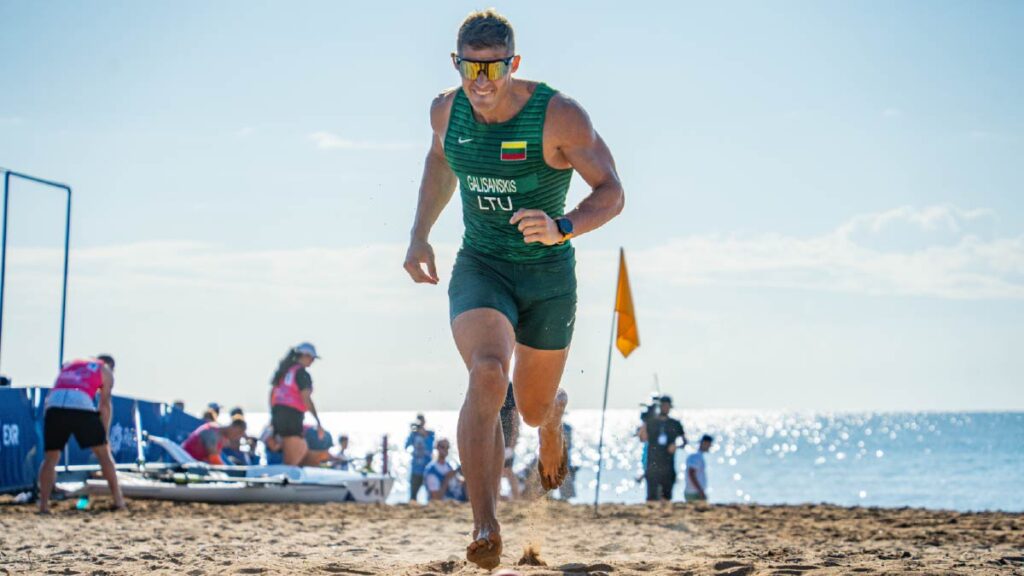
Neither Virsilas nor Galisanskis knew a lot about beach sprint at the time, and there was a lot to learn before their first world championship. “For us it was very hard to understand how to get into the boat quickly. We’d never done that,” Virsilas says. “We started looking on YouTube. How the Italian guys are doing it. How the Polish guys are doing it.”
“At competitions,” he explains. “I would stand every day on the beach and watch how all the teams do it. And then figure out how to do that. It’s not easy to do it safely.”
“It was a lot of training. The whole system, how to do everything.”
Galisanskis finished fourth in the men’s solos in Portugal that first year, but mostly switched back to flat-water rowing in 2022, racing with Jancionis in the men’s quad in two World Rowing Cups and at European and world championships. Then, right at the end of the season, in late October, he travelled out to the European beach sprint championships in Donostia/San Sebastián, Spain. And won gold in the men’s solo.
Unlike some of Lithuania’s bigger rivals in beach sprint, the country has a much smaller coastline, spanning about 262km along the Baltic Sea. The best feature of that short stretch are the beaches. “It is perfect sand, like in the Maldives,” Virsilas says. “It’s almost the same. It is white, nice sand.” The most challenging parts are the weather and water. The summer season is short because the water temperature drops quickly to potentially dangerous levels. This year the team wrapped up training there at the beginning of September because the water was already down to 10 degrees celsius.
“It’s a cold sea,” Virsilas says. “And very hard because the waves can be big but with little time between them, like two to three seconds. In Italy, we have gaps like eight or nine seconds, and we can do the turns safely. But when two waves catch a single boat at the same time, it’s really difficult.”
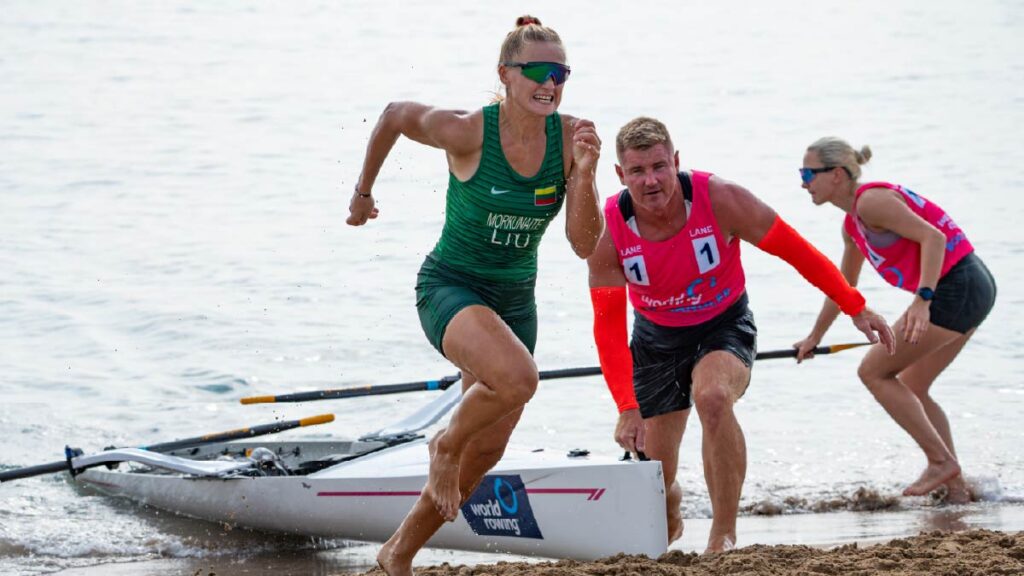
A couple of times over the last few years, they’ve even had to call for help from lifeguards when training sessions have gone awry.
When they know in advance that a competition venue is likely to have relatively flat conditions, such as this year’s European championships in the protected Bay of Algeciras, or the beach planned for the LA28 Olympic Games, they can also train effectively on lakes. “But [the sea] is a good place to have a camp,” Virsilas says. “[The] European championships [in 2024] were in a perfect place for us. We were training in the Baltic Sea. And Poland is in the Baltic Sea. The conditions were what we were used to every day.”
Jancionis and Kazlauskaite beat Great Britain by just 92 hundredths of a second to win their 2024 European title. At worlds that year they had a little bit more breathing room over runner-up Italy, with a gap of 3.58 seconds, but then last year Team USA’s double of Chris Bak and Sera Busse ran them incredibly close. Jancionis and Bak leaped for the line almost simultaneously, and Lithuania took the win by just 24 hundredths.
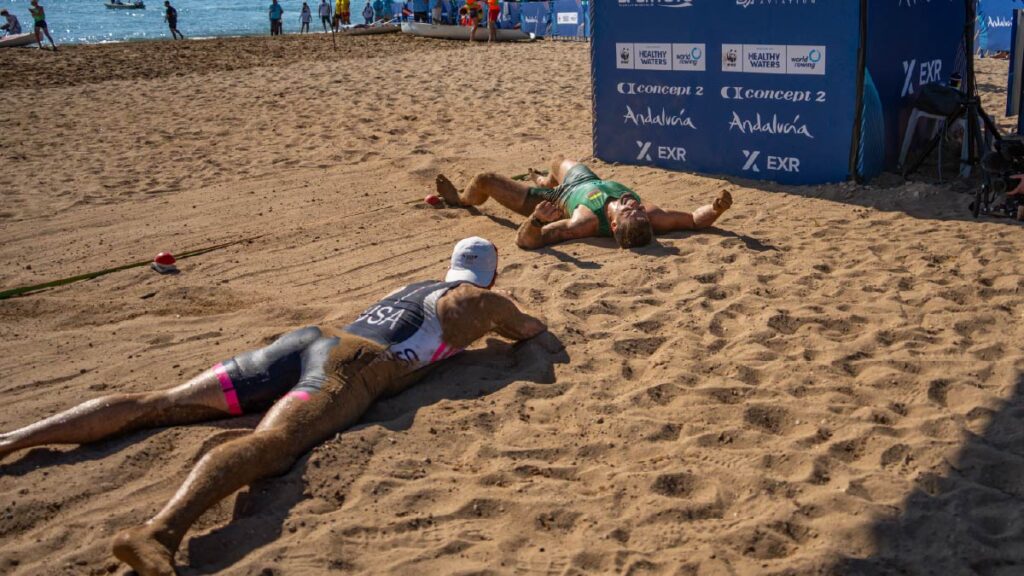
“From first to sixth place used to be a very big time difference,” Virsilas says. “Seven or eight seconds when the conditions were good. Now everyone’s arriving in one second. It’s much faster. Now everyone knows how to get in and how to jump out.”
The level of technical skill among their competitors has also improved substantially. “I remember in our first competitions, when the boat was moving to one side [some teams] didn’t know what to do. Do we need to stop? Do we need to row? And there were many crashes. Now, in the last few years, the adults are going straight. They know how to do everything on the water. It is much safer now,” Virsilas says.
“[Although] for the fans, maybe it is better when there is more crashing.”
In the short history of beach sprint, five complete boats—without lineup changes—have won multiple championships in the same discipline: Tunisia’s Hela Belhaje Mohamed in the under-19 women’s solo, Adrián Miramón and Chris Bak in the men’s solo, the Spanish mixed double of Ander Martín and Esther Briz, and Jancionis and Kazlauskaite’s Lithuanian mixed double. But only two of those have won three, Belhaje Mohamed and Bak, and only the Tunisian rower managed three-in-a-row. Belhaje Mohamed won in 2021, 2022 and 2023, before aging out of the junior category in 2024.
Jancionis understands that achieving that rare accomplishment in 2025 will be tough. While both he and Kazlauskaite are currently the world’s top ranked rowers in the mixed double, they finished in second place at the 2026 European championships and haven’t had as much time as they may have wanted to fine tune everything.
“This year it was kind of tough to change anything because of Martyna going to flat water and beach sprints,” Jancionis says. “We didn’t have a lot of time to make changes. But every year we try to adapt, with new technique, new skills. Trying to improve the time getting into the boat, jumping out of the boat, the turning points, everything.”
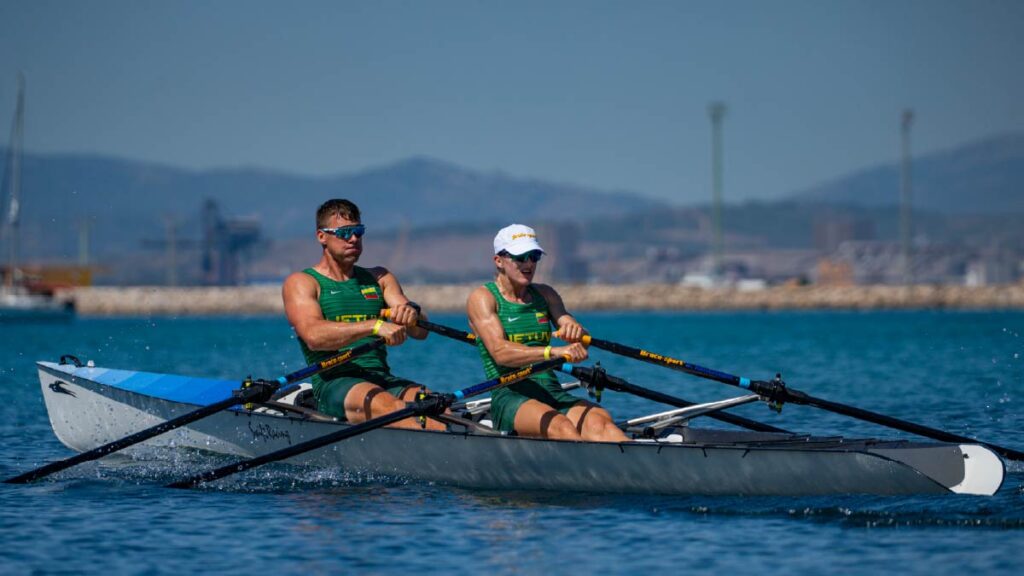
Next year could well be different, with qualification for LA28 potentially starting as soon as the European Games in Istanbul, Turkey, in June, and with national teams needing to make difficult decisions over which athletes will lead that effort.
“In the Olympics it’s only going to be two people,” Jancionis says. “We don’t even know how we will decide who will go to the Olympics. It might not be me, but Martyna. It might not be her, but someone else.”
“I don’t even understand why there are so few people going to the Olympics, only two people. If there would be at least four people, I think there would be a lot more trying to come from flat water. But it’s only two places, one male, one female.”
And beyond 2028 the future for beach sprint remains very uncertain. The senior Lithuanian beach sprint team has been a stable group of four athletes since 2024. Kazlauskaite and Morkunaite are 25 years old—they were born two days apart in November 2001—and are still just getting started. But at some point Lithuania will need to find substitutes for Galiskanis and Jancionis.
“We still don’t know if there will be beach sprint at the next Olympics,” Jancionis says. “I think our federation, and everyone else, is still waiting for confirmation if it will be at the Olympics in 2032. Then I think they will try to develop more youth in beach sprint.”