
Even in 2026, the year of its (Youth) Olympic debut and seventh world championships, beach sprint continues to throw surprises. Conventional wisdom would tell us that the days of switching from flat water and quickly achieving beach sprint success are gone, that you can’t learn the skills and adapt your physiology to this sport in just months, that the top beach sprint racers are increasingly specialists. Tell that to Australia’s Isabella Scammell, whose first ever race was at the fourth round of the 2026 Filippi Trophy in June (eliminated in the time trial in the solo, and in the knockout round in the mixed double), and who is now the reigning world champion in the women’s solo.
German junior Carolina Guerra Gonzalez, Youth Olympic silver medallist in the women’s solo, is another key example. A former swimmer—she won a German under-13 national championship in the freestyle pentathlon in 2022—Guerra Gonzalez switched to flat-water rowing a few years back. Last year she won a national title in the under-17 women’s coxed quad and this past season took silver in the same category. But then earlier this year her coach Thomas Wichelhaus at Ruderklub am Baldeneysee near Essen suggested that she try beach sprint.
Essen is in the western part of Germany, several hundred kilometers from the sea. It has a reservoir, the Baldeneysee, but the closest coastline is actually in the Netherlands. And Guerra Gonzalez’s first experience of beach sprint was at a team selection in land-locked Berlin on the other side of the country.
In July, she would be the only under-17 competitor in Die Finals, the equivalent of national championships, on Lake Steinhude near Hanover—also nowhere near the sea—where she took third place in the under-19 women’s solo (out of just four participants). At the end of August, she raced in the German Coastal Challenge in Zinnowitz against a deeper junior field of 10 women’s solos and six mixed doubles, and this time on the Baltic Sea. There she topped the time trial in the solo and the double, with Dakar 2026 teammate Johann Meyer, and picked up bronze in both.
“The first experience was very chaotic because it was simply very new and much more dynamic,” Guerra Gonzalez says. “And also with the waves that you can’t control. I know the perfection of classic rowing, but in the sea it was simply survive and reach the finish line.”
Both of Guerra Gonzalez’s main rivals in the German national team, Ella-Solene Chave and Anneke Johanna Ihmann would turn 18 before Dakar 2026 and thus be too old to compete at the Youth Olympics. While those older athletes would get to travel to worlds in China, Germany brought its Dakar 2026 juniors to European championships in Spain. However, Guerra Gonzalez’s results in La Línea didn’t hint at what her season would eventually be remembered for. She was eliminated in time trials and her mixed double was knocked out in quarterfinals.
Guerra Gonzalez admits that this year has been a learning experience: “I like to see this progress. It didn’t work well at first, but then I got better.”
Two weeks later, at the Coupe de la Jeunesse in Portugal, Germany combined its Dakar 2026 and worlds teams together, and dominated. And Guerra Gonzalez outshone everyone, picking up gold in both the women’s solo and in the mixed double with Meyer.
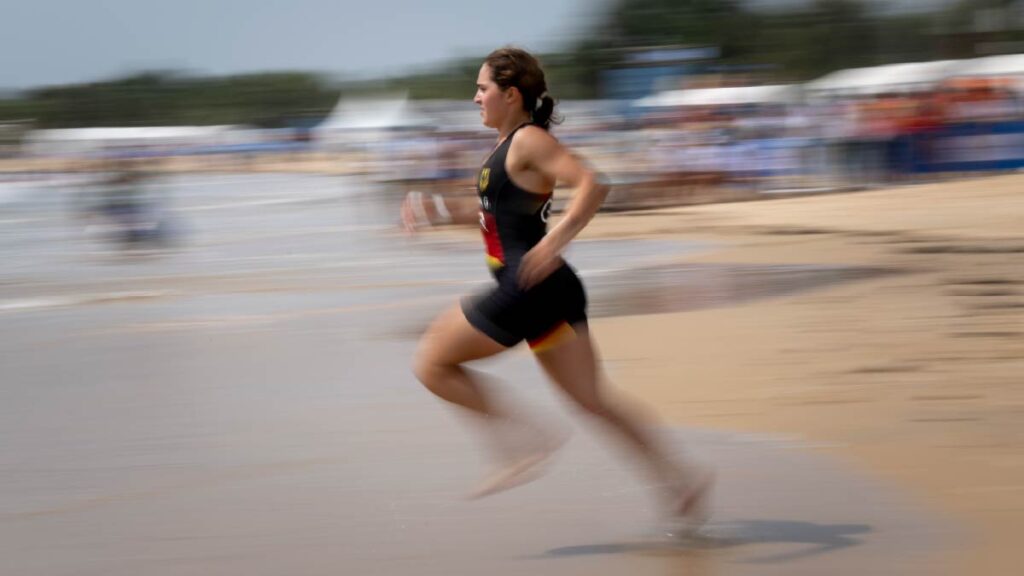
Perhaps the most spectacular finish of Dakar 2026 came in the first quarterfinal of the women’s solo. In lane 1, Switzerland’s Tanya Brendle, who had set the fastest time on the first day of racing, and in lane 2, Germany’s Carolina Guerra Gonzalez.
“I finished in eighth place in the time trial,” Guerra Gonzalez says. “I knew that it was going to be very hard in the following races. I didn’t have a lot of hope. But I wanted to fight.”
The previous day, Meyer was eliminated by Czechia’s Ondrek Zizka in the men’s solo last 16, and Guerra Gonzalez and Meyer’s mixed double, which had been fastest in time trials, was knocked out in a tight semifinal race against Austria. The women’s solos were Germany’s last chance to go home with a medal.
In that quarterfinal, Brendle appeared to be struggling a little with her blade work in the choppy conditions, but she held a slight edge over her German rival throughout most of the race, and was leading as the two approached the final buoy on the way to the shore. The waves were breaking hard onto the beach, though, making the final transition from running to running treacherous. There had already been flips and falls in the men’s races.
“I was a little behind the Swiss girl,” Guerra Gonzalez recounts. “Then a wave came and I knew that I had to catch it. I took the risk and it carried me along a lot.”
At the same time, Brendle passed too close to that final buoy, and had to pause a moment to disentangle her oar. Guerra Gonzalez surfed into a narrow lead, but the wave she was on quickly steepened as it reached the shallows, and she couldn’t keep her boat straight. The stern skidded out towards the port side and the boat ended up side-on to the breaking wave. The boat flipped and dumped her into the water.
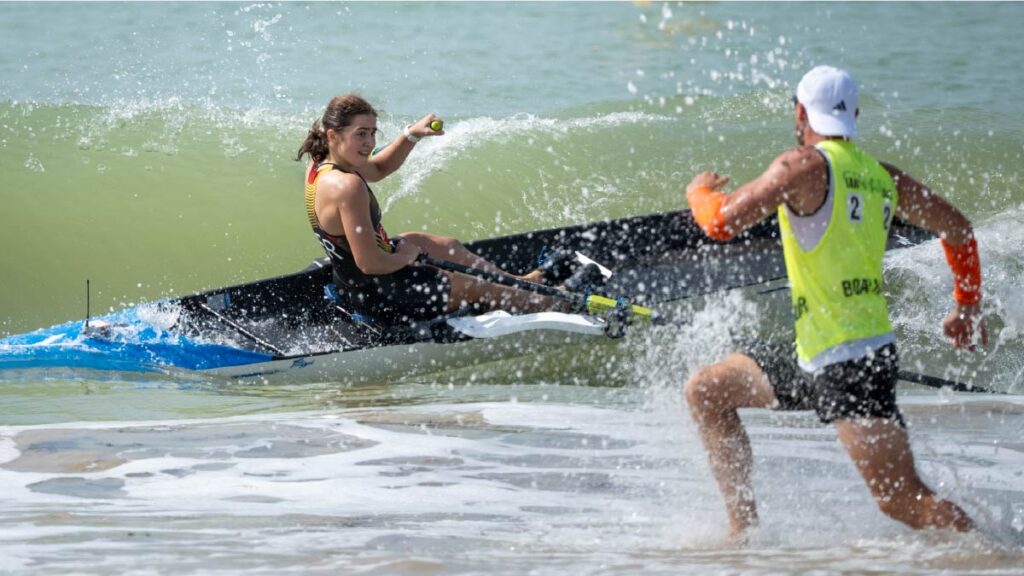
“I was ahead, but then I fell and I don’t know what happened afterwards,” Guerra Gonzalez says. “It was a lot of adrenaline.”
As her boat handlers went to grab the solo, driven by pure instinct, Guerra Gonzalez managed to wade out of the breakwater, run up the sand and somehow still cross the line first. “Winning that race gave me hope for the following races,” she adds.
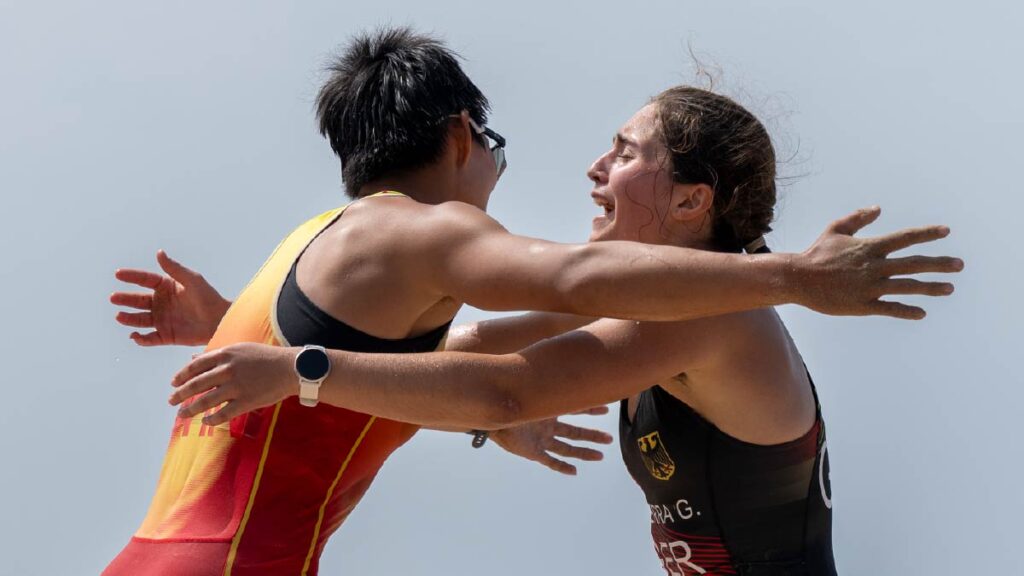
She would go on to outsprint Czechia’s Marie Zavadilová at the end of her semi final to reach the gold medal race against China’s Lili Liu. But didn’t have enough left to repeat that feat against the Chinese rower, and ultimately came away with silver.
German head coastal coach Adrian Bretting has talked previously about the difficulty of attracting junior rowers to coastal and beach sprint, and of convincing their coaches of the value of this discipline of rowing. Perhaps he now has a key ally in Guerra Gonzalez’s coach Thomas Wichelhaus, whose suggestion earlier this year that she try beach sprint has more than paid off. Just eight rowers worldwide can claim to have won an Olympic medal in beach sprint, and one of those competes for Wichelhaus’s club, Ruderklub am Baldeneysee.
Above all, though, the German national coastal team now has a role model in Guerra Gonzalez herself. German juniors have won beach sprint world championship medals before (including this year), and the senior partnership of Franz Werner and Sophie Leupold is now the reigning world champion in the mixed double. But in coastal, just like in flat-water rowing, the Olympics carry more weight than worlds.
Beach sprint suffers in its ability to draw participation because of the very small quotas on offer at Olympic events (Dakar 2026 and LA28). There were just two beach sprint places (one male, one female) available per country in Senegal, and there will be two on offer in the USA. In contrast there will be up to 44 (22 male, 22 female) in flat-water rowing at the next Olympic Games. But the message of Guerra Gonzalez’s silver medal to her German counterparts is clear: You could win one of these too.
Though winning isn’t everything. Perhaps the real message is that you could get to experience all that she has experienced over the last few months. And everything she hopes to experience in the next few years.
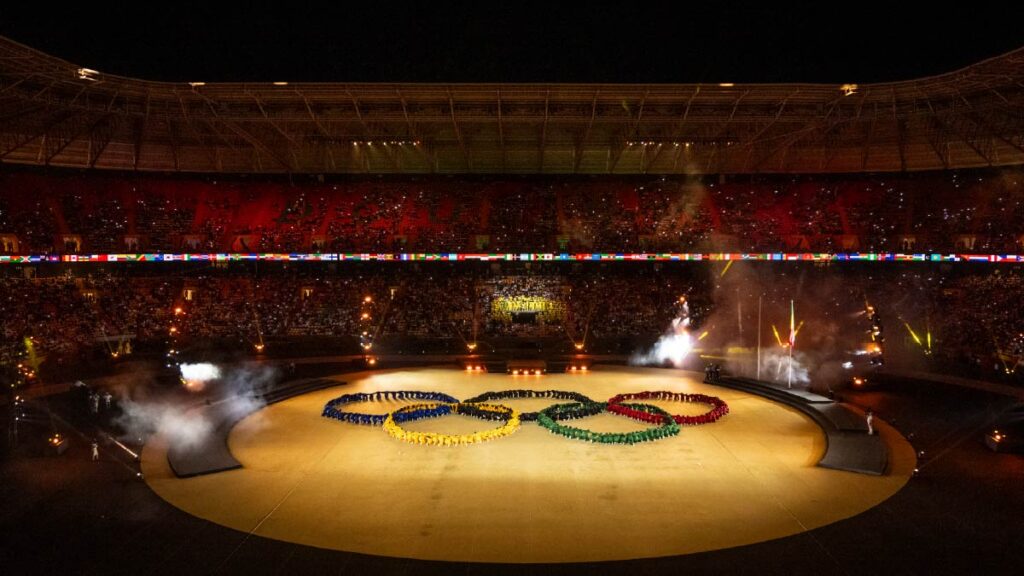
“The thing that I liked most, and that showed me that ‘Wow, this is so much bigger,’ was the Opening Ceremony of the Games,” she says. “To walk through the stadium was a really emotional experience. And to be there, preparing to race in the Youth Olympics, I had the feeling that everything counted more.”
Just a few months ago, Guerra Gonzalez was a complete newcomer to coastal rowing. Yet in an international career lived on fast-forward, Guerra Gonzalez is now the seasoned expert.
“Because it is a very new sport,” she says, “people don’t know what it is. You always have to explain what beach sprint is. But I like to explain it because it is very interesting.”
Now back at home, her thoughts shift from the beach back to the flat water. She might be the most experienced German beach sprint junior next year, but she’s still just 16, which means that she has two full years of under-19 rowing ahead of her. Guerra Gonzalez wants to make next year’s team for beach sprint worlds in Oeiras, Portugal, but she also wants to prove that you can compete in both disciplines.