
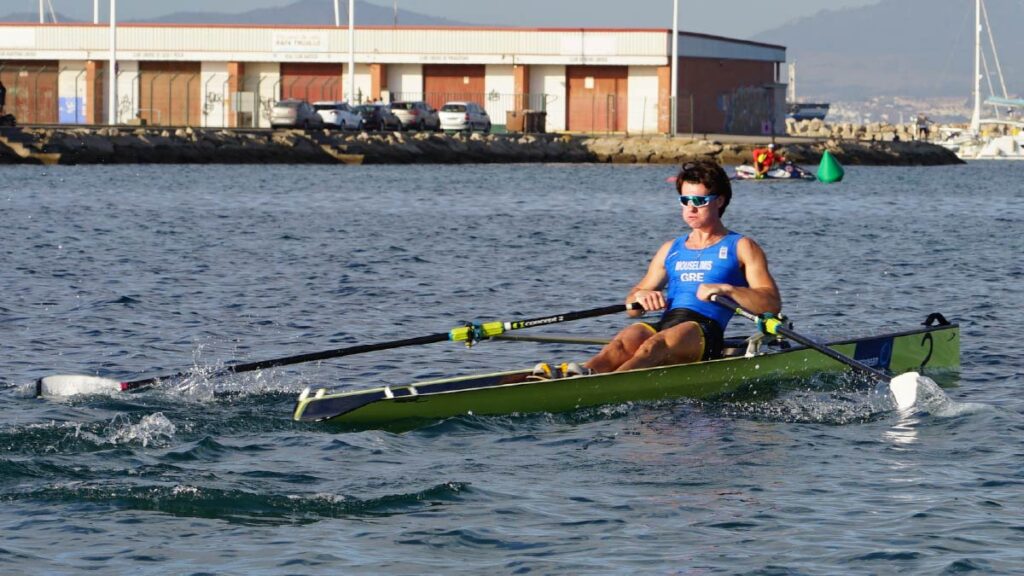
Among the athletes to watch in beach sprint’s debut at the Dakar 2026 Youth Olympic Games will be Greece’s Iason Mouselimis, the Chinese duo of Lili Liu and Juntao Su, and Great Britain’s Lexi Gill. Mouselimis took silver in the junior men’s solo at worlds and gold at European championships this year. Meanwhile, Liu and Su won the world title in the junior mixed double two weeks ago at Qingdao 2026, and Gill picked up gold in the junior women’s double.
Correctly picking the winners and losers before any beach sprint competition is incredibly difficult. In this sport, the waves and the wind can always throw upsets. Doing this in junior categories is surely even more challenging, with rising stars apparently coming out of nowhere, and athletes generally having lower levels of experience than their senior teammates. And on top of that, between one year and the next, the best rowers often age out, adding another level of unpredictability. This is especially true at the Youth Olympic Games, where many of the rowers who secured qualification places are now too old to take part.
At Dakar 2026, birthdates are crucial, and partly explain why we are picking Mouselimis ahead of everyone else. He was born on 21 November, 2008, meaning that he’ll turn 18, and lose eligibility to compete in future Youth Olympic Games, just after the end of competition. His biggest rival at worlds and Europeans this year, Spain’s Xavier Torres, was born on 10 July, 2008, meaning that he’s already 18, and already too old to race in Dakar.
Added to that, Mouselimis has had a standout year. While every beach sprint coach knows that flatwater training can be crucial to developing rowing technique and fitness, many increasingly believe athletes need to specialize and make the decision to focus on coastal or classic. Yet Mouselimis did all he could do to prove them wrong in 2026. As well as his beach sprint success, he is the reigning world and European champion in the junior men’s single.
Two of his biggest challengers on the beaches of Saly, Senegal, could be Italy’s Davide Gazzola and Hungary’s Adam Moor. Gazzola was eliminated in the knock out rounds at worlds, but won bronze in Europe, and Gazzola and Mouselimis didn’t face off in that competition. Moor in contrast lost his semifinal against Mouselimis in La Línea, Spain, and is sure to want revenge. Dakar will also offer a chance to test out the LA28 plan of all athletes in the mixed double racing in the solos, too, and Su will surely be an interesting competitor for Mouselimis. As far as we can tell, the two haven’t come head-to-head this season.
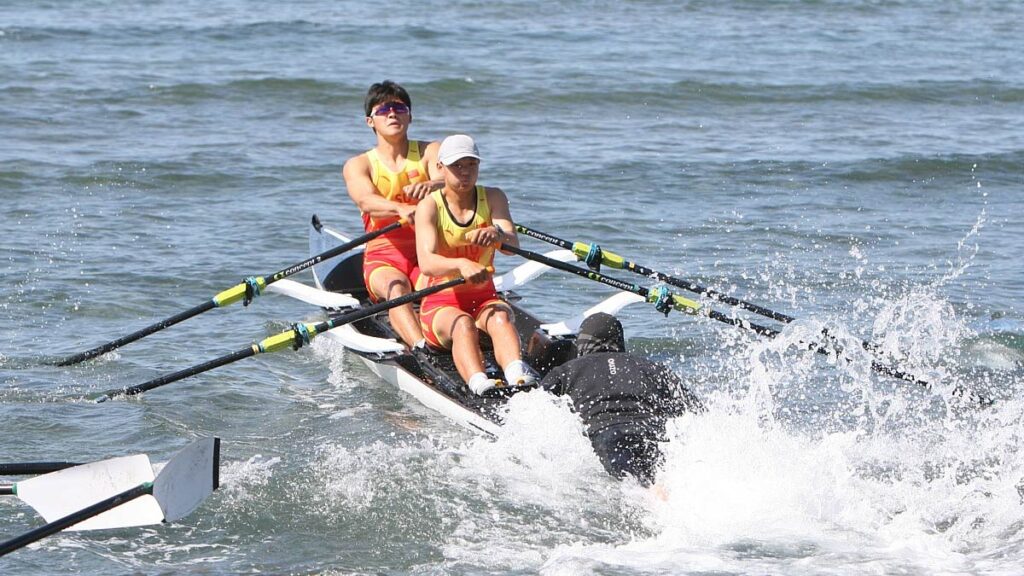
Liu and Su won the mixed double together at the third round of the 2026 Filippi Trophy back in May, but then raced separately at the other two big travel regattas this year. They split the A final in the Filippi Trophy’s fourth round, Liu taking gold with Xu Zhao, and Su winning silver with Lele Li, and finished on the podium in the reverse order in the 1924 Pharoes Trophy in July, this time with Su coming second alongside Jiale Gong, and Liu and Zhao in third. Their home world championship in Qingdao brought them back together, though, and as a partnership they could be tough to beat in Senegal.
Because of the way that qualification works, there will only be 18 mixed doubles in Dakar, out of a maximum possible of 32 boats. With the depth of beach sprint talent still somewhat concentrated within Europe, both the European championships and the Coupe de la Jeunesse beach sprint competition, which took place at the beginning of October, could offer additional insight on who else to watch in Senegal. Both Germany’s and Czechia’s lineups, Johann Meyer and Carolina Guerra, and Ondrej Zizka and Marie Zavadilova, respectively, picked up good results in the Coupe de la Jeunesse, but struggled to impress in Europe. Spain’s Blanca López won gold in the junior mixed double in Europe and bronze in the same discipline at worlds, and we already mentioned Gill’s win in the women’s double in China, but both race with different teammates, Diego Molina and Louie Walker, respectively, in Dakar.
The USA double of Isaac Moos and Allison Grove is less experienced internationally, but Team USA is the second-ranked country on the all-time worlds medal table, and always hard to discount. Tunisia (Iyed Zantour and Sarra Amari) and Egypt (Yossuf Moursi and Alia Ali) are worth keeping an eye on, too. They are the only two African countries with world championship success: Tunisia is sixth all-time and Egypt 18th.
Gill’s world championship gold—in the women’s double—means that alongside Liu she is the rower with the best result this year in the women’s field. Also, like Liu (and Mouselimis) she’s one of the athletes who will age out of the under-19 category at the end of this year. The upside of that is that she may be stronger than some of her younger rivals this week, though the downside for her is that next year she’ll face the senior category.
The women’s solo field, though, is arguably more open than the men’s or mixed double. None of the podium winners in this category from worlds are present, and there’s no clear favorite. López is likely to be among the contenders, and in beach sprint’s short history, Spain has almost always found a way to come home with at least one gold medal from major competitions. In China we also saw Australia begin to live up to its beach sprint potential. Camilla Griffin wasn’t racing there, but at home in the dual Australia/Oceania championships in September, Griffin won four different events in a performance not entirely different to her senior teammate, and now world champion, Isabella Scammell. And add to that list rowers from the mixed double like Liu, Guerra and Zavadilova.
Maybe the experience factor could play in, too. Many of the national representatives at Dakar 2026 only picked up beach sprint recently. Less than half the field have raced at world championships, just 13 have world championship experience prior to 2026, and only two—Cyprus’s Evgenia Maria Polycarpou and Turkey’s Zihni Senih Alatas—raced in worlds as far back as 2024. Polycarpou may have even been the youngest ever competitor in a world championship. Two years ago she was just 14, and she still has two more whole years in the under-19 category.
Or perhaps none of our predictions will come true. We’ve mostly avoided looking at national regattas to pick out the names above, because those competitions are harder to gauge than international races. We’ve also put greater emphasis on the European championships than on other continental regattas because they are by far the most competitive and have the deepest field, and because more than half of the junior semifinal competitors at this year’s worlds were European. But in Senegal, there will be 11 young athletes from across Africa, 10 from the Americas, 10 from Asia and four from Oceania up against the 29 rowers from beach sprint’s European homeland. And beach sprint always seems to have the ability to throw surprises.
Action from the Dakar 2026 Youth Olympic Games will be streamed live on the Olympic Games YouTube channel. The provisional schedule for the beach sprint competition is (all times in UTC):
Saturday, 31 October:
- 10:00-10:30: Mixed double – Time trial 1
- 10:40-11:15: Men’s solo – Time trial 1
- 11:30-12:00: Women’s solo – Time Trial 1
Sunday, 1 November:
- 10:00-10:20: Mixed double – Time trial 2
- 10:20-10:50: Men’s solo – Time trial 2
- 11:00-11:20: Women’s solo – Time trial 2
- 11:30-12:10: Mixed double – Last 16
Monday, 2 November:
- 10:00-10:40: Men’s solo – Last 16
- 10:45-11:25: Women’s solo – Last 16
- 11:40-12:30: Mixed double – Last eight
- 12:35-12:40: Mixed double – Victory ceremony
Tuesday, 3 November:
- 10:00-10:50: Men’s solo – Last eight
- 11:00-11:50: Women’s solo – Last eight
- 11:55-12:00: Men’s solo – Victory ceremony
- 12:01-12:06: Women’s solo – Victory ceremony