
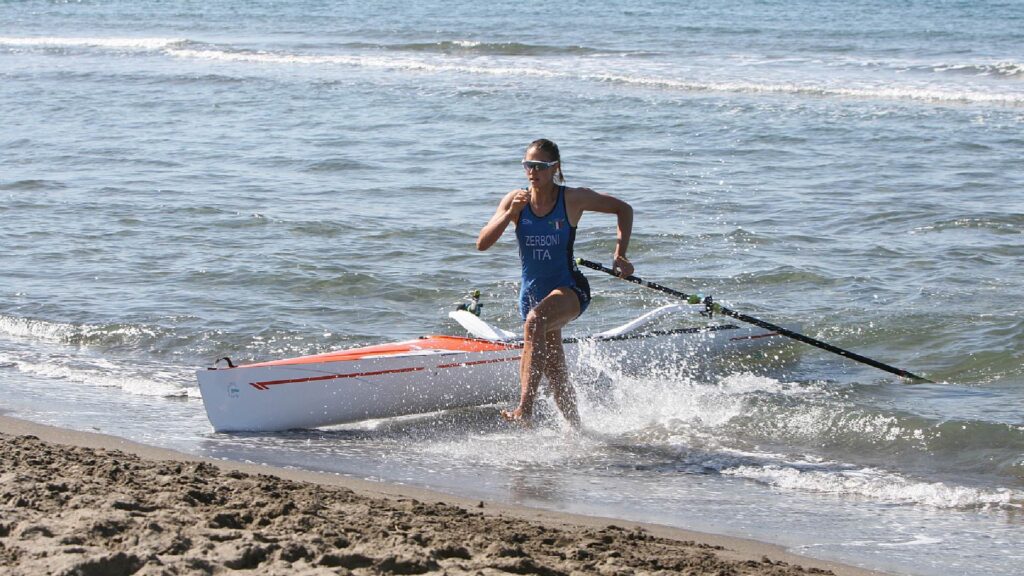
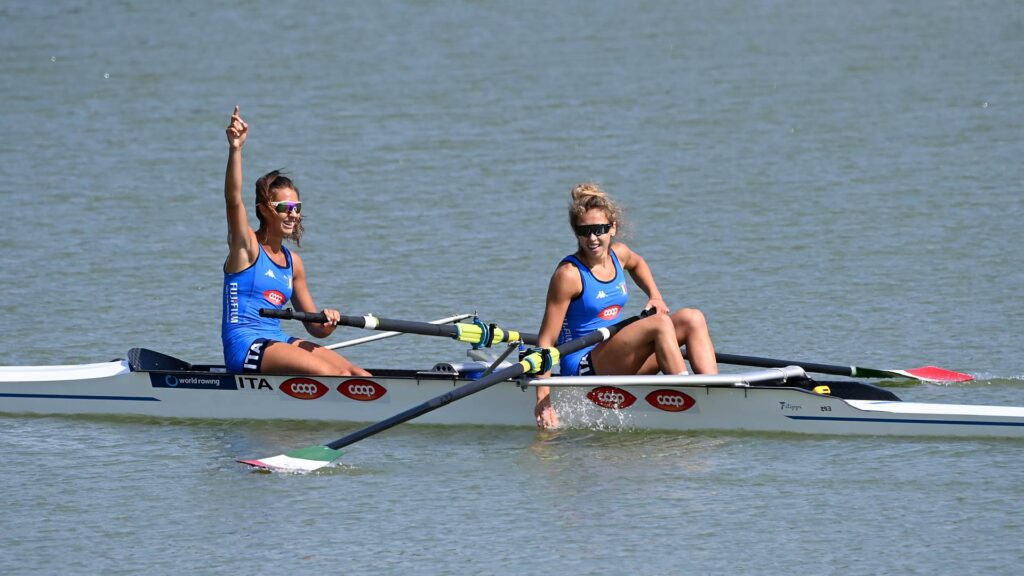
Before lightweight Maria Elena Zerboni switched her focus to beach sprint she had an enviable flatwater rowing resume: four World, two European and a dozen Italian titles. In 2022, she and her lightweight women’s pair partner, Samantha Premerl, even won back-to-back under-23 and senior world championships. But then, in 2023, the year she won her last—to date—world championship gold medal, Zerboni took a leap into the unknown.
“I felt the need to step out of my comfort zone and take on a different challenge, both physically and mentally. Beach sprint immediately intrigued me because of its dynamism and the direct contact with natural elements such as the sea and the sand, which make every race unpredictable,” explains Zerboni.
This wasn’t her first experience with coastal rowing—she won endurance and beach sprint national championships in the women’s quad in 2020—but the learning curve was steep. “It was almost like starting from scratch,” she says. “I had to adapt my technique, improve my balance and develop new skills.”
Flatwater rowing is demanding, but beach sprint also incorporates running, transitions, turns and always changing environmental conditions. And all of that is packed into less than half the time and a third of the distance of traditional Olympic rowing. Beach sprint is explosive, spectacular and intense, and nothing like what most rowers have ever done before.
“I really like the comparison with triathlon because it captures the idea well. Triathlon combines swimming, cycling, and running—three already existing sports—creating something with a precise identity, specific rules and strategies,” Zerboni says. “Beach sprint follows a similar logic: it starts with rowing and integrates running on the sand, wave management, transitions and reading the wind and sea, arriving at a discipline in its own right.”
In 2023, Zerboni won one round of the Filippi Lido Trophy in the mixed double, two rounds in the women’s quad, and national championships in the mixed quad with her club Circolo Canottieri Saturnia. And she also picked up a silver medal in the Italian national team’s mixed quad at world championships. Over the last few years she has added Filippi wins and national championships in the women’s solo, women’s double and mixed quad. She enters the final round of this year’s Filippi Trophy International Circuit in Donoratico the first weekend of June ranked fifth overall in the women’s solos.
Because of beach sprint, she says she now feels a more complete athlete, and not just in a sense of physical preparation but also in being adaptive and able to handle unexpected situations. Almost certainly, her journey over the last few years has made her wiser, too. In March, Zerboni graduated with honors from the Università San Raffaele in Rome with a masters degree in Scienze e Tecniche delle Attività Motorie Preventive e Adattate (the science and technique of preventive and adapted motor activities). Her 141-page thesis: Il Beach Sprint Rowing come nuova disciplina nel panorama olimpico: aspetti tecnici e neuromuscolari della performance (Beach Sprint Rowing as a new Olympic discipline: technical and neuromuscular aspects of performance).
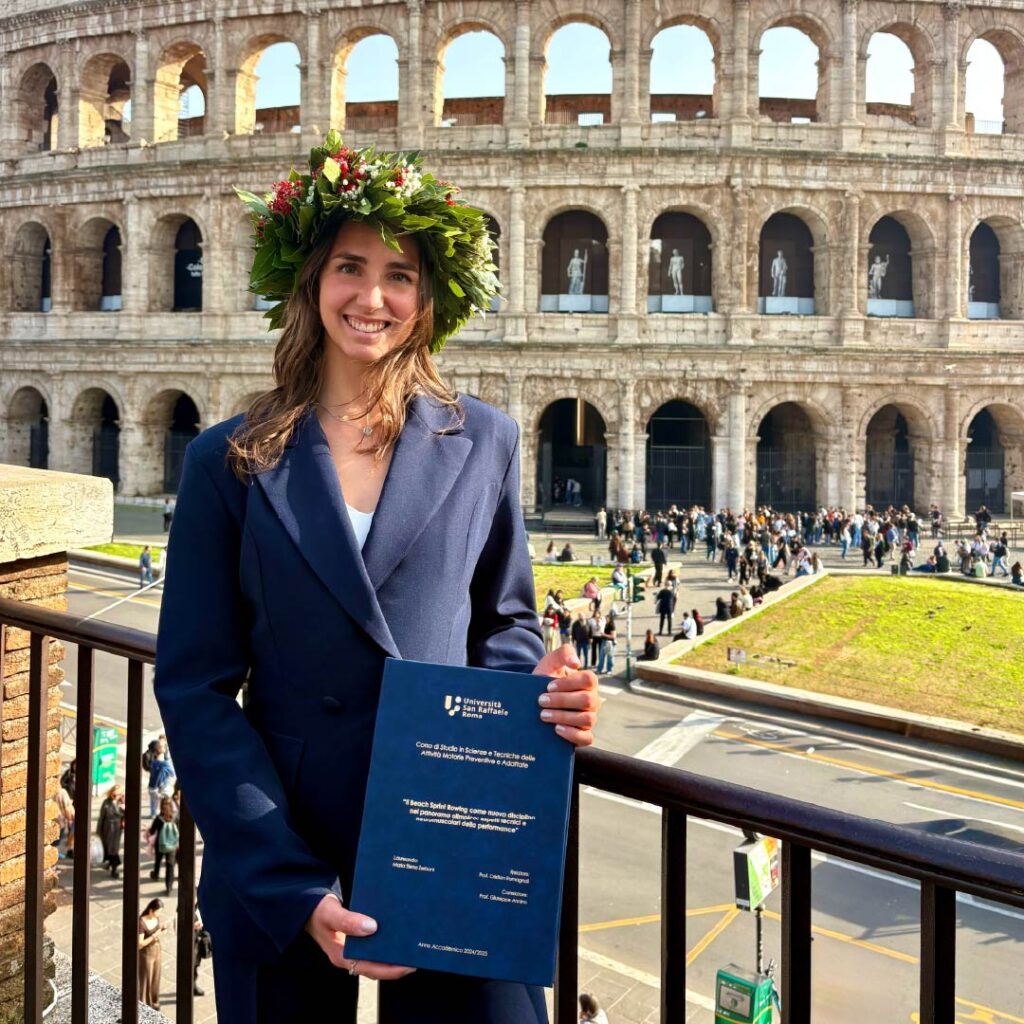
There are still few beach sprint-specific studies which back up everything that has been learned empirically since the first ever race at the Pescara 2015 Mediterranean Games. To help fill that gap, Zerboni’s thesis turns to blogs and articles on the sport, and pulls information from flatwater rowing and surf life saving, and of course from her own lived experience.
Even when Zerboni moved over to coastal rowing in 2023, the sport was highly experimental. “Athletes came from traditional rowing, bringing with them techniques and habits developed on flat water, and applied them to a completely different discipline, often with results that are almost laughable today,” she says. But as more and more national teams have turned their attention to a discipline that will be worth three gold medals at the LA28 Olympics, training, transitions and tactics have become increasingly refined.
Zerboni’s thesis is a call to action to take this sport seriously. “I wanted to demonstrate that [the complexity of beach sprint] deserves respect and attention, even from a scientific perspective,” Zerboni explains. “Beach sprinting is not a secondary or accessory sport, but a complete discipline, with its own biomechanics, tactics, and specific athletic training. And it is precisely this richness that, in my opinion, makes it so fascinating.”
The inclusion of running is perhaps the most unique part of beach sprint. “It is what most distinguishes beach sprint from anything a rower has done before,” Zerboni says. And while the majority of a race still takes place on the water, the initial and final sprints make up around 10% of the total time. “Running on the sand and transitions aren’t just secondary elements; they often decide the race,” explains Zerboni, who devoted a large part of her thesis to running.
The biomechanics of sprinting on sand are poorly studied, and Zerboni believes there is still significant opportunity for innovation in the running phases of beach sprint. Perhaps the sport that has most experimented with and developed the technique of sand running is surf life saving, which includes disciplines such as beach sprinting and beach flags (in which athletes compete to capture markers spread out on the sand), and others that combine both running and water stages. (Surf Life Saving Australia and the International Life Saving Federation launched a campaign two years ago to have their sport added to the Brisbane 2032 Olympic Games.)
Sand is an unstable, shifting and highly changeable surface. The sand on one beach may also react very differently to the sand on another, and wet sand in the shallow water, or if it rains the day of a race, doesn’t behave the same as dry sand. Some beach sprint races, in land-locked regions without access to the sea, even take place on grassy lake shores.
Jumps and different step exercises performed on the beach like high knees, skipping and direction changes can help develop technique and the ability to accelerate fast on soft terrain. Running barefoot is generally better because it helps develop proprioception, the ability to instinctively adjust to changes of terrain. The critical first few steps driving off the start, or when hitting the beach again after jumping from the boat, and the dive for the finish line buzzer all need practice. As does running both on the beach and in the water, and learning how to adjust step length and cadence to maintain speed and control.
“Transforming a rower into a runner means developing specific qualities such as explosiveness, speed, and coordination,” Zerboni explains. “The ideal athletic profile for the running portion is that of a reactive athlete, powerful and agile in movement, capable of accelerating quickly and maintaining speed on an unstable surface. It doesn’t require great endurance in running, but rather the ability to express speed even under extreme fatigue.”
That fatigue kicks in most of all in the final part of a beach sprint race, when a rower jumps from the boat and hits the sand running. Not only do they need perfect timing and coordination in those first few steps into shallow water and onto soft, wet sand, but they must also deal with the fatigue and burn of muscles that have already been working at maximum intensity for more than two minutes.
A beach sprint race “is not linear, but fragmented and intense, alternating between explosive phases and moments of great effort in the water, before returning to running again,” Zerboni says.
That intense muscular activity in the rowing phase burns up muscle energy stores and generates blood lactate faster than the body can eliminate it. Even the most trained athletes can only sustain that extreme pace for a small amount of time before their muscles fail them physiologically or their brain cuts back the effort psychologically. In beach sprint, that wall often arrives in the final run.
“The feeling is of empty legs and little coordination in the first steps, with the body pushing you to slow down when the race demands the opposite,” Zerboni explains from experience. “It’s precisely in that moment that the difference is made, because the winner is the one who manages to remain lucid, technically clean, and capable of expressing speed.”
The other key difference with traditional Olympic rowing, or perhaps with almost any other sport, is the sheer complexity, and related unpredictability, of beach sprint. An Olympic triathlon comprises a 1.5km swim, a 40km bike ride and a 10km run, with two transitions (swimming to cycling and cycling to running) between each phase. The fastest Olympic results came at Paris 2024, when Alex Yee won the men’s race in one hour, 43 minutes and 33 seconds, and Cassandre Beaugrand won the women’s in 1:54:55. Beach sprint packs three transitions (running to rowing, a 180-degree turn and rowing to running) into a race that by the clock is about 40 times shorter. At last year’s World Rowing Beach Sprint Finals, Chris Bak won the men’s solos in two minutes, 33 seconds and 82 hundredths of a second, and Emma Twigg won the women’s in 2:42.70.
“These transitions are not simple changes in movement, but rather true biomechanical transitions of great complexity, requiring intermuscular coordination, extremely rapid activation times, high proprioception and the ability to adjust the distribution of force within fractions of a second. The effectiveness with which they are executed can significantly impact the final outcome of the race, as even small inaccuracies can result in wasted time, slowdowns or difficulty regaining maximum speed,” Zerboni writes in her thesis (translated from Italian).
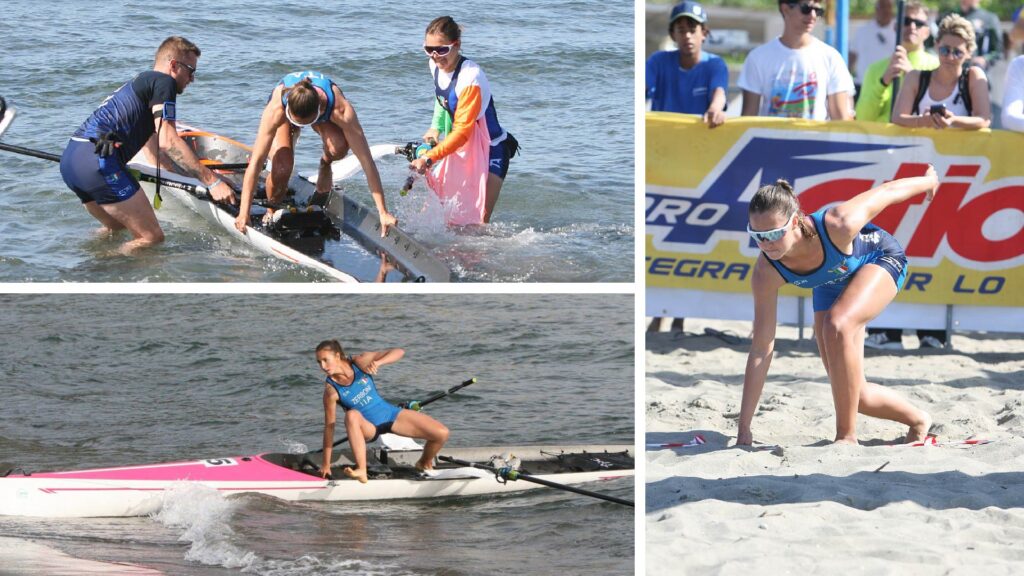
Training running or rowing in isolation isn’t enough for beach sprint, and athletes need to spend a significant amount of time learning and practicing transitions with boats in shallow water or even at rest on the sand. They must also perfect teamwork with their boat handlers, whose role can make or break the entry into the boat after the initial sprint. “In a discipline where margins are often measured in tenths of a second, mastery of these phases represents a specific technical skill as important as running quality or rowing power,” Zerboni writes.
The buoy slalom and turn present critical tactical dilemmas. Do you aim to row as tight as possible to the markers to minimize distance, or take a wider, more fluid curve to maintain speed? Staying close to the buoys carries the risk of impact or, much worse, crossing a buoy on the wrong side. A longer course is more conservative but theoretically slower.
“Optimal course management involves not only the technical execution of the stroke, but also the speed of decision-making when exerting maximum effort,” Zerboni writes ”A trajectory that’s too long toward the buoy, an imprecise turn, or a suboptimal return line can cost precious seconds.”
And then there is the factor of unpredictable weather and the dynamic surface of the sea. The quickest racing line will depend on drift caused by winds and currents, Lane 1 might be affected differently to Lane 2, and waves can both power your boat back to shore on the return leg, turn it sideways, or even, in the worst of cases, flip it over.
“Complexity isn’t just technical, but also decisional. During the race, you must continually adapt to changing conditions—waves, wind, and trajectories—making quick decisions without losing precision. No two races are ever the same, and this makes every situation unique,” Zerboni says. “Even the smallest error, whether technical or trajectory related, can jeopardize the entire race. Precisely for this reason, managing unpredictability becomes a central challenge.”
“From an experiential perspective, it may seem simple and quick, but in reality, those few minutes concentrate a very high physical and mental intensity. You have the constant sensation of being at the limit, with very little margin for error.”
And then, to add to the complexity, there is the ever-evolving ecosystem of beach sprint. Over the sport’s 11-year existence, almost everything has changed. At every major race, one team will invariably show up with an innovation that everyone else will quickly attempt to copy: new running biomechanics, new boat entries, new ways to signal from land to rower, new techniques for the 180-degree turn. Behind the scenes, coaches are turning to GPS, biometric and oarlock sensors plus drone footage to better analyze their athletes. And new national teams seem to be arising almost daily.
“I don’t think we’re entering a stabilization phase at all. On the contrary, I believe we’re still just getting started,” Zerboni says. “With the official inclusion in the 2028 Los Angeles Olympics, resources, scientific research and attention that have been limited until now will arrive, and this will further accelerate the discipline’s development.”
Zerboni hopes to be part of that evolution. She says she wants to follow up on the research from her thesis, and has also felt empowered recently by the opportunity to teach and share her knowledge with students. But elite competition is still her focus. “My priority remains competitive activity: my goal is to continue competing internationally and further develop my skills in beach sprinting. It’s a rapidly growing discipline with enormous room for development, and this deeply fuels my motivation and desire to remain competitive over time.”
After all, perhaps there is no better laboratory than the beach.