
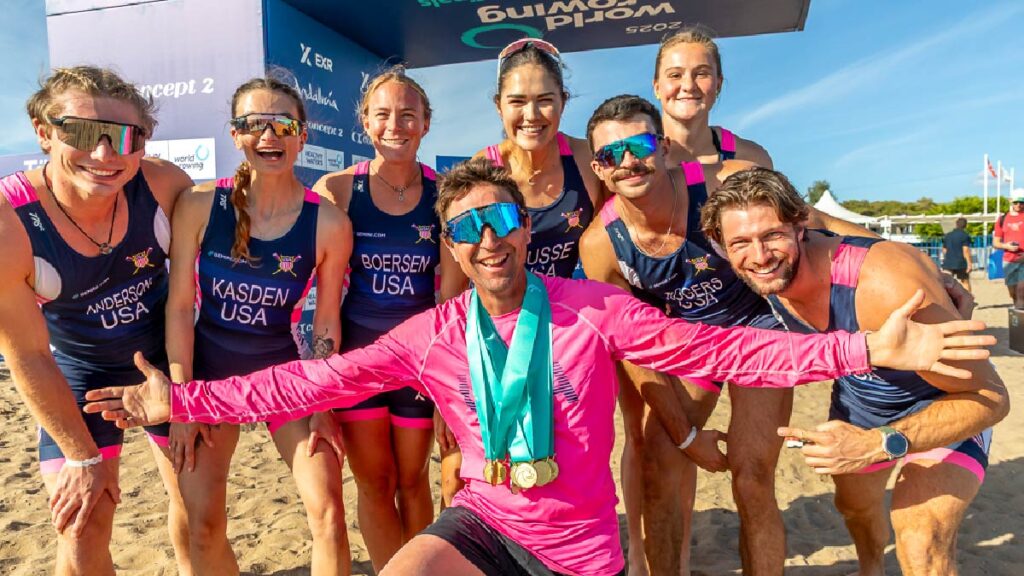
As a rower, Marc Oria missed the beach sprint boat. He grew up in Barcelona, Spain, back when World Rowing was still known as FISA, and long before the global federation invented the sport’s newest Olympic version. As a coach, though, Oria has been the driving force behind the success of the USA’s beach sprint national team, and a key World Rowing ally in the push to grow the sport globally.
“I never raced beach sprints, but I did a lot of coastal,” Oria says. “In Barcelona, basically the summers for us were racing traditional boats like the fixed-seat llauts and the [sliding-seat] yolas. These involve a lot of turns all the time and that’s why Spain is so good in turning and racing these coastal events. We would go to France in the 1990s and in the 2000s to race coastal endurance regattas like Marseille-Cassis, that was part of our summer. But I never practiced beach sprints.”
Oria learned to row at Reial Club Marítim Barcelona in 1990, aged 12, and would go on to race with the Catalan regional team from 1998 to 2007 and the Spanish national team from 1999 to 2002. He took his first steps into coaching at Marítim, too, and even rose to become the club’s director and head coach in 2007. His academic career, though, soon began to take precedence.
After completing a Ph.D. in neuroscience from the Universitat Autònoma de Barcelona in 2011, Oria moved to the U.K. to pursue a post-doctoral fellowship at University College London. There he switched his athletic focus from rowing to mountain biking, triathlons and ultrarunning. A year later he moved again, to Cincinnati Children’s Hospital in Cincinnati, Ohio, in the U.S., more than 700km from any coastline, and a long way from the summer coastal rowing regattas of his childhood.
Rowing in the USA was at a scale he’d never seen before. Youth clubs might have hundreds of athletes, and many row, in part, for the dream of a college scholarship that might pay their way through university. Top university rowing programs have boathouses and fleets that outstrip many of the world’s national teams. In Spain, children begin rowing aged 10 or 11, and some as early as eight years old, but in the U.S., rowers don’t usually pick up the sport until four years later at high school. And while Spanish rowers start in small boats, because of the size of U.S. teams, athletes typically learn in eights; some may never even learn to scull.
“One of the biggest differences that I saw, and it fascinated me, is that I only rowed my entire life for one club in Spain. I never imagined rowing for another club. My main goal was to make the regional team and to make the national team, but I always wore the same uni my whole life,” Oria says. “In the U.S., it’s way different. You row in a club, you row in college, then you transfer to another one, and then you go to a high-performance program.”
“I don’t know if it’s true or not, but I have the feeling that rowing in the same environment, with the same coaches, the same style, that we had that care for the athlete that we are sometimes missing in the U.S.”
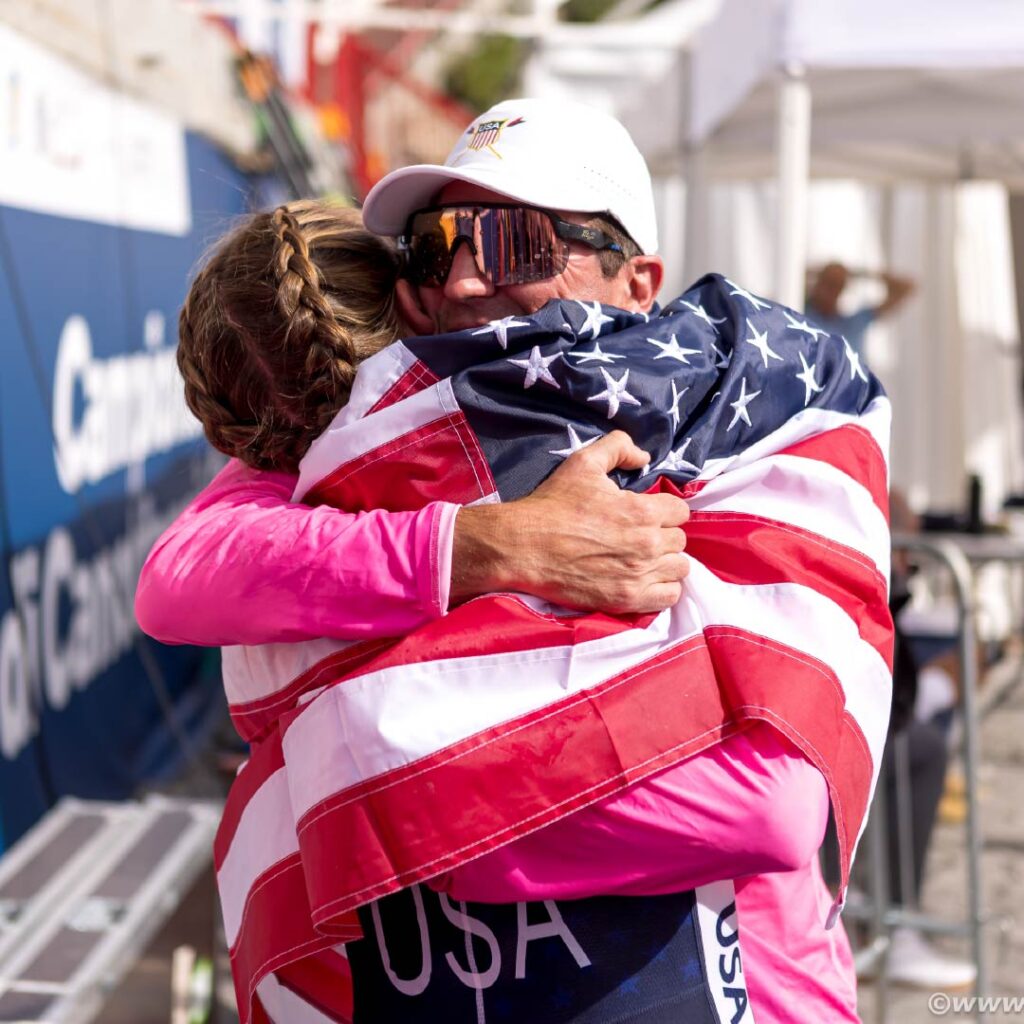
Oria’s story is perhaps an immigrant story. He built a new home a long, long way from where he grew up, adapting to the way of life in the USA, becoming an American but without entirely losing his Spanish roots. He became an assistant professor at the University of Cincinnati, where he is currently investigating therapies to treat spinal-cord injuries and radiation-induced brain damage, and found a way to balance that with coaching. He was named USRowing’s Man of the Year in 2023, and was a finalist for World Rowing’s Coach of the Year in 2025. And while as an elite Spanish rower he never fulfilled the Olympic dream, as an American coach he finally will.
Los Angeles secured the 2028 Olympic Games on 28 August 2015, coincidentally exactly the same day that the first ever beach sprint competition began, at the Pescara 2015 Mediterranean Beach Games. When World Rowing and the International Olympic Committee subsequently confirmed in 2023 that beach sprint would make its Olympic debut at LA28, the USA was all-but guaranteed to compete—host countries more or less qualify automatically across all sports—. But the fact that Team USA seems certain to be among the early beach sprint favorites may be in large part thanks to the fact Oria decided to take up that post-doc in Cincinnati more than a decade ago.
The Cincinnati Children’s Hospital is part of the University of Cincinnati, and alongside his research commitments, Oria also became the head coach of the Bearcats varsity women’s team in 2016. Over three seasons with the university’s club team, Oria’s athletes would win one gold, one silver and two bronze medals at the American Collegiate Rowing Association’s national championships. There he also first met hometown kid Christopher Bak, who had enrolled as a freshman in 2015.
Bak was a lightweight who had switched from playing tennis to rowing after watching the regattas at the London 2012 Olympic Games. He would go on to set the Bearcats’ lightweight 2,000m erg record in 2017 (6:15.9) and the open 6,000m erg record in 2018 (20:15.7, though he’s now in second place). Bak dreamed of competing for Team USA as a lightweight, but when he didn’t make it through the repechage at U.S. Olympic Trials in February 2021, Oria suggested trying something new: beach sprint.
That year, Oria launched the U.S. beach sprint team from scratch, and with limited support from the national federation. USRowing did create a trials regatta to help team selection, but pretty much everything else was up to Oria. “It was me searching for athletes, desperate,” he explains. “Calling athletes that I knew around the U.S. to put a team together, a squad to go to worlds.”
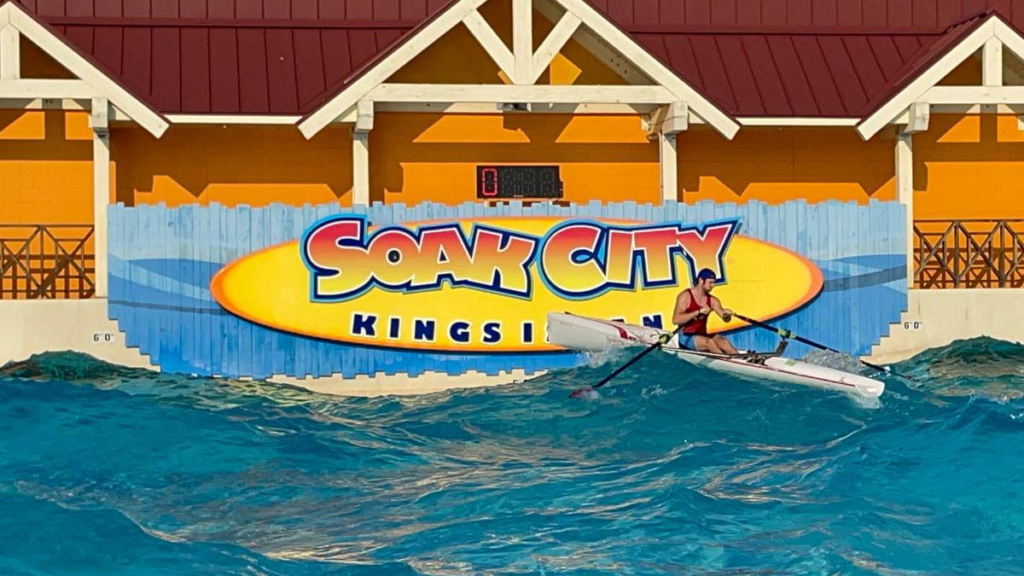
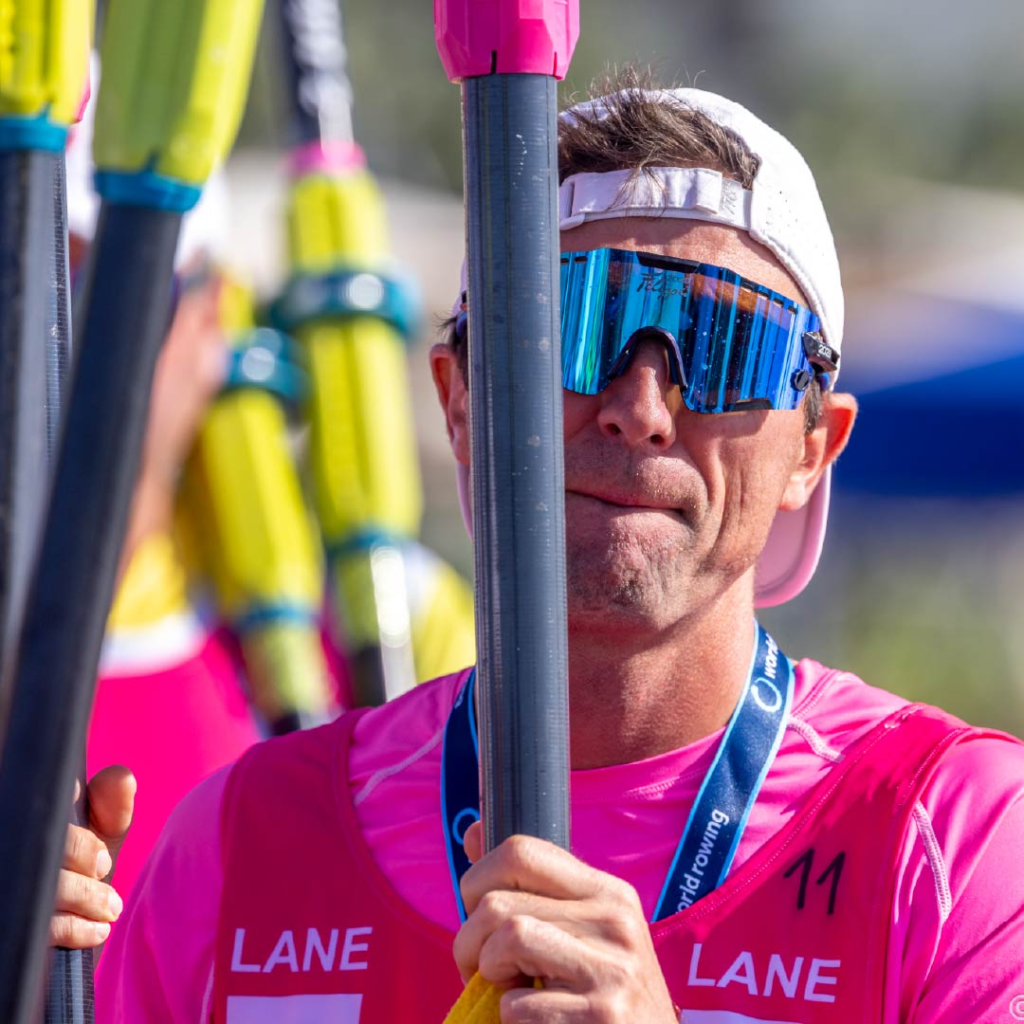
Team USA hadn’t taken part in the inaugural beach sprint world championship, in Shenzhen, China, in 2019, and was at a disadvantage to teams like Spain and France that had, and that also had a long history of coastal rowing. But beach sprint was still very much in its most experimental phase, and that suited Oria’s background perfectly. An academic researcher, he was used to developing hypotheses, testing them and using the results to innovate. He theorized that pink might be an easier color for athletes to see at a distance, and now not only do he and his boat handlers wear pink, but the U.S. unis even incorporate the color. And before 2021 worlds, he sent Bak and Cassidy Norton out into a theme park’s wave pool to practice their skills.
The sample population for many of Oria’s experiments consisted of himself, his daughter Marina and Bak. Marina was a freshman on the Indian Hill High School swim team in Cincinnati back in 2021. This fall she’ll begin her junior year at Case Western University in Cleveland, Ohio, where she is studying biomedical engineering and competes on the women’s swimming and diving team.
“The three of us, my daughter, Chris and myself were the lab rats for everything I’ve tried,” Oria says. “I don’t put anything out there to any of my athletes that I haven’t tried. I’m 48 years old, but I try to do the workouts with them. I do every single movement with them. I do the training with them as much as I can. If I change anything in the diet, if I change anything in their training, I do it first.”
Oria’s team came home from the 2021 World Rowing Beach Sprint Finals in Oeiras, Portugal, with a pair of medals, silver in the mixed quad and bronze in the under-19 mixed double. But Bak, who was fastest of all in the first time trial, crossed the turn buoy on the wrong side in his quarterfinal against Italian Giovanni Ficarra. By the time the American looped back around, he was out of the race, while Garibaldi went on to win the world championship.
On that same international trip, Oria also raced together with his athletes and U.S. coastal guru Ben Booth in the men’s quad at coastal worlds. Less than a year later, in July 2022, Booth and Oria founded a high-performance coastal rowing club that was split between Cincinnati and Dartmouth, Massachusetts. (The two would later publish a guidebook to coastal rowing and beach sprint in 2025: Ride the Waves.)
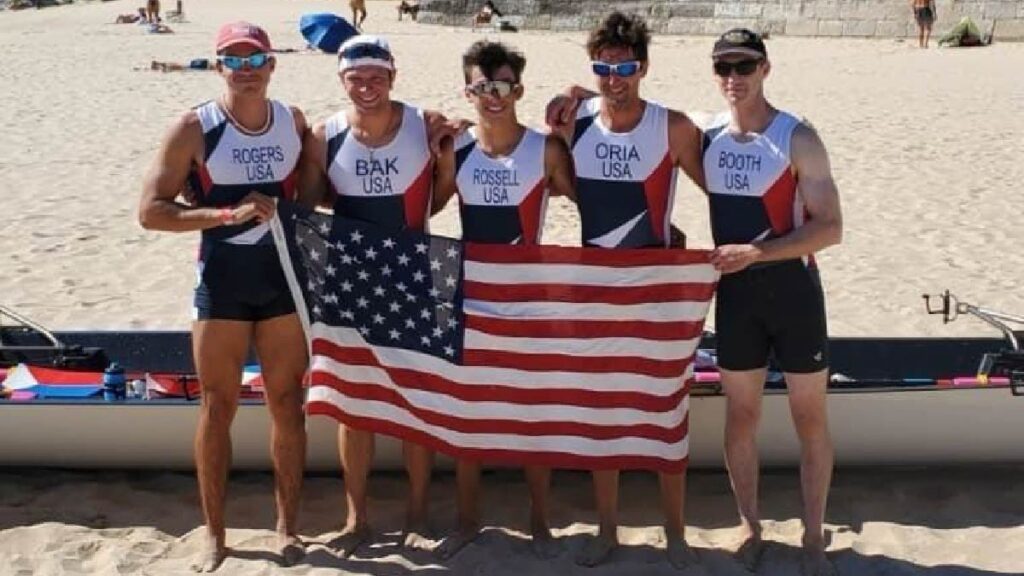
“We created a club, Next Level Rowing, to give opportunities to the athletes,” Oria explains. “But we didn’t have boats, we didn’t have anything that we needed. Basically what we created was a system of camps abroad, especially in Europe, in Spain and Italy where I had contacts.”
In the return to worlds, at Saundersfoot 2022, Bak made up for his mistake the year before and took the gold medal. Team USA also picked up another silver and three bronze medals. And since 2023, the USA has had the best record of any country, adding six more golds, five silvers and a bronze, and has jumped up to second place in the all-time standings. (Oria’s country of birth, Spain, is still top.) The U.S. also boasts the most decorated athlete of all in Chris Bak, who now has three wins in the men’s solos (2022, 2024 and 2025), one in the mixed quad (2023) and a second place in the mixed double (2025).
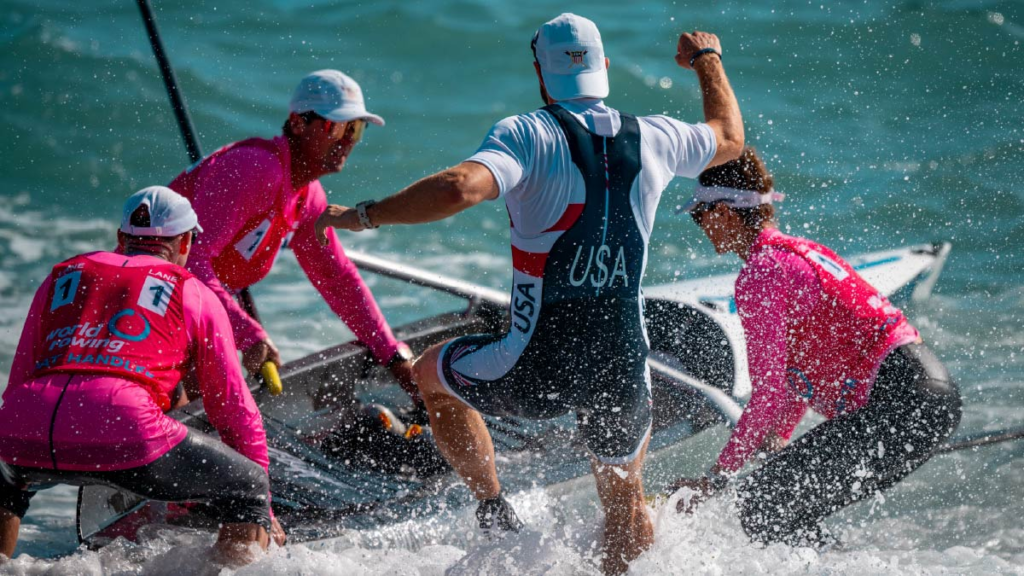
But Oria is quick to stress that the success of his athletes has really been thanks to the help of many people. He deeply values collaboration. While now an American coach, Oria has been part of the phenomenon that has seen Spanish coaches take up key positions in coastal and beach sprint national teams across the world. And especially early on, those other coaches were an essential resource.
“I have to say that great coaches from Spain like Pin [Real Club de Regatas de Alicante coach Lionel Jiménez], Sergio [Austria coach Sergio Pérez] or Moncho [Hong Kong coach Moncho Ferrer] helped me a lot in the process, they were my mentors in the sport,” Oria explains.
“I used my skills as a rowing coach, my skills in triathlon, my skills in sailing, my skills in mountain biking and ultra. All the skills that I had learned over the years, and started putting everything together, trying to innovate a little bit on the training plan, trying to innovate on the way we confront beach sprints. But a big shout out to the Spanish coaches, that they’ve always been there to help. Pin, Sergio and Moncho were a keystone for me.”
The main focus right now for Oria and for his athletes is unquestionably LA28. Although given the tight restriction on quota places, most will miss out—just one man and one woman will race for Team USA in the Olympic beach sprint competition—. But a bigger challenge looms the morning after the Olympic Closing Ceremony: guaranteeing the future of beach sprint both at home and abroad.
We will find out later this year if the sport will remain part of the Olympic program at Brisbane 2032. But even if it is confirmed, if the sport doesn’t engage sufficiently at LA28, it could still get axed from future Games. And beyond that elite level, long term success for beach sprint means founding clubs and leagues and regattas, and providing opportunities for new athletes and new fans to get involved—essentially creating a culture and ecosystem for one of the world’s youngest sports.
“I truly believe that it is going to stay. It’s been growing in places that don’t have flat water, islands in the Caribbean,” Oria argues. “I think it’s coming to stay and will grow worldwide.”
In addition to his U.S. coaching commitments, Oria is a World Rowing Lead Instructor and over the last few years he has worked together with the sport’s global federation to help develop athletes and coaches at courses and camps run worldwide, and especially so in the Americas.
Unlike back in 2021, Oria’s rowers no longer need to travel so far to compete. In May, the Copa America Coastal, which includes beach sprint races, celebrated its fifth year in Peru and the Americas Rowing Beach Sprint Championships held its fourth annual competition in Costa Rica. There has also been a growth in domestic races. The first youth beach sprint national championships were held in Sarasota, Florida, in June 2025, and this August the inaugural senior nationals will take place at the same time as U.S. trials in New Bedford, Massachusetts. In July 2025, the most iconic U.S.-based flatwater regatta, the Head of the Charles, launched the Boston Beach Sprints (set to return again this year), and after a successful test this spring, the San Diego Crew Classic is planning a beach sprint competition next March. And just last weekend, the Long Beach Rowing Association held the first international race at the LA28 venue.
But perhaps the key to beach sprint success in America will be making beach sprint a truly American sport. And there is little more American than college sports.
“My dream would be to have an IRAs [Intercollegiate Rowing Association national championships] in beach sprint as well. The NCAA [National Collegiate Athletic Association] colleges are going to be really difficult, the big schools are going to be difficult, but there are other ways to create a college league. That’s a dream. College nationals for beach sprints as soon as they are done with flat water, that would be a dream come true.”
“But coordinating a country like the U.S. is massive work,” Oria admits. “We will need time as a country. We are evolving, we are investing. And USRowing is working on it. But it’s a matter of time.”