
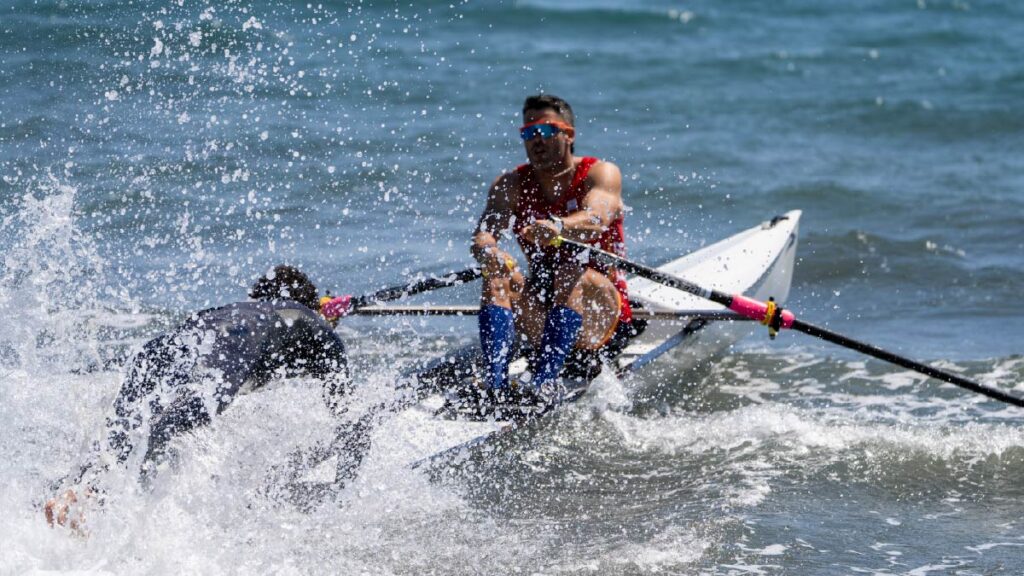
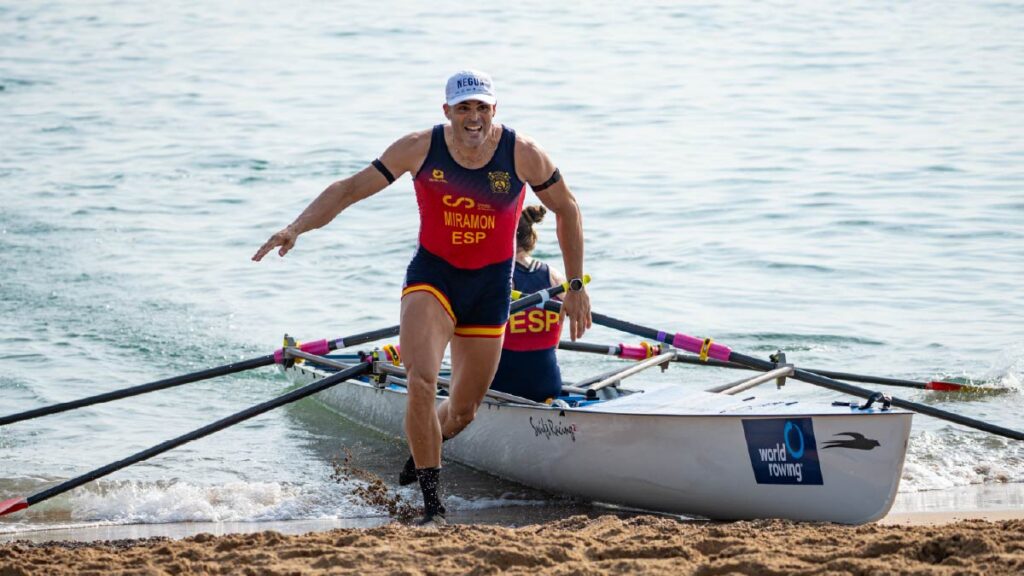
Until last year, Spain’s Adrián Miramón had reached the A final every time he’d been on the starting line at coastal or beach sprint world championships. And he’d won at least one medal every year, with the lone exception of Victoria 2018. And even then, in the coastal men’s solo in Canada, his fourth place was less than seven seconds off the podium.
In total, Miramón had won five coastal rowing world championships in the men’s solo (Lima 2015, Monaco 2016, Hong Kong 2019, Saundersfoot 2022 and Barletta 2023) and two beach sprint world championships in the same boat (Shenzhen 2019 and Barletta 2023). Including all podium finishes, out of 14 attempts, he had come away with hardware 13 times.
“Adrián has been an amazing coastal rower. He’s been the G.O.A.T. [Greatest Of All Time] for coastal for many, many years. He’s been the king of the endurance. He’s been the guy to beat,” says U.S. coach Marc Oria.
But then came October 2024. A month after picking up his last world championship medal, a silver in the beach sprint men’s solo at Genoa, Miramón signed up to compete in a hyrox competition in Milan, Italy. He’d never trained or competed in fitness races—hyrox combines running laps with exercise stations, and the goal is to complete them in the fastest time—and he admits that this was probably a mistake. An elite athlete in a totally different sport, he signed up for the pro division. Statistically, the result (66 out of 302 competitors) was respectable. But he came home suffering from back pain.
He had an MRI scan a month later, and it detected two hernias. “A hernia doesn’t appear in one determined moment. I had been rowing for almost 25 years. In one way you have to pay the bill,” Miramón says. But, “and I find it hard to admit, the coaches and national team doctors advised me that I shouldn’t do [the competition]. That I could hurt myself.”
He was told that he would have to forget about the 2025 season. His short term goals had to shift from competition to rehabilitation, even if Los Angeles still remained the overall dream.
“Last year was a very, very, very complicated year. Very hard physically, but even harder psychologically,” he says. ”The most complicated thing for an athlete is accepting that you have to take a pair of steps backwards to fix yourself, to heal yourself.”
From November 2024 until April 2025, Miramón was more or less stuck at home. “Practically the only thing that I did was very light cycling. And a maximum of 20 to 30 minutes,” he explains. Running, and the impact of beach sprint, was too much of a risk. “Then from April I began to row, but I couldn’t row more than five minutes at a time. I went rowing for five minutes, returned to the beach, and I had to walk for five minutes.” Over that month he began to make progress, slowly increasing the time rowing and reducing the time walking.
“But for an athlete who is used to giving 100% in every training session, doing a lot of series, putting in a lot of pressure, seeing yourself rowing five minutes lightly, walking five minutes, is mentally, I don’t know what to call it, destructive. In the end your brain, what it wants, is the suffering that you’re used to. To arrive home and say ‘I can’t do more. What a training session I did!’ ”
Back in 2002, when Miramón was just a kid in Málaga, on the Mediterranean coast of Spain, Real Club Mediterráneo coach Fernando Gómez—now the Saudi head coastal coach—told him that if he signed up to rowing, they’d make him a Spanish national champion. “For an 11-year-old child,” Miramón says, “Spanish national champion is the maximum. It’s a crazy thing to be national champion.”
He was an accomplished swimmer, already more than 170cm tall and weighing in at around 70kg. (He’s now 186cm and about 84kg.) While he tried to combine swimming and rowing for a while, ultimately rowing won out. And at the end of that first season, in early summer 2003, Miramón would be crowned national champion in the under-13 boys single.
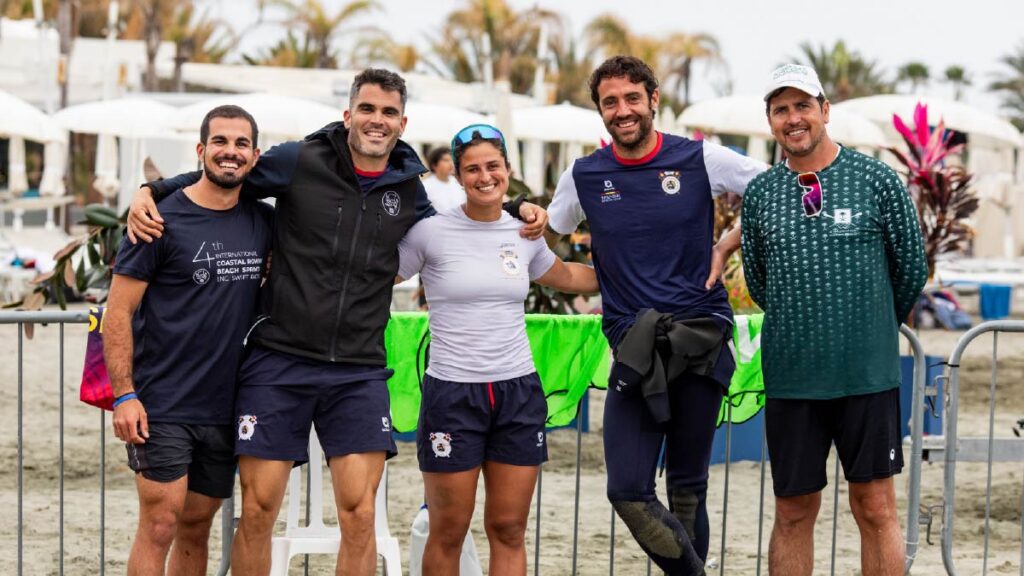
He began in flat-water boats, training on the sea, but within the confines of the port of Málaga. The first coastal rowing world championships wouldn’t be held until 2006, but even then they weren’t much of a focus for Spain; no Spanish rowers signed up for that inaugural World Coastal Rowing Challenge in Guernsey. Later Miramón also began to race in a Spanish traditional eight-rower boat called a llaut. These incorporate modern advances like carbon fiber, but have fixed seats: rowers rely more on their body and arm strength, with less power coming from the legs.
The experience in the llaut eventually led to a rare opportunity in the rowing world: the chance to turn professional. On the north coast of Spain there are two pro rowing leagues, one male and one female, that race in traineras—essentially the llauts’ bigger cousins: 13-rower boats whose regattas are covered live on TV and whose athletes are even paid to compete—. When Carlos Aparicio, head coach of Cantabrian club Santoña, came to visit Málaga to help offer advice on fixed-seat rowing, he spotted Miramón and convinced him to move north. (Aparicio still works with Miramón, as his physical trainer.)
In 2014, Miramón signed for Pedreña, a team from the top ACT (Asociación de Clubes de Traineras) league. Over the next decade, he’d race for Astillero, Kaiku and Zierbena, and mostly during the summer, when teams travel across the northern coast of Spain to compete in back-to-back regattas every weekend. He won a Spanish national championship and the Bandera de Ondarroa with Zierbena in 2018. (In the biggest trainera races, you win the host town’s flag, or bandera.) He raced four times in the prestigious Bandera de la Concha—on the northern coast of Spain, they call this race the “Olympics of rowing”—and stuck with Kaiku in 2021 to help the team bounce back to the ACT following relegation the previous season.
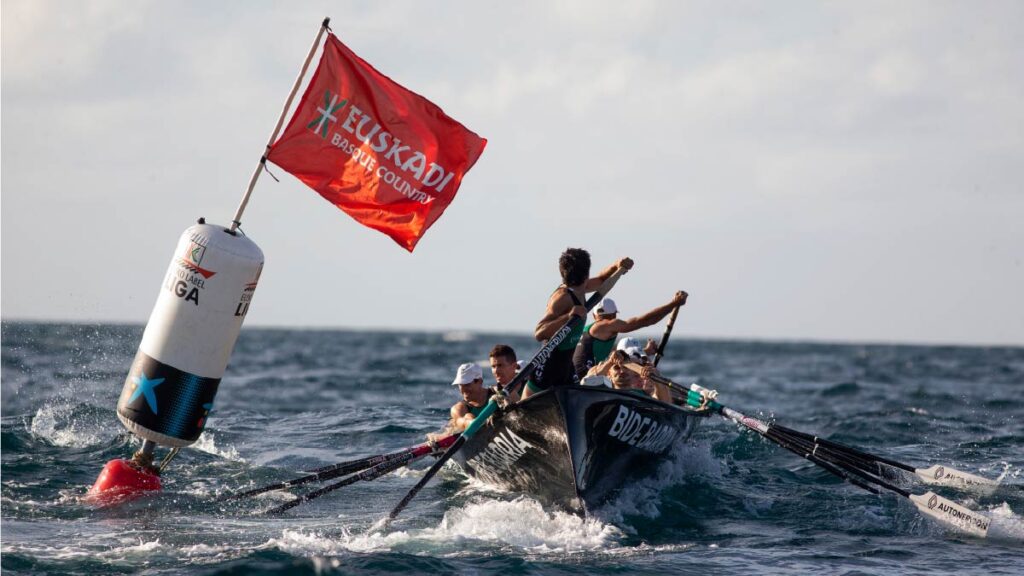
At the same time, his coastal rowing career began to flourish. “Adrián could do it very well, when he rowed in the traineras he connected that with the long distance [coastal] season. He came with a brutal aerobic capacity. The [trainera] regattas are 20 minutes with a brutal training base” says Andrés Redondas, head coach of the Spanish coastal rowing and beach sprint team. Redondas also coached Miramón back then, when he’d head down to southern Spain to row for Redondas’s club, Mar Clot de L’Illot El Campello, at the end of the pro season.
But then World Rowing began to seriously develop beach sprint. When the inaugural world championship was announced for Shenzhen, China, in 2019, Miramón, who was already due to race in coastal worlds in nearby Hong Kong, signed up.
He admits now that he knew barely anything about the sport before showing up to that competition, but he came home with gold in the men’s solo and silver in the mixed quad, and a lot of motivation. “The Chinese had been training for three months on the course. It was incredible. We hadn’t trained and we had many more errors. You saw them, and they didn’t even look behind. They had all the references. Competing against them was complicated. They won all the categories, except the solo. Which I won.”
Balancing the demands of the traineras with coastal rowing had been achievable, but with beach sprint that became impossible. The two types of rowing require different athletic profiles. Elite trainera rowers look more like lightweights, whereas beach sprint athletes increasingly don’t. “The weight that they require you to have in the trainera is very low. I weighed 75 or 76kg at the end of the season,” Miramón says. “Now for example I weigh 84kg. The difference is very big. You get to the point in which you still have to lose weight. But you can’t lose more fat so you have to lose muscle.”
“It was very difficult for me. I always wanted there to be lots of waves and wind, because then I could supply everything that I knew about catching waves and navigating with the wind, to make up for the lack of strength in my legs.”
After the final trainera race of the 2022 season, Miramón realized he needed to focus on one thing. He had originally left flat-water rowing behind for the opportunity to earn a living as a pro athlete in the north, and leaving a fixed salary would be a leap into the unknown. But “in the end for any athlete, it’s very easy. The most important thing is their dream,” Miramón says. “And it began to be talked about that this could be Olympic.”
In Miramón’s written-off 2025 season, he made the Spanish European and world championship teams. He raced in those back-to-back regattas in Antalya, Turkey, alongside long-time teammate Nadia Felipe in the mixed double. The two had won a coastal bronze medal together at Hong Kong 2019 again at Oeiras 2021, plus a national championship in 2019. And in 2025 they came home with a pair of quarterfinal finishes, ranked sixth overall in both events.
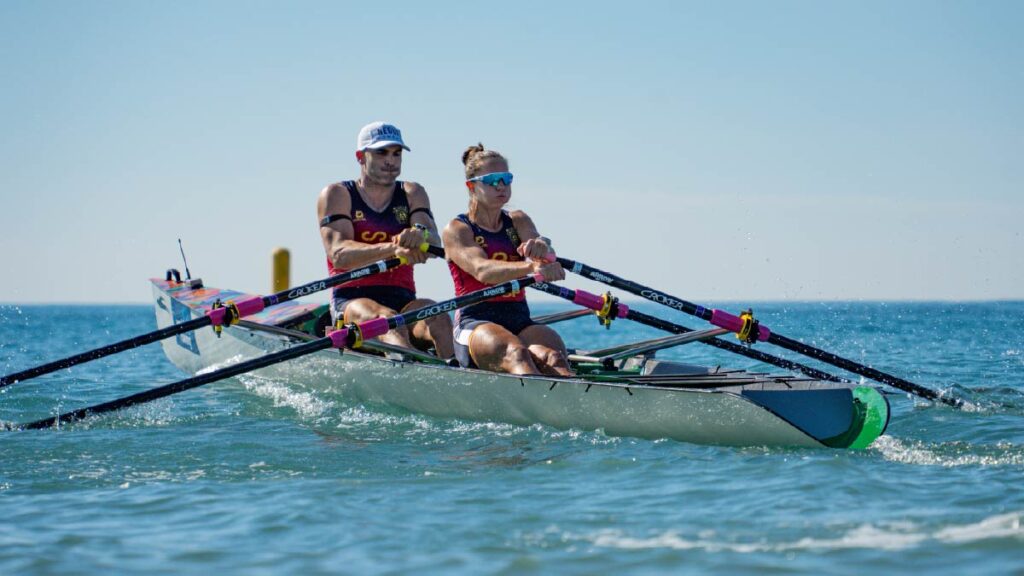
No rower has won both a beach sprint world championship and a coastal world championship in the solo, except Miramón. And he’s done that twice, and both times in the same year (2019 and 2023). But his results last year, and the story behind them, might rank alongside those achievements. “Winning is great,” Miramón says, putting that difficult year into perspective, “but being sixth in Europe, sixth in the world, I don’t think there are many people who achieve that.”
Perhaps the lesson from this might be that you should never bet against Adrián Miramón. As another example, take the Oeiras 2021 world coastal championships. In the A final of the men’s solo, with a narrow lead over the rest of the field, Miramón hit the buoy at the first turn, and flipped. He quickly righted his boat, got back in, and rejoined the race in eighth place. And he ultimately finished on the podium, just a minute behind the leader, compatriot Jaime Canalejo, and 36 seconds off second place, Peru’s Eduardo Gabriel Linares.
“These things are part of the process and very complicated. When you get past them, you believe that you can deal with anything.” Miramón says.
“I want to erase [2025] a little from my head,” he admits. “But the truth is that I’m very good. This season I’m training really well. I’m setting the best records on the ergometer that I’ve had in my whole career.”
Miramón turned 35 last May, and will be one of the oldest rowers hoping to qualify for beach sprint’s debut in Los Angeles. He’s more than a decade older than some of his Spanish teammates, and rival LA28 hopefuls, like Miguel Salas and Marcos Delgado. But he’s around the same age as Lithuania’s top men, Zygimantas Galisanskis and Dominykas Jancionis, and New Zealand’s Emma Twigg, the Tokyo 2020 women’s singles champion and reigning World Rowing Beach Sprint Finals women’s solos champion, is four years older.
While he wasn’t at the European championships, he’s been on or close to the podium at international regattas all season. He also finished second in all three national team erg tests in February, March and July this year, and third in Spain’s on-water trials in La Línea de la Concepción. And Spain may be the most complicated country for anyone hoping to win the lone male national quota place on offer for Los Angeles: Most of Miramón’s key rivals have been junior or senior world champions.
The plan for world championships this year in Qingdao, China is that he’ll race in the senior mixed quad alongside María Ángeles Macián and last year’s under-19 solos rowers, Ignacio Ramón-Borja—2025 world champion—and Alejandra García, and with Ainoha Casanova as coxswain.
“Will I reach Los Angeles? Really, I can’t tell you that,” he says. “I don’t know. But I’m going to fight 100% to be there.”