

By a wide margin, the best two qualification spots from the time trials at the World Rowing Beach Sprint Finals are first and second. But the worst, at least according to data from 2021 through 2025, isn’t the final 16th place, but 12th. In 24 competitions, including solos and doubles, and both men’s, women’s and mixed, the boat that qualified in that spot is the only one never to have won a medal of any color.
Finish fastest in the time trial and your chance of winning gold is 41.7%, while your odds of picking up silver are 20.8%, and you’re the easy favorite to reach the A final (62,5%). The second spot is almost as good: 25.0% gold, 25.0% silver and in half of all competitions in this analysis, you’d have reached that top final. The boats with the best options to pick up bronze are predictably those that qualify third (20.8%), fourth (12.5%) and fifth (16.7%). Although sixth place interestingly has historically had the third best probability to walk away with silver (16.7%).
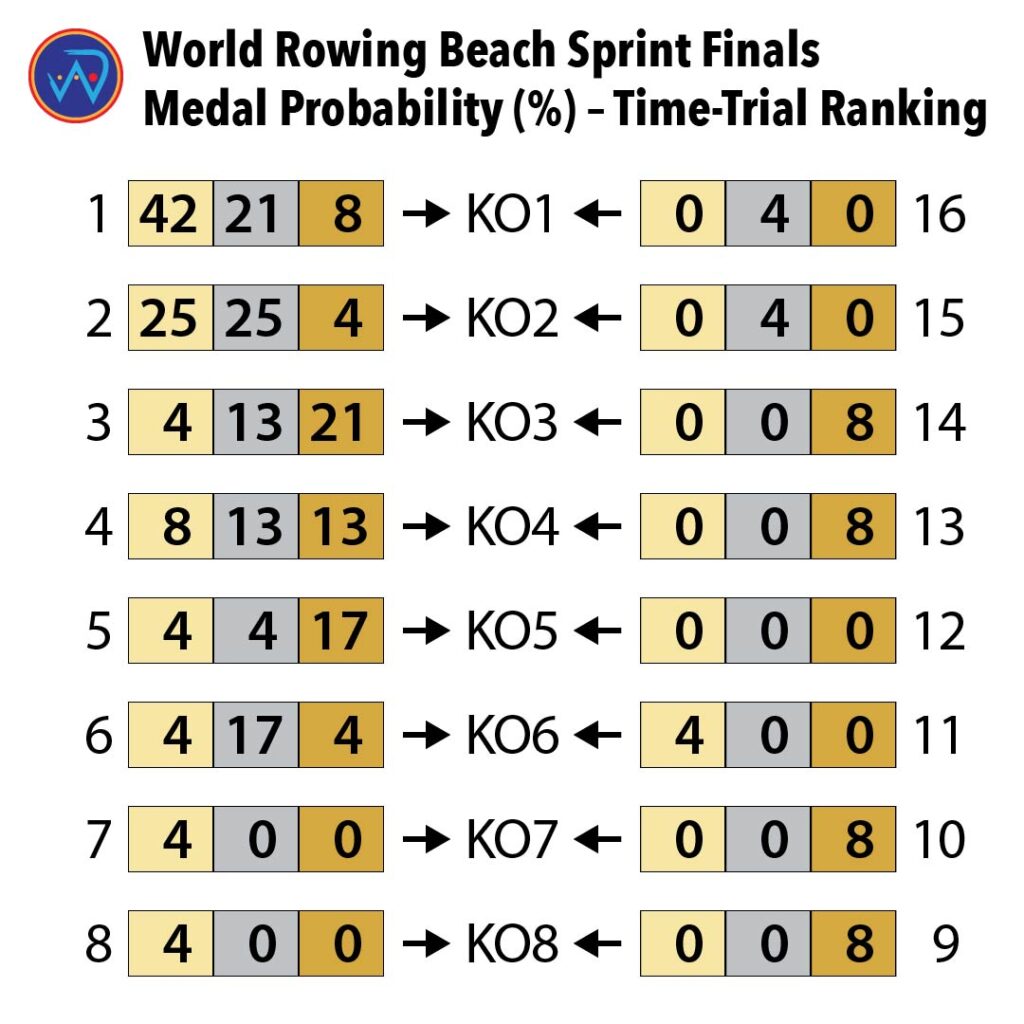
Outside of the top six, medal possibilities drastically drop. From a total of 72 medals awarded in the 24 competitions studied, just 13 of those have been won by the final 10 qualifiers. But the unluckiest of all has been number 12. In 2024, China’s Yuqi Yang managed to convert 11th place into a world championship win in the U19 men’s single. In that very same competition, Germany’s Ben Luis Henke came from 16th to win silver and Italy’s Lucio Fugazzotto took bronze after qualifying 13th. But in 24 attempts, no 12th place qualifier has won any medal, or reached a single semifinal. And just once has the boat in that spot survived the knockout stage to reach the quarterfinals: Turkey’s Kaan Aydin in the men’s solo last year.
The same trends continue through the later stages of competition. The winner of the first knockout race (the race contested by the top- and bottom-ranked boats from time trials) retains a 41.7% probability of winning the gold medal, and sees a slightly increased 25.0% chance of silver. And the winner of the second knockout (second spot versus 15th) keeps the 25.0% odds of gold and increases the odds of silver to 29.2%. No other knockout races come close in terms of the probability to reach that A final.
By quarterfinals, the races begin to get closer. The first and third quarterfinals (potentially home to the first- and second-ranked boats from time trials) still dominate, with 45.8% gold and 25.0% silver, and 29.2% gold and 33.3% silver, respectively. But the second and fourth quarterfinals have each accumulated four world championship wins, and four and six silver medals respectively. Still, the bronze medal winner is most likely to come from these two lesser quarterfinals, with the two combining for 18 bronze medals (75%).
There is a much smaller difference between the two semi finals. The winner of the first has walked away with gold 58.3% of the time (14 medals), and the loser has picked up the bronze at the same rate. That leaves a 41.7% gold probability for the winner of the second semifinal (10 medals) and the same for the loser’s chance of bronze.
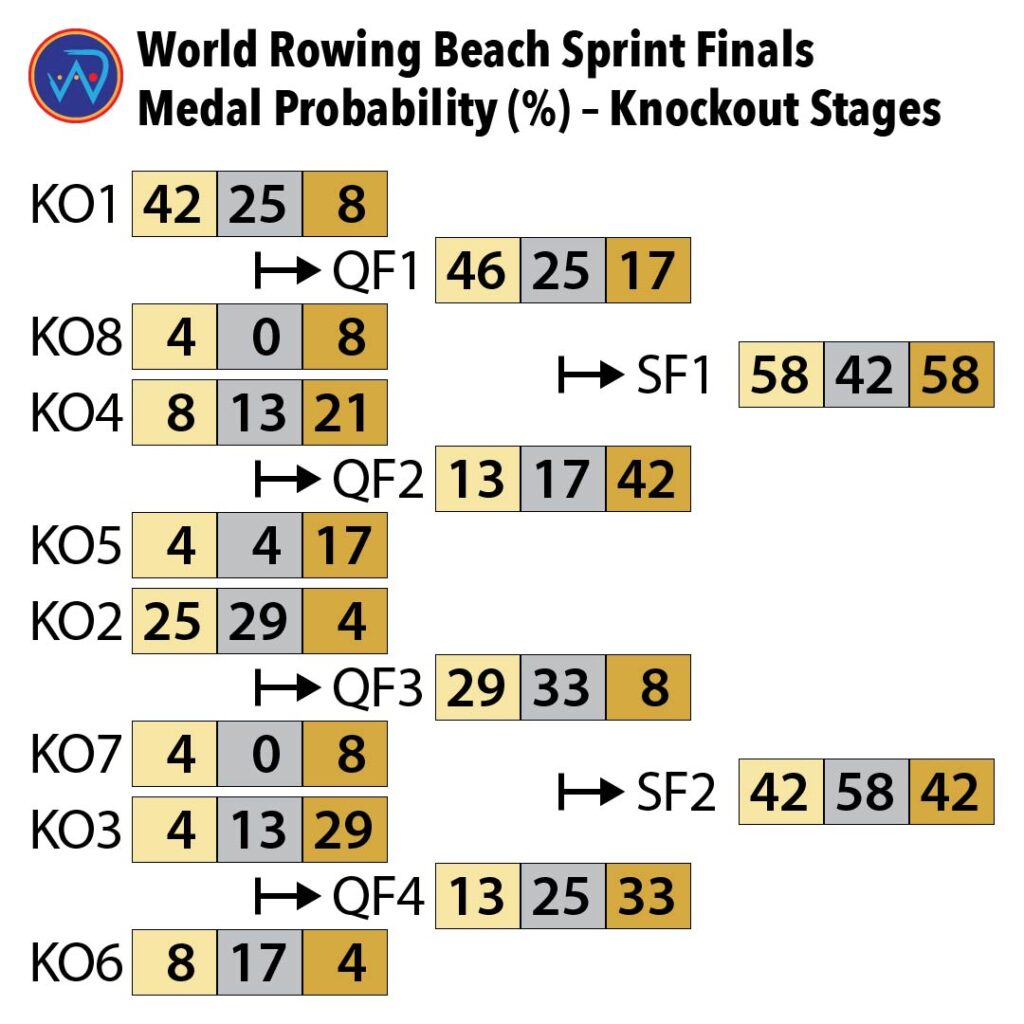
Another interesting statistic coming out of semifinals is that the number of times that the first semifinal has produced both the silver- and bronze-medal winners is the same as that for the second semifinal: five. In contrast, the second semifinal has produced the gold- and bronze-medal winners only five times compared to nine times for the first semifinal. This could be a symptom of the fact that the loser of the first semifinal always gets more recovery than the loser of the second.
Understanding exactly why there have been such contrasting probabilities of winning medals between different time trial qualification spots and the different knockout stages of competition may be impossible. One argument is that the time trials may provide a very fair measurement of each boat’s ultimate speed, and thus naturally the first- and second-ranked boats should win medals. Another is that the progression system itself creates inequality, handing a clear advantage to those first- and second-ranked boats. The true situation is likely to be a combination of the two: the top boats qualify higher and the system benefits those who qualify higher.
But, at least according to historical data, while qualifying top might be overwhelmingly best, the worst time trial result could be 12th.
The data used in this analysis comes from the solos and doubles competitions from the last five world championships. Only competitions with 16 or more boats in the time trial stage were considered, in order to provide a fair analysis of the full progression system. No data was taken from the inaugural world championship, because no competitions had that many entries. The mixed quad competition was excluded because it could be considered a more significantly different discipline, and only once, in 2024, did it reach the 16-entry minimum. The women’s solos from 2022 were also excluded because their final stages were canceled and medals were assigned purely on time trial rankings.
Progressions from one round to the next followed the World Rowing system. (Note that the published World Rowing progression system from January 2026 may include an error: It is different to the previous system and has the top two spots from time trials meeting in the semis.) In cases where only a first time trial was run, the top 16 from that round were included. When two time trials were run, the top eight from the first time trial received the top eight spots, and the top eight from the second time trial received spots nine through 16.